

An auditor resignation letter is a formal document. It announces an auditor’s decision to leave a company. The letter serves as official notification. It outlines the departure date and any relevant details.
Preparing such a letter can be daunting. No worries! We’ve got you covered. We’ll share several templates and examples. These samples will make it easy for you. You can adapt them to your specific situation.
Think of it as your toolbox. Choose the template that fits. Customize it with your information. You’ll create a professional letter. This will help make the process smooth and straightforward.
Auditor Resignation Letter
Below is a sample of a Auditor Resignation Letter:
[Your Name/Company Name (if applicable)]
[Your Address]
[Your Phone Number]
[Your Email Address]
[Date]
[Recipient Name] (If known, otherwise use title)
[Recipient Title]
[Company Name]
[Company Address]
Dear [Mr./Ms./Mx. Last Name or To Whom It May Concern],
Please accept this letter as formal notification that I am resigning from my position as Auditor, effective [Date of Last Day of Employment].
I have carefully considered this decision and have decided to pursue other opportunities.
I would like to express my gratitude for the opportunities I have been given during my time here. I have gained valuable experience and knowledge, and I appreciate the support I have received.
I am committed to ensuring a smooth transition during my departure. I am available to assist in any way possible to train my replacement and complete any outstanding tasks. Please let me know how I can be of assistance in this process.
I wish you and the company all the best in the future.
Sincerely,
[Your Signature (if printing)]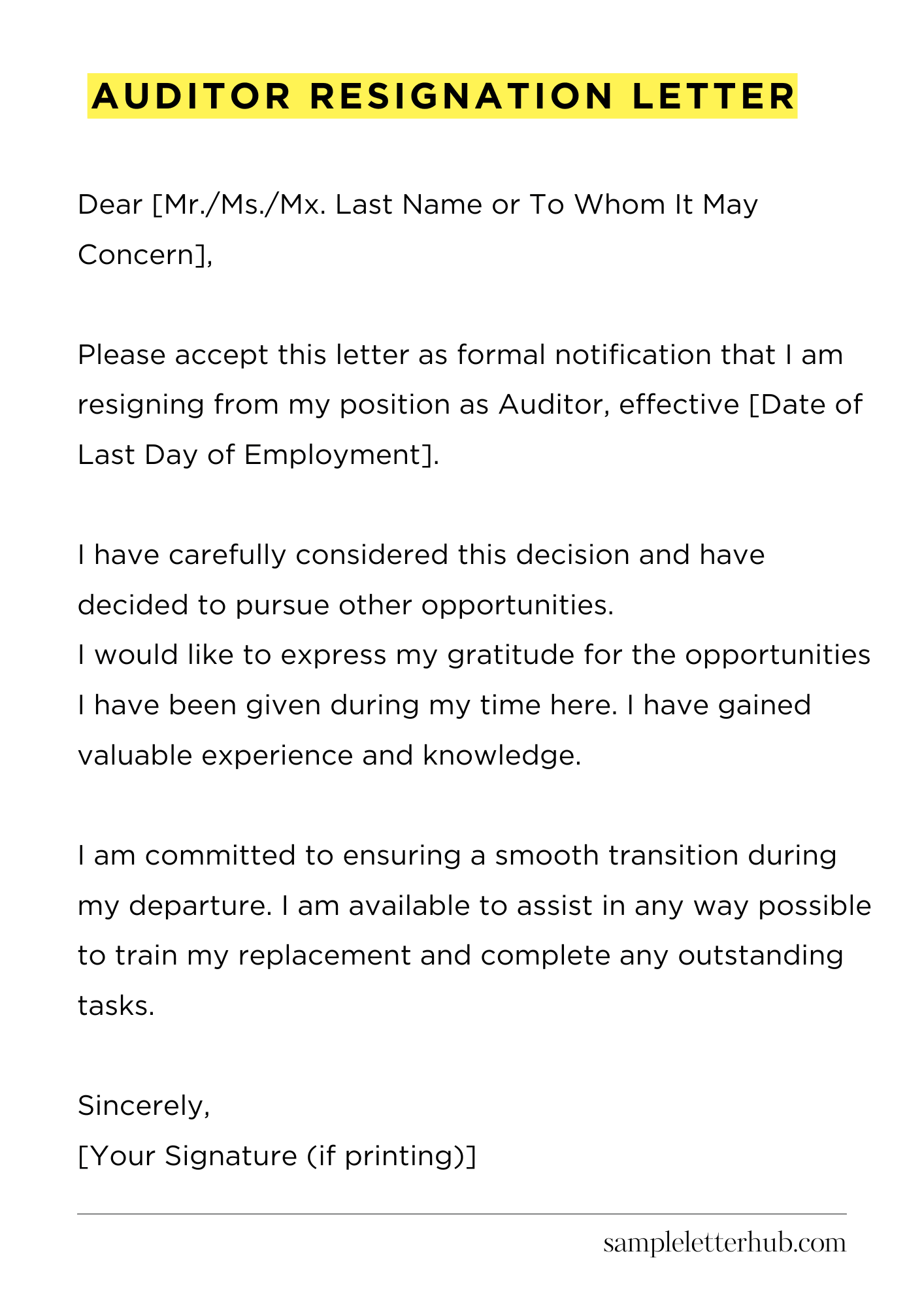
How to Write Auditor Resignation Letter
So, you’re an auditor, and it’s time to move on. Maybe a better opportunity has presented itself, or perhaps you’re simply ready for a change. Whatever the reason, you’ll need to resign gracefully. This guide will walk you through crafting a professional and effective auditor resignation letter, ensuring a smooth transition.
1. Start with the Basics: Formatting and Tone
First things first: Format matters! Your letter should be on company letterhead (if applicable) and addressed to the appropriate person, usually your direct supervisor or the partner in charge. Keep it concise. Use a professional and respectful tone. Avoid any negativity or complaints; this is not the place for them. Focus on the facts.
Your letter should follow a standard business letter format. Include your contact information (name, address, phone number, email) at the top. Next, include the date. Then, list the recipient’s name, title, and the company address. Always be polite.
2. The Core of the Matter: Declaring Your Resignation
This is the most important part! Clearly state your intention to resign. State your position and, importantly, the effective date of your resignation. Be specific. This date is critical because it officially marks the end of your employment. This allows the company time to find your replacement.
For example, you could write: “Please accept this letter as formal notification that I am resigning from my position as Senior Auditor, effective [Date].” Keep it simple and direct.
3. Expressing Gratitude and Professionalism
Even if you’re leaving due to negative reasons, maintaining a professional demeanor is crucial. Express your gratitude for the opportunity to work at the company. Acknowledge the experience and skills you’ve gained. This is a chance to leave a positive lasting impression.
Consider a sentence like: “I am grateful for the opportunities I’ve been given during my time here and for the experience I have gained.” This shows respect. It is good practice.
4. Addressing Handover and Future Support
Show your commitment to a smooth transition. Offer your assistance in training your replacement or completing any outstanding tasks. This demonstrates your professionalism and dedication. This is often appreciated by your employer.
Include something along the lines of: “I am committed to ensuring a smooth handover of my responsibilities and am happy to assist in training my replacement during my remaining time here.” This can make a huge difference.
5. Concluding and Sending
Wrap up your letter with a polite closing, such as “Sincerely” or “Best regards.” Below your closing, type your name. Then, sign your name above your typed name. Keep the letter brief. Keep the message clear.
Before sending, review your letter carefully for any errors in grammar or spelling. Make sure your dates and names are correct! Proofread it and then send it via email or hard copy, as is company policy. Leaving on good terms can be beneficial. Your reputation is important. Good luck!
FAQs about Auditor Resignation Letter
Understanding the nuances of an auditor resignation letter is crucial for both the auditor and the client. This document initiates a significant change in the financial oversight of an organization, and these frequently asked questions aim to clarify common concerns.
What is the primary purpose of an auditor resignation letter?
The primary purpose of an auditor resignation letter is to formally notify a client of an auditor’s intent to cease their engagement. It serves as a legal document, providing a record of the auditor’s decision and the effective date of the resignation.
It allows for the orderly transfer of responsibilities and ensures compliance with regulatory requirements, such as those related to reporting changes in auditors to relevant oversight bodies.
What key information should be included in an auditor resignation letter?
An effective auditor resignation letter typically includes the auditor’s name and address, the client’s name and address, a clear statement of resignation, the effective date of the resignation, and the reasons for the resignation (if applicable and if the auditor chooses to share them).
It may also include a statement about the auditor’s cooperation in the transition, information about the auditor’s rights and responsibilities, as well as a request for confirmation of receipt and acknowledgment.
What are the common reasons for an auditor’s resignation?
Auditors may resign for various reasons. These can include disagreements with management over accounting practices or financial reporting, a change in the client’s business that affects the audit’s scope, failure to maintain auditor independence, a lack of payment, a change in firm structure, or simply a shift in strategic direction.
In some cases, auditors may resign due to conflicts of interest or because they feel they can no longer fulfill their professional obligations.
What are the auditor’s obligations after submitting a resignation letter?
After submitting a resignation letter, the auditor is generally expected to cooperate with the client in the transition process. This may involve providing information to the incoming auditor, answering questions, and facilitating a smooth handover of audit documentation.
The auditor is also obligated to maintain confidentiality of client information and to comply with any legal or regulatory requirements related to the resignation, such as reporting the change to relevant authorities.
How does the client respond to an auditor resignation letter?
Upon receiving an auditor resignation letter, the client should acknowledge receipt, typically in writing. The client will then need to initiate the process of finding a new auditor. This includes evaluating the resignation reasons, understanding the implications of the change, and ensuring that all necessary filings are completed.
The client may also need to inform the outgoing auditor about the status of the ongoing audit, as per the engagement letter. Clients must also communicate the change to stakeholders and relevant regulatory bodies.
Related:
Resignation letter due to rude boss
Resignation letter moving to another state
Resignation letter due to illness of family member
Resignation letter due to study