

An Audit Senior resignation letter is a formal document. It is written by an Audit Senior. The purpose is to officially inform the employer of their departure. This letter signals the end of employment.
So, you’re ready to move on. Finding the right words can be tricky. We’ve got you covered. We’ll share several templates and examples. These are tailored for Audit Seniors.
These samples will help simplify the writing process. They provide a solid foundation. You can easily adapt them to fit your unique situation. Craft your perfect letter with ease.
Audit Senior Resignation Letter
Below is a sample of a Audit Senior Resignation Letter:
[Your Name]
[Your Address]
[Your Phone Number]
[Your Email Address]
[Date]
[Recipient’s Name]
[Recipient’s Title]
[Company Name]
[Company Address]
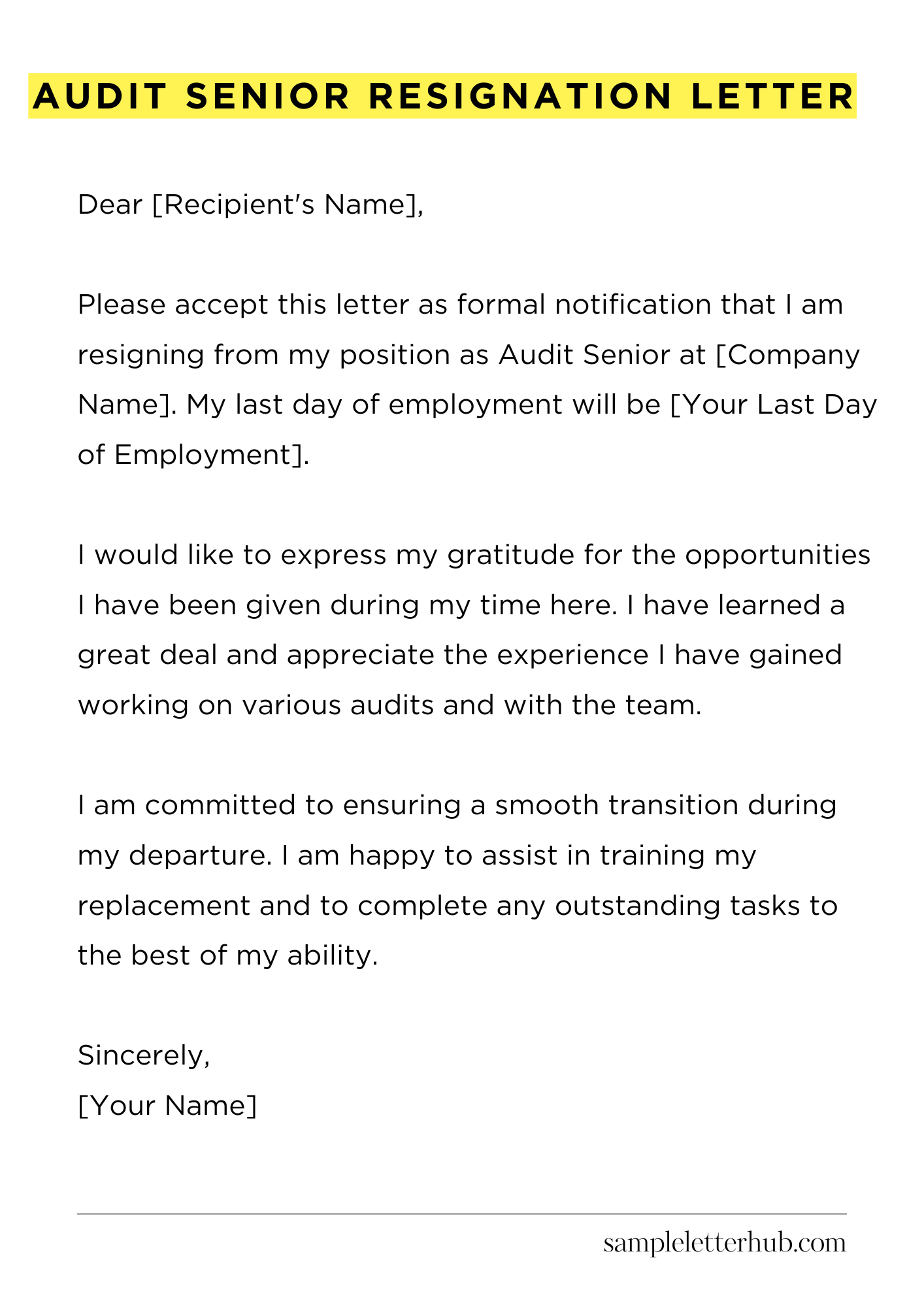
Dear [Recipient’s Name],
Please accept this letter as formal notification that I am resigning from my position as Audit Senior at [Company Name]. My last day of employment will be [Your Last Day of Employment].
I would like to express my gratitude for the opportunities I have been given during my time here. I have learned a great deal and appreciate the experience I have gained working on various audits and with the team.
I am committed to ensuring a smooth transition during my departure. I am happy to assist in training my replacement and to complete any outstanding tasks to the best of my ability.
I wish you and [Company Name] all the best in the future.
Sincerely,
[Your Name]
How to Write an Audit Senior Resignation Letter
1. Getting Started: The Basics You Can’t Skip
Resigning from any job can feel like a big step. This is especially true when it comes to a role like Audit Senior. It’s a position of responsibility. You have to handle this in a professional way. First things first: you need a well-crafted resignation letter. Don’t worry, it’s not as daunting as an audit itself! The goal is to make it clear. Keep it concise.
Begin by including your name, address, phone number, and email. Next, add the date, and the recipient’s information (your supervisor’s name and title, and the company address).
This is a standard business format. Always do this. It sets the tone for professionalism. Consider your current work dynamics. Be mindful, because you’re also building your future professional image.
2. The Core Message: What to Actually Say
Now, let’s get down to the meat of the matter. You must clearly state your intention to resign. Keep it short and direct. State the date of your last day of employment.
This is crucial for a smooth transition. For example: “Please accept this letter as formal notification that I am resigning from my position as Audit Senior, effective [Your Last Day of Employment].” You can always refer to your employment agreement for the notice period. Usually, the minimum is 2 weeks.
Consider briefly thanking your employer for the opportunity. Mentioning a specific aspect of the job you appreciated is a nice touch. This shows respect. Avoid lengthy explanations for your departure. Keep the reason for leaving brief and positive, if you choose to include it. Focus on future goals.
3. Key Considerations: What NOT to Do
There are some things to avoid. First, steer clear of negativity. Don’t complain about your colleagues, or your boss. Refrain from listing grievances. This is not the time or place. Similarly, avoid making accusations. It’s better to maintain a professional demeanor throughout.
Don’t burn bridges. Your professional world is often interconnected. Keep things positive. Don’t be too verbose. Get to the point. Also, avoid using informal language. You should not use slang or emojis. Make sure your tone is respectful.
4. The Finishing Touches: Polishing Your Letter
Proofreading is essential. Read the letter carefully. Check for any grammatical errors or typos. This helps make sure you come across as professional. Does it sound good? Does it make sense?
If possible, try printing the letter on professional paper. Consider using a clear, easy-to-read font. The font should be the standard Times New Roman or Arial. Keep the tone friendly. At the end, you can offer assistance in the transition process. This is a very thoughtful gesture.
5. After the Letter: Beyond the Written Word
Once you’ve finalized the letter, hand it in to your direct supervisor. Consider scheduling a meeting to discuss your resignation. Be prepared to answer any questions. Be open and honest in the conversation. This reinforces your professionalism.
Be prepared for a counteroffer. But think about your reasons for leaving. Stick to your decision. Finally, remember to maintain a positive attitude until your last day. Leaving on good terms is important for future references. Remember to remain cordial. Always.
FAQs about Audit Senior resignation letter
How do I write a resignation letter as an Audit Senior?
When crafting your resignation letter, you should maintain professionalism and provide clarity. Start with a formal salutation (e.g., “Dear [Manager’s Name]”), state your intention to resign, and specify your last day of employment.
Briefly express gratitude for the opportunities you’ve been given, and if you wish, briefly explain the reason for your departure without going into excessive detail. Offer to assist with the transition of your duties and end with a courteous closing (e.g., “Sincerely,” or “Regards,”). Proofread your letter carefully before submitting it.
What information should be included in an Audit Senior resignation letter?
Your resignation letter should include your name, the date, the name of your manager or the appropriate recipient, and your company’s name.
Clearly state your intention to resign, the date of your last day of employment (typically two weeks from the date of submission, although this may vary based on company policy and employment contracts), and express gratitude for your time at the firm.
You may optionally mention the reason for your resignation, although this is not a requirement. It’s often helpful to offer your assistance with the transition process.
What is the appropriate notice period for an Audit Senior resignation?
The standard notice period for an Audit Senior is usually two weeks, but this can vary depending on your employment contract or company policy. Some firms might require a longer notice period, especially for senior-level positions.
Always review your employment agreement to clarify the required notice period. It’s advisable to submit your resignation letter well in advance of your last day to allow for a smooth handover.
Should I provide a reason for resigning in my Audit Senior resignation letter?
While not mandatory, it’s generally acceptable to briefly state a reason for leaving in your resignation letter, though this should be kept concise and professional.
You might simply mention seeking a new opportunity or pursuing career advancement. Avoid being overly critical of your current employer. If you choose not to provide a reason, it is also perfectly acceptable. The main goal is to be clear and maintain a positive tone.
How should I handle the transition of my responsibilities when resigning as an Audit Senior?
In your resignation letter, offer your help with the transition of your responsibilities. This may involve providing documentation, training colleagues, and completing any urgent tasks. Create a list of ongoing projects, their statuses, and any key contacts.
Be prepared to answer questions from your colleagues and ensure that all necessary information is transferred smoothly. Your professionalism during the transition period reflects well on you and helps maintain positive relationships.
Related:
Resignation letter due to rude boss
Resignation letter moving to another state
Resignation letter due to illness of family member
Resignation letter due to study