

The words “Athletic Director resignation letter” refer to a formal document. It is written by an athletic director. The purpose is to officially announce their departure. This letter signals the end of their employment. It informs the relevant authorities of their decision.
Crafting a resignation letter can feel daunting. We understand. That’s why we’re here to help. We’ll share several templates. These templates can act as a starting point. They’ll also provide examples and samples.
These examples can guide your own writing. We want to make it easy. Writing a professional resignation letter is important. We hope these examples help you. Good luck with your next step!
Athletic Director Resignation Letter
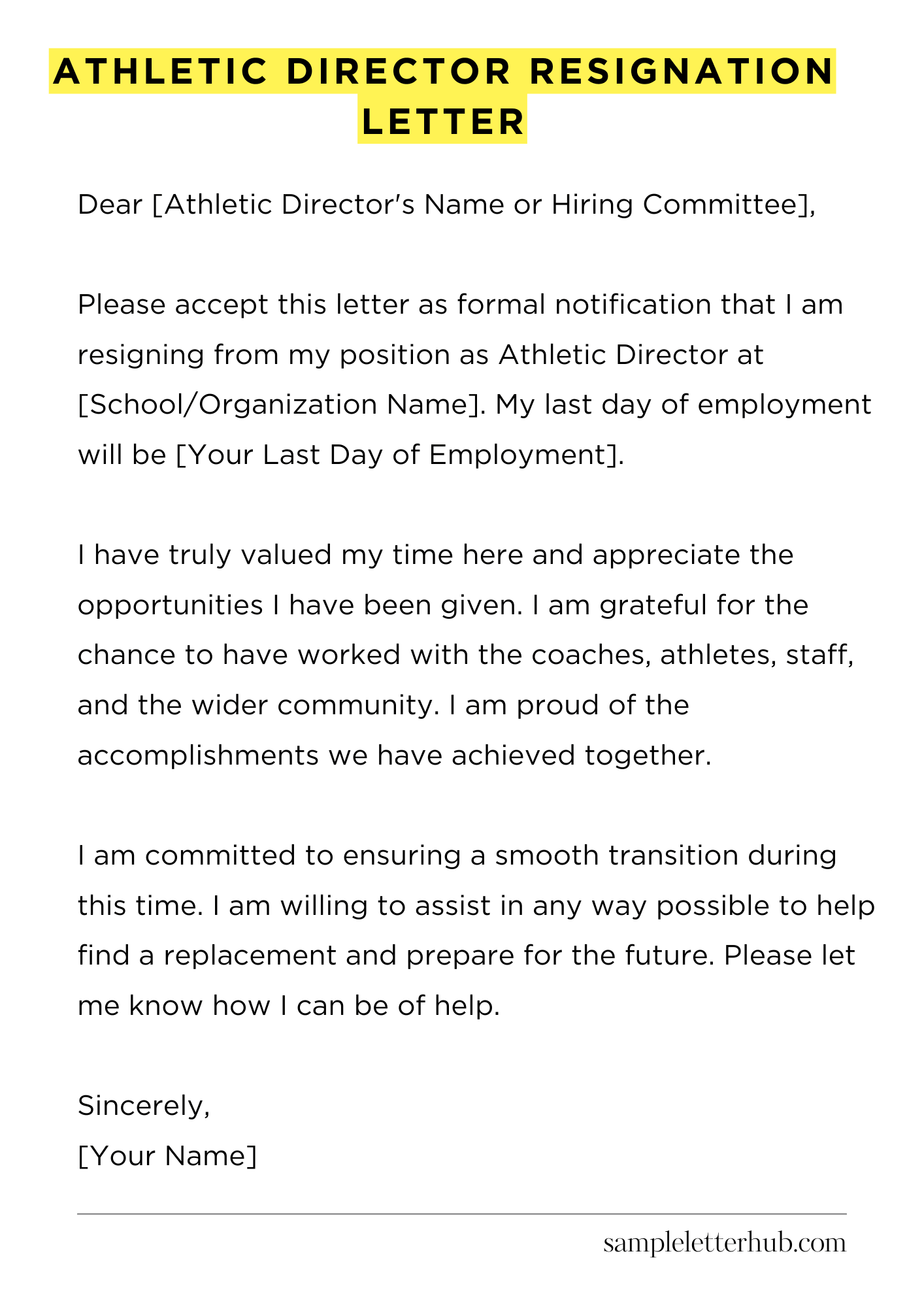
Below is a sample of a Athletic Director Resignation Letter:
[Your Name]
[Your Address]
[Your Phone Number]
[Your Email Address]
[Date]
[Athletic Director’s Name (if known), or “The Hiring Committee”]
[School/Organization Name]
[School/Organization Address]
Dear [Athletic Director’s Name or Hiring Committee],
Please accept this letter as formal notification that I am resigning from my position as Athletic Director at [School/Organization Name]. My last day of employment will be [Your Last Day of Employment].
I have truly valued my time here and appreciate the opportunities I have been given. I am grateful for the chance to have worked with the coaches, athletes, staff, and the wider community. I am proud of the accomplishments we have achieved together.
I am committed to ensuring a smooth transition during this time. I am willing to assist in any way possible to help find a replacement and prepare for the future. Please let me know how I can be of help.
I wish the school and athletic program continued success in the future.
Sincerely,
[Your Name]
How to Write an Athletic Director Resignation Letter
Understanding the Necessity
So, you’re an Athletic Director ready to move on. That’s a big decision! But before you walk out the door, you need something important: a resignation letter. This isn’t just a formality. It’s a crucial document. It’s how you officially inform your employer of your departure. Think of it as the ultimate closing statement.
A well-written resignation letter is professional, leaves a good impression, and protects your future career prospects. It sets the tone for your exit. It’s your final official act.
Structuring Your Letter: The Core Components
Let’s break down the essential parts. First, the date. Always include the date you’re sending the letter. Next, your formal salutation, like “Dear [Superintendent’s Name]”. The body is where you state your intention to resign from your position as Athletic Director. Keep it concise and clear. Mention your last day of employment.
Be specific! Then, include a brief expression of gratitude for the opportunity. You can mention specific positive experiences you’ve had. A simple “Thank you for the opportunity” works well.
Consider a short sentence about the transition. Suggesting you are available to help during the transition period is a nice touch. Finally, a closing like “Sincerely” or “Respectfully,” followed by your typed name and signature. Remember to sign the letter physically after printing it.
Content is King: What to Actually Say
The content matters! Keep it professional and positive. Start with a straightforward statement of resignation. For example: “Please accept this letter as formal notification that I am resigning from my position as Athletic Director…” Next, state your last day. Example: “…my last day of employment will be [Date].”
Then, express your gratitude for the opportunity to have served in the role. Perhaps mention some of the key achievements you’re proud of. It’s smart to offer assistance with the transition.
This shows courtesy and professionalism. Avoid negativity. Steer clear of complaints or criticisms about the administration, the coaches, or the athletes. Focus on what you did and what you achieved. Keep it positive. The goal is to leave on a good note.
Formatting for Success: Presentation Matters
The presentation of your letter says a lot. Use a standard business letter format. Use a professional font like Times New Roman or Arial. Keep the font size between 10 and 12 points. Use a standard letter size (8.5 x 11 inches) paper.
Ensure consistent formatting throughout, with proper margins (usually 1 inch). Proofread, proofread, proofread! Check for any typos, grammatical errors, and spelling mistakes. This demonstrates attention to detail.
The tone should be formal and respectful. Avoid slang or informal language. Print the letter on high-quality paper. After printing, sign it by hand. Deliver it personally if possible or send it via certified mail with a return receipt requested. This ensures you have proof of delivery.
Beyond the Basics: Tips for a Smooth Departure
Consider what else you can do to make your departure seamless. Before submitting your letter, think about assembling some key documents. This could include a summary of your accomplishments, outstanding projects, and any important contacts. If your contract requires specific notice, make sure you are in full compliance with those terms.
Cooperate fully during the transition period. Be prepared to assist your successor. Offer any necessary training or documentation. Leaving on a positive note can have a significant impact on your future job prospects. Remember, you’re leaving a legacy. It’s important to leave a positive one!
FAQs about Athletic Director Resignation Letter
What are the essential components of an Athletic Director’s resignation letter?
An effective resignation letter typically includes: a clear statement of resignation (e.g., “I hereby resign from my position as Athletic Director”); the effective date of resignation; a brief expression of appreciation for the opportunity or the experience gained; and a professional closing. It may also mention reasons for leaving, although this is optional.
The letter should be concise, professional, and respectful.
How far in advance should an Athletic Director submit their resignation letter?
The timing of submitting a resignation letter often depends on the employment contract or institutional policy. However, a general guideline is to provide at least two to four weeks’ notice. This allows for a smooth transition, the identification of a replacement, and the completion of any necessary handover tasks. Check the employment agreement for specific requirements.
What should an Athletic Director consider when stating the reason for resignation?
The level of detail included about the reason for leaving is a matter of personal choice. Reasons can be stated broadly (e.g., “to pursue other opportunities”) or with more specificity (e.g., “to focus on personal commitments” or “to accept a position elsewhere”).
It’s generally advisable to keep the statement professional and avoid negative comments about the organization or individuals. Consider the potential implications for future references and career prospects.
Should an Athletic Director offer to assist with the transition process in their resignation letter?
Offering assistance with the transition process is a professional courtesy and can be beneficial. It can include offering to help train the new Athletic Director, assist with ongoing projects, or provide documentation for a seamless transfer of responsibilities. It is a good practice to state your availability to help the transition.
Who should the Athletic Director address the resignation letter to?
The resignation letter should be addressed to the appropriate authority within the organization, such as the President, Superintendent, or the Board of Directors. It is crucial to determine the correct chain of command as defined by your organization’s policy to ensure the letter reaches the appropriate person or people.
Related:
Resignation letter due to rude boss
Resignation letter moving to another state
Resignation letter due to illness of family member
Resignation letter due to study