

An Assistant Manager resignation letter is a formal document. It informs your employer of your intention to leave. This letter initiates the official departure process. It also helps maintain a professional relationship.
Planning your exit can feel overwhelming. Don’t worry, we’re here to help. We’ve compiled various templates. Examples of different resignation scenarios are available. You will find everything you need.
Our goal is to make things simple. We provide sample letters. Customize these examples to fit your needs. Craft your resignation letter with confidence. Your next chapter awaits.
Asst Manager Resignation Letter
Below is a sample of a Asst Manager Resignation Letter:
[Your Name]
[Your Address]
[Your Phone Number]
[Your Email Address]
[Date]
[Hiring Manager Name] (If known, otherwise use title)
[Hiring Manager Title]
[Company Name]
[Company Address]
Dear [Mr./Ms./Mx. Last Name],
Please accept this letter as formal notification that I am resigning from my position as Assistant Manager at [Company Name]. My last day of employment will be [Your Last Day of Employment].
I would like to express my sincere gratitude for the opportunity to work at [Company Name] for the past [Number] years/months. I have learned a great deal and appreciate the experiences I have gained during my time here.
I am committed to ensuring a smooth transition during my departure. I am happy to assist in training my replacement and completing any outstanding tasks to the best of my ability.
I wish you and [Company Name] all the best in the future.
Sincerely,
[Your Signature]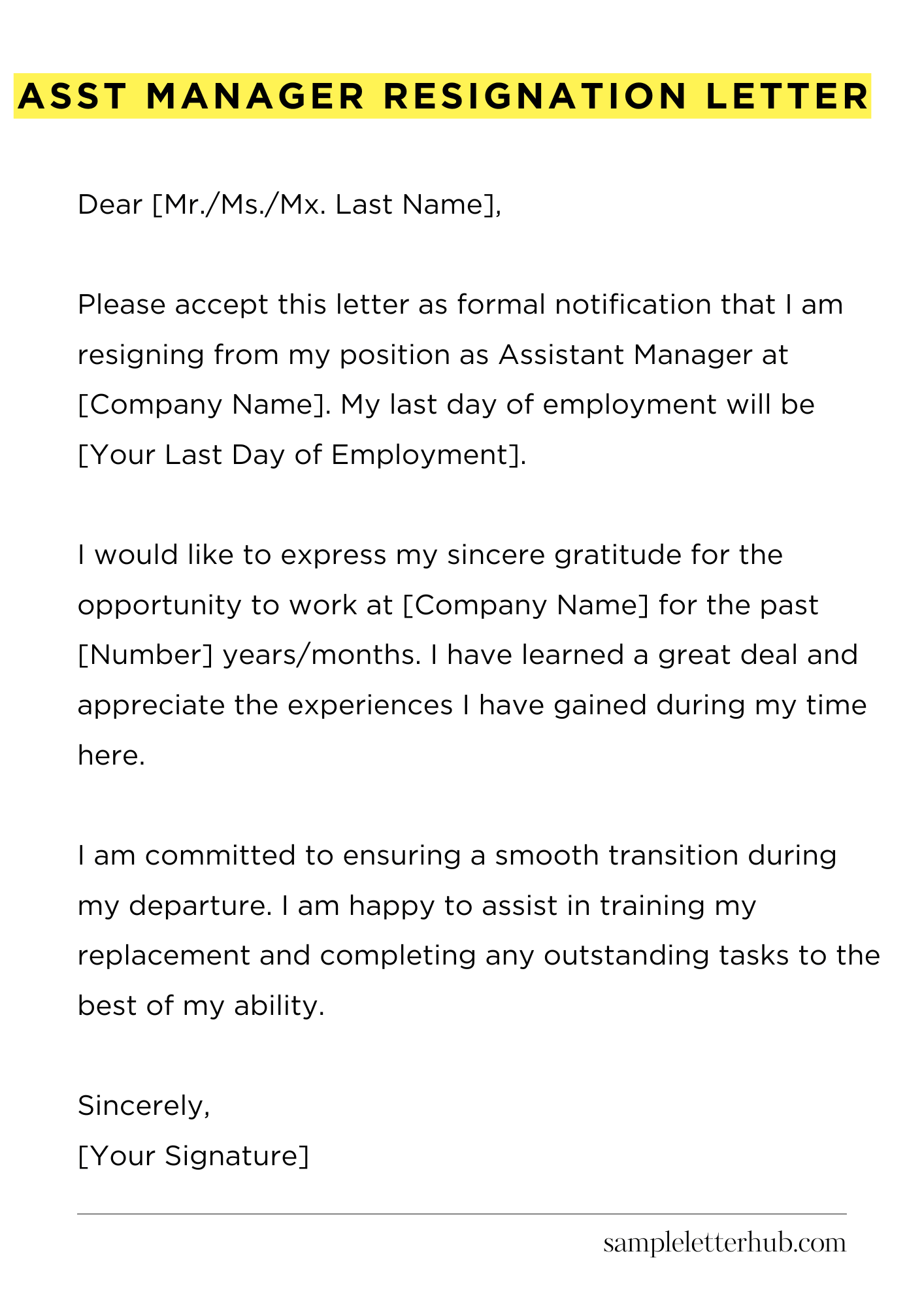
How to Write Asst Manager Resignation Letter
Getting Started: Your First Draft
Resigning from any job can be daunting. It’s especially true when you’ve held a position like Assistant Manager, where you’ve likely built relationships and have responsibilities. However, life changes. Sometimes, you need to move on. That is where a resignation letter comes in. First things first: you need a draft.
Begin by simply stating your intention to resign. Keep it clear and concise. State your name, your current title (Assistant Manager, in this case), and the effective date of your resignation. Don’t overthink this opening paragraph; it’s a straightforward announcement.
For example: “Dear [Manager’s Name], Please accept this letter as formal notification that I am resigning from my position as Assistant Manager, effective [Date of resignation].”
The Body of the Letter: Key Details
After the initial announcement, the body of your letter should address key considerations. You need to be professional; no matter your reasons for leaving. Briefly, express your gratitude for the opportunity. You can say something like: “I am grateful for the opportunities I have been given during my time here.”
If you are feeling inclined, you can briefly touch on what you’ve learned or the positive aspects of your employment. This is optional and depends on your comfort level. Avoid negativity; even if you’re leaving because of negative experiences. Keep the tone appreciative and respectful.
Next, offer your assistance during the transition. Offer to help train your replacement, or to complete any outstanding tasks. This demonstrates your professionalism and commitment.
Example: “I am committed to ensuring a smooth transition during my departure. I am happy to assist in training my replacement and completing any remaining projects.”
Formatting and Style: Polishing Your Letter
Presentation matters. Proper formatting makes your letter easier to read and reflects well on you. Use a standard business letter format. This typically includes your address, the date, and the recipient’s information (manager’s name, title, company address). Use a professional font like Times New Roman or Arial, and a font size of 12 points.
Keep the letter concise; one page is usually ideal. Proofread carefully for any typos or grammatical errors. A poorly written letter can undermine the positive impression you want to create. Double-check all dates and names. Review the company’s policy for submitting resignation letters. Some companies have specific procedures.
Keeping it Positive: The Tone of Your Letter
The tone of your resignation letter is critical. Aim for a positive and professional tone. Avoid dwelling on any negative experiences or issues. You are leaving the company, so there is no need to create any negativity. Even if you’re leaving due to dissatisfaction, it’s best to maintain a neutral or appreciative stance.
Focus on future endeavors. This will help maintain positive relationships with your former colleagues and superiors. This may be very helpful in the future, if you require a reference, or you meet them in your career.
Finalizing and Delivering Your Letter
Before submitting your resignation letter, make sure you have a copy for your records. Consider asking a trusted colleague or friend to review it for you. Once you are satisfied, deliver your letter according to company policy. This is usually to your manager. Ensure that you discuss your resignation in person.
Delivering the resignation letter is only a formality. If you are unsure, speak to your HR department. This will help to provide a smooth transition. Consider the timing of your letter, based on your employment contract. Some contracts require a specific amount of notice; make sure you adhere to those terms. Good luck with your next adventure!
FAQs about Asst Manager resignation letter
How do I start my resignation letter as an Assistant Manager?
Begin your resignation letter professionally. Start by clearly stating your intent to resign from your position as Assistant Manager. Include the date of your resignation and the date of your last day of employment. Be direct and concise in your opening.
What key information should I include in my Assistant Manager resignation letter?
Your letter should include your job title (Assistant Manager), the effective date of your resignation, and a brief statement of your decision. While you are not obligated to provide a reason, you may include a brief, positive statement if you wish. Also, consider expressing gratitude for the opportunity and offering assistance with the transition.
Is it necessary to provide a reason for my resignation in the letter?
Providing a reason for your resignation is optional. It is generally advisable to keep the explanation brief and positive. You can simply state that you are pursuing other opportunities or making a career change. If you have any grievances, it is best to address them separately through HR rather than in the resignation letter itself.
How should I express gratitude in my resignation letter?
Expressing gratitude is a crucial part of a professional resignation letter. You can thank your employer for the opportunity to work as an Assistant Manager and for any learning experiences or career development you gained during your tenure. You may also acknowledge your colleagues and the overall work environment, if it was positive.
What should be the tone and format of my Assistant Manager resignation letter?
Maintain a professional and respectful tone throughout your letter. Use a standard business letter format, including your contact information, the date, your manager’s or HR department’s contact information, a formal salutation (e.g., “Dear [Manager’s Name]”), the body of the letter.
Related:
Resignation letter due to rude boss
Resignation letter moving to another state
Resignation letter due to illness of family member
Resignation letter due to study