

An Associate Scientist resignation letter is a formal document. It informs your employer of your intention to leave your job. The letter officially ends your employment. It is a crucial step in the resignation process.
Need to resign as an Associate Scientist? Writing the perfect letter can be tough. Don’t worry. We’ve got you covered. We’ll share helpful templates and examples. These samples will guide you.
This article provides various resignation letter samples. Choose the best fit for your situation. Adapt them to reflect your specific needs. Use these to craft your own professional and effective letter.
Associate Scientist Resignation Letter
Below is a sample of a Associate Scientist Resignation Letter:
[Your Name]
[Your Address]
[Your Phone Number]
[Your Email Address]
[Date]
[Hiring Manager Name] (If known, otherwise use title)
[Hiring Manager Title]
[Company Name]
[Company Address]
Dear [Mr./Ms./Mx. Last Name],
Please accept this letter as formal notification that I am resigning from my position as Associate Scientist at [Company Name]. My last day of employment will be [Your Last Day of Employment].
I am grateful for the opportunities I have been given during my time here. I have learned a great deal and appreciate the experience I’ve gained working on [mention a specific project or area].
I am committed to ensuring a smooth transition. I am happy to assist in training my replacement and completing any outstanding tasks before my departure. Please let me know how I can be of assistance during this period.
I wish you and [Company Name] all the best in the future.
Sincerely,
[Your Signature]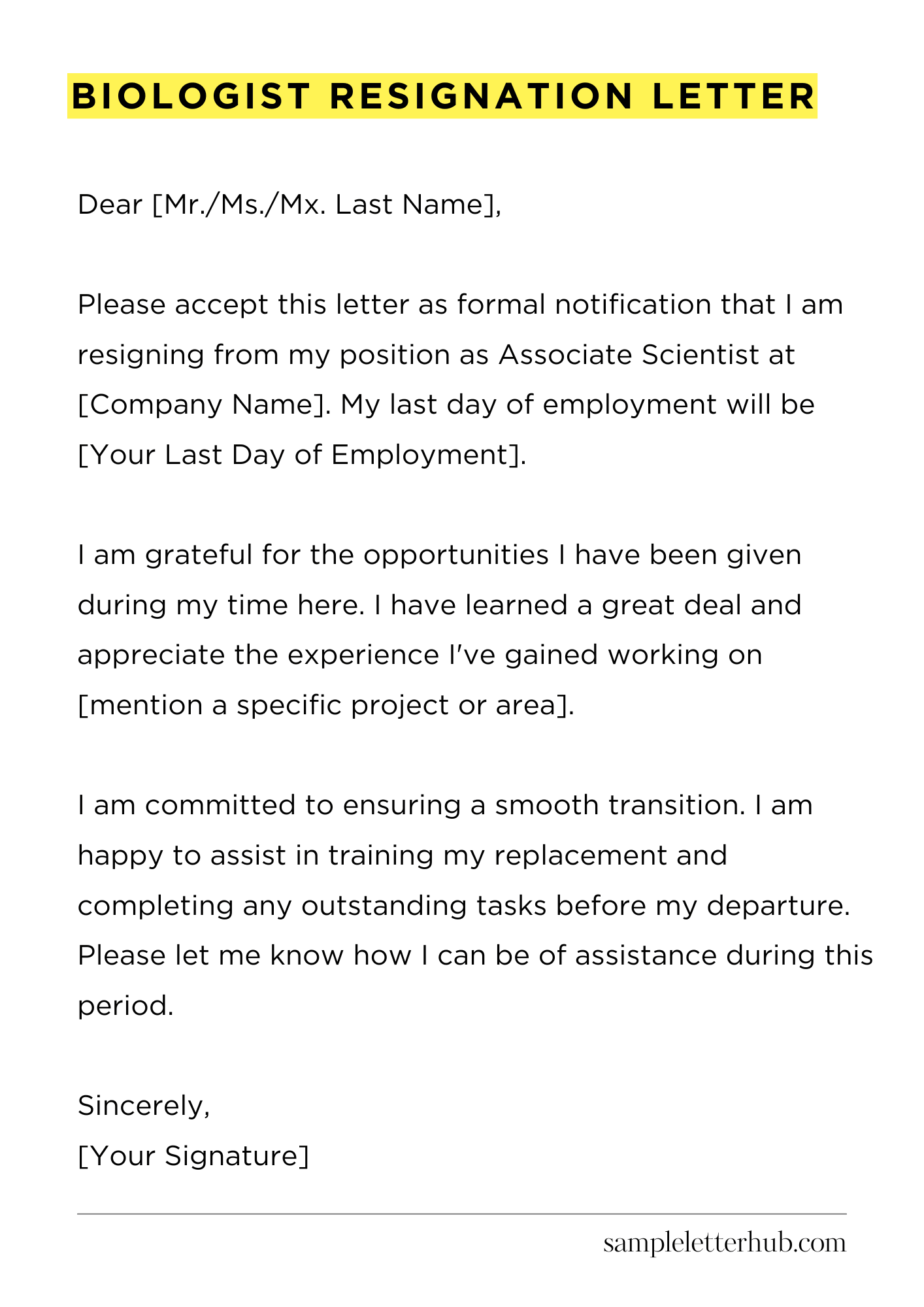
How to Write Associate Scientist Resignation Letter
1. Preparation is Key: Before You Start
So, you’re ready to move on. That’s a big step! Before you even think about putting pen to paper (or fingers to keyboard), there are a few things you should consider. First, make sure you’ve finalized your plans. This means you know your departure date and have a clear idea of where you’re going next.
Next, take a look at your employment contract or company handbook. Are there any specific guidelines for resignation letters? Often there will be a specific notice period you need to adhere to. Failure to comply can lead to issues, like the withholding of your final paycheck or legal complications.
Furthermore, consider who you need to inform, starting with your direct supervisor. Have a brief, professional conversation with them before submitting your letter. This gives them the heads-up and shows respect.
2. Structure: Laying the Foundation
A well-structured resignation letter is clear and professional. You should keep it concise and to the point. Start with a formal greeting, such as “Dear [Supervisor’s Name]”.
Then, state your intention to resign and your last day of employment. Use a simple and direct sentence like, “Please accept this letter as formal notification that I am resigning from my position as Associate Scientist, effective [Date].” Next, you might briefly thank the company for the opportunity and express gratitude for your time there.
Keep this section short and positive. It’s a great opportunity to briefly mention any specific achievements or experiences you enjoyed during your employment. Finally, close with a professional closing, such as “Sincerely” or “Best regards,” followed by your full name.
3. Content: Crafting the Message
The core of your letter is the message you want to convey. The most important thing is to clearly state your intention to resign and your last day. Avoid going into excessive detail about your reasons for leaving.
Generally, a simple and neutral explanation suffices. You can, for instance, say, “I am pursuing other opportunities” or “I have accepted a position at another company.” Avoid any negative comments about your current employer or colleagues; this is not the time to air grievances.
If you’d like to offer any assistance during the transition period, such as helping with training a replacement, this can be a positive gesture. However, don’t feel obligated to do so.
4. Tone: Maintaining Professionalism
The tone of your resignation letter is crucial. It should always be professional and respectful, even if your experience with the company has been less than ideal. Avoid any hint of negativity, anger, or sarcasm. Even if there are underlying issues, a professional tone reflects well on you and keeps all doors open for future opportunities.
Remember, this letter becomes part of your permanent employment record. It’s also wise to proofread the letter carefully. Check for any grammatical errors, spelling mistakes, and ensure the language is clear and concise. Ask a friend or colleague to read it over as a second pair of eyes always helps.
5. Delivery: Finalizing and Submitting
Once you’ve written and proofread your letter, it’s time to submit it. Always adhere to your company’s policy for submitting resignation letters. This usually involves submitting the letter to your direct supervisor, and possibly HR.
In some instances, it might be an email, or a physical copy. Make sure you keep a copy of your resignation letter for your records. This is important. If you’re submitting the letter via email, it’s a good practice to request confirmation of receipt.
After submitting your letter, start the handover process. This is the opportunity to be helpful to your colleagues. It will show your professionalism and integrity. This whole process, if executed correctly, will leave a positive and lasting impression, even after your departure.
FAQs about Associate Scientist resignation letter
How do I start my Associate Scientist resignation letter?
Begin your letter by clearly stating your intent to resign from your position as an Associate Scientist. Include the effective date of your resignation. Be direct and professional. Address the letter to your immediate supervisor and, potentially, the Human Resources department.
What key information should be included in an Associate Scientist resignation letter?
Your resignation letter should include your official title (Associate Scientist), the company name, and the date of your letter. Specify your last day of employment (the effective date of your resignation). It’s also advisable to briefly express gratitude for the opportunity and experiences gained during your employment. You may optionally offer to assist with the transition.
Is it necessary to provide a reason for leaving in an Associate Scientist resignation letter?
While not mandatory, it’s generally a good practice to briefly mention your reason for leaving. This can be a simple statement like “pursuing another opportunity” or “to focus on personal development.” You are not required to provide extensive details. Keeping it concise and positive is often best.
What should be the tone and style of an Associate Scientist resignation letter?
Maintain a professional and respectful tone throughout your letter. Use formal language and avoid negativity or criticism. Express gratitude for the opportunity. The style should be clear, concise, and easy to understand. Proofread carefully for any grammatical errors or typos.
Should I offer assistance with the transition in my Associate Scientist resignation letter?
Offering assistance with the transition is a thoughtful gesture and often appreciated by employers. You can state your willingness to help train your replacement or assist with the handover of your responsibilities. This demonstrates professionalism and can help maintain a positive relationship with your employer.
Related:
Resignation letter due to rude boss
Resignation letter moving to another state
Resignation letter due to illness of family member
Resignation letter due to study