

An Associate Editor resignation letter is a formal document. It informs your employer of your intention to leave. This letter officially ends your employment. It is a crucial step in the process.
Feeling overwhelmed? Writing a resignation letter can be tough. We’ve got you covered. We’ll share various templates. These templates include examples and samples. Use them to craft your own perfect letter.
Whether you’re moving on or taking a new opportunity, we have options. We want to make it easy. Find the right words to say goodbye. Simplify the process.
Associate Editor Resignation Letter
Below is a sample of a Associate Editor Resignation Letter:
[Your Name]
[Your Address]
[Your Phone Number]
[Your Email Address]
[Date]
[Hiring Manager Name] (If known, otherwise use title)
[Hiring Manager Title]
[Publication Name]
[Publication Address]
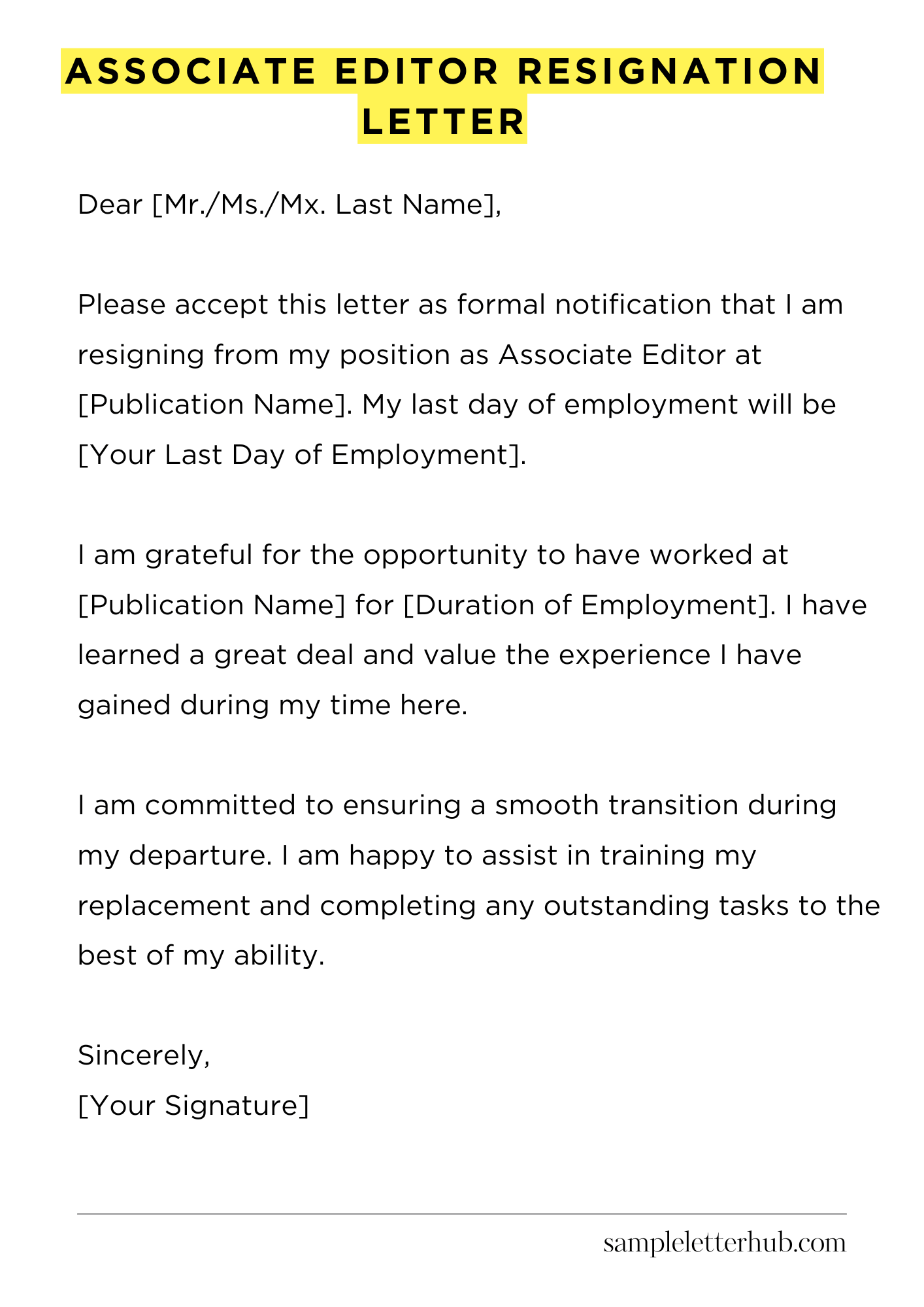
Dear [Mr./Ms./Mx. Last Name],
Please accept this letter as formal notification that I am resigning from my position as Associate Editor at [Publication Name]. My last day of employment will be [Your Last Day of Employment].
I am grateful for the opportunity to have worked at [Publication Name] for [Duration of Employment]. I have learned a great deal and value the experience I have gained during my time here.
I am committed to ensuring a smooth transition during my departure. I am happy to assist in training my replacement and completing any outstanding tasks to the best of my ability.
Thank you again for the opportunity. I wish you and [Publication Name] continued success in the future.
Sincerely,
[Your Signature]
How to Write an Associate Editor Resignation Letter
Resigning from any job can be a big step. It’s important to do it professionally, and that includes crafting a well-written resignation letter. This is especially true when leaving a role like Associate Editor, which usually involves maintaining strong relationships and a professional image.
1. Keep it Short and Sweet (and Respectful!)
First things first: brevity is your friend. Your letter doesn’t need to be a novel. A clear and concise letter is the most effective. Start by stating your intention directly. For example, “Please accept this letter as formal notification that I am resigning from my position as Associate Editor.”
Keep it polite and respectful throughout, even if your reasons for leaving are less than positive. You’ll want to maintain a positive relationship, or at least avoid burning bridges.
Think about the future; you will not want to have problems with your boss. This simple gesture will go a long way.
2. State the Effective Date of Your Resignation
Clearly indicate your last day of employment. This is crucial for your employer to plan for your departure and make necessary arrangements. Don’t leave any room for ambiguity. This allows the company to move forward. The date also sets expectations.
Make sure this date is in line with your employment contract or any company policies regarding resignation notice periods. Usually, it’s two weeks’ notice.
3. Express Gratitude (Always a Good Idea!)
Even if the job wasn’t a perfect fit, or you’re leaving for a better opportunity, it’s generally good practice to express your gratitude. A simple thank you can leave a positive lasting impression.
Acknowledge the experience and opportunities you’ve been given. Mention any positive aspects of your tenure. It’s a nice touch and shows professionalism. This is vital when it comes to maintaining a good relationship.
Consider mentioning something specific, like “I appreciate the opportunity to have worked on [Project Name] during my time here.” Or, “I am grateful for the chance to learn [Skill] at [Company].”
4. Offer Assistance with the Transition
This shows that you are committed to a smooth transition. Offer to help with the handover process. Mention your willingness to train a replacement or complete any ongoing projects. This demonstrates responsibility and a willingness to help. This kind of positive energy will make it easier for your boss.
Suggest that you are happy to provide documentation. You can also help with anything else you are required to do. This gesture will leave your boss and colleagues with a positive feeling. It also helps to prevent disruption when you leave.
5. Finalize the Letter and Proofread Meticulously
Before you send the letter, re-read it carefully. Check for any errors in grammar, spelling, and punctuation. Make sure your tone is professional and positive. Be extra cautious.
Consider asking a trusted colleague or friend to proofread it for you as well. Small mistakes can undermine the impact of your message. Ensure that all the important details, such as the date and your role, are correct. Once you are satisfied, sign the letter and send it to your supervisor. Good luck!
FAQs about Associate Editor resignation letter
How do I start my Associate Editor resignation letter?
Begin your letter by clearly stating your intention to resign from your position as Associate Editor. Include the date of your resignation, ensuring it aligns with any notice period outlined in your employment contract or company policy. This sets the tone and provides a formal and concise starting point.
What key information should be included in an Associate Editor resignation letter?
Beyond the core statement of resignation, your letter should include: your current job title (Associate Editor), the effective date of your resignation, a brief expression of gratitude for the opportunity to work at the organization, and potentially a brief, professional reason for leaving (optional, but may be expected). If appropriate, you could offer assistance during the transition period.
Is it necessary to provide a reason for resigning as Associate Editor?
Providing a reason for your resignation is optional. However, it can be beneficial. A simple and professional explanation, such as “to pursue other opportunities,” “for personal reasons,” or “to focus on other career goals,” is usually sufficient. Avoid overly detailed explanations or negative comments about the company or colleagues. Keep it concise.
What is the proper format for an Associate Editor resignation letter?
The standard format for a business letter is recommended. Include your name, address, and the date. Address the letter to your direct supervisor or the appropriate person as per company protocol. Use a formal and professional tone throughout. Keep the letter concise, usually within one page.
Should I offer assistance during the transition period in my Associate Editor resignation letter?
Offering assistance during the transition period is highly recommended. This demonstrates professionalism and a commitment to ensuring a smooth handover of your responsibilities. You could offer to train your replacement, complete any ongoing projects, or provide documentation. This gesture can leave a positive lasting impression.
Related:
Resignation letter due to rude boss
Resignation letter moving to another state
Resignation letter due to illness of family member
Resignation letter due to study