

An Assistant Registrar resignation letter is a formal document. It is written by an Assistant Registrar. The letter announces their decision to leave their job. It also marks the official end of their employment.
Leaving a job can be tricky. Writing the right words is important. We’ve got you covered. This article offers helpful templates. You can use these examples as guides. Adapt them to fit your specific needs.
Crafting your resignation will be easier. These samples are designed to help. Whether you want to quit gracefully or with a bang, we are here. Just find the template you need and get writing!
Assistant Registrar Resignation Letter
Below is a sample of a Assistant Registrar Resignation Letter:
[Your Name]
[Your Address]
[Your Phone Number]
[Your Email Address]
[Date]
[Hiring Manager Name] (If known, otherwise use title)
Assistant Registrar
[University/Organization Name]
[University/Organization Address]
Dear [Mr./Ms./Mx. Last Name],
Please accept this letter as formal notification that I am resigning from my position as Assistant Registrar at [University/Organization Name], effective [Your Last Day of Employment].
I am grateful for the opportunity to have worked here for the past [Number] years/months. I have gained valuable experience and appreciate the support I have received from my colleagues.
I am committed to ensuring a smooth transition during my departure. I am happy to assist in training my replacement and completing any outstanding tasks to the best of my ability. Please let me know how I can be of assistance.
I wish the university/organization continued success in the future.
Sincerely,
[Your Signature]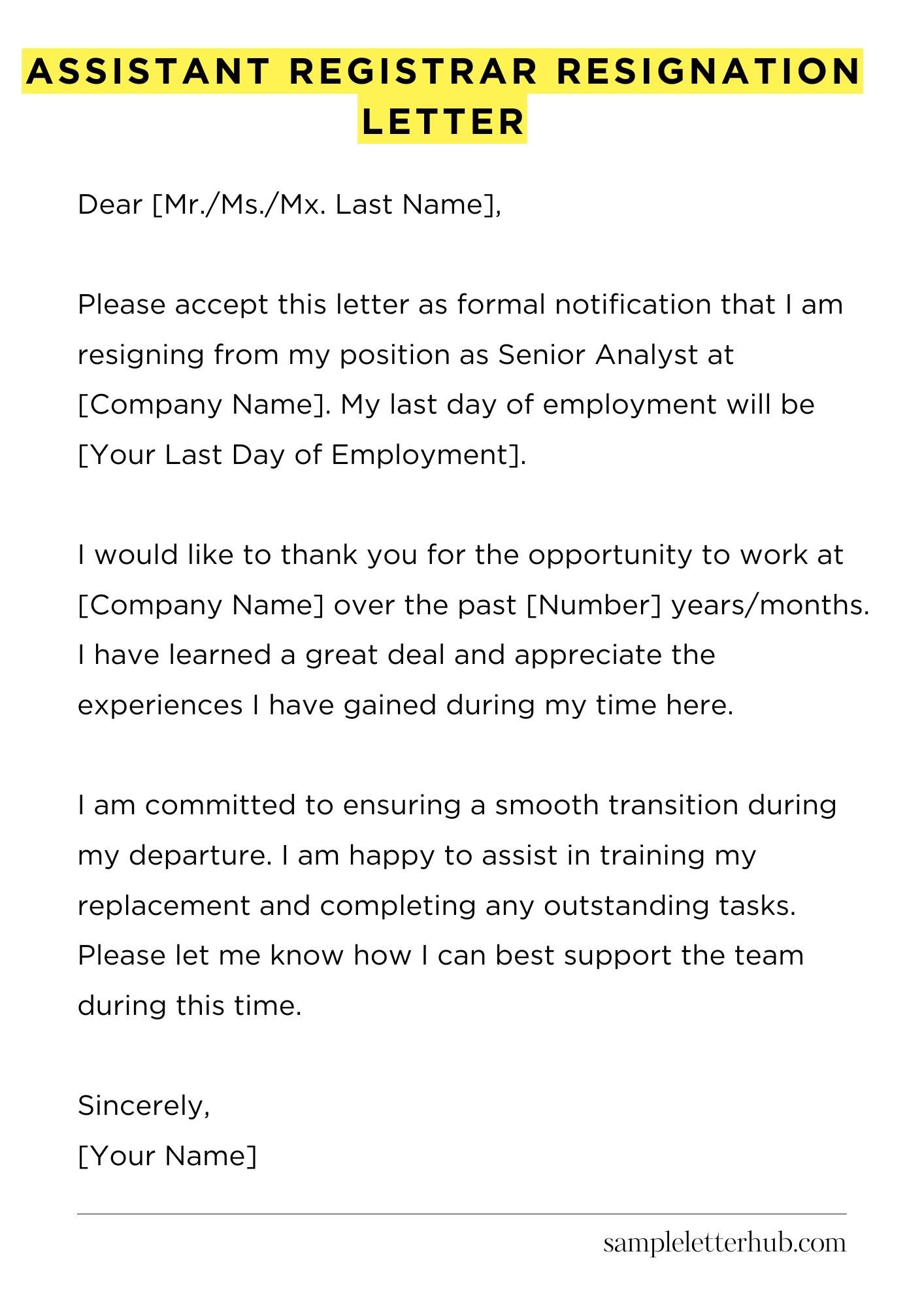
How to Write Assistant Registrar Resignation Letter
1. Grasping the Basics: Why a Resignation Letter Matters
So, you’ve made the decision to move on. Congratulations! Before you simply walk out the door, take a moment. You need a formal resignation letter. It’s an essential step. It’s more than just a formality; it’s a professional courtesy. A well-crafted letter ensures a smooth transition.
Think of it as a bridge, not a burnt one. It provides a clear record of your departure. It also safeguards your professional reputation. Believe me, you’ll be glad you took the time.
2. Essential Components: What to Include
Let’s get down to the specifics. Your letter must contain key information. First, include your name, title (Assistant Registrar, of course!), and the date. Second, state your intention to resign. Keep it direct. Specify your last day of employment. Give the correct date. Then, express your gratitude for the opportunity.
Briefly mention any key experiences. Consider thanking specific individuals. Finally, include your contact information. It is important for future communication. Don’t forget your signature! Keep it concise.
3. Crafting the Content: A Step-by-Step Guide
Now, let’s write it. Start with a professional salutation, such as “Dear [Recipient’s Name].” In the first paragraph, clearly state your resignation. For instance: “Please accept this letter as formal notification that I am resigning from my position as Assistant Registrar, effective [Date].” Next, include a sentence or two of appreciation.
You could say, “I am grateful for the opportunities I have been given during my time here.” Follow this by a very brief mention of your experience. A sentence will do. End with a simple “Sincerely,” followed by your signature and typed name. Proofread it very carefully! Double-check all dates and names. Make sure you avoid typos.
4. Tone and Style: Keeping it Professional
Maintain a professional tone throughout. Avoid negativity. Do not air grievances. This isn’t the time. Keep your language polite and respectful. Use clear and concise sentences. Your goal is to communicate effectively. Avoid overly emotional language. Stick to facts. Think of this letter as a business document. It’s a reflection of your character. Keep the tone positive.
5. Beyond the Letter: The Importance of Follow-Up
Your letter is just the first step. After submitting your letter, follow up. Talk to your supervisor. Offer to assist with the transition. Be prepared to answer questions. Remember, you want to leave on good terms. This helps with references.
It shows integrity. Always remain professional during your final days. A successful transition is beneficial for everyone. You’ll thank yourself later.
FAQs about Assistant Registrar resignation letter
What are the essential elements to include in an Assistant Registrar resignation letter?
An effective Assistant Registrar resignation letter should include: a clear statement of resignation, the effective date of resignation, a concise statement of appreciation for the opportunity, any handover plans, and a professional and respectful tone. It’s also advisable to include contact information for future correspondence, if desired.
How much notice should an Assistant Registrar provide in their resignation letter?
The notice period depends on the employment contract or company policy. However, as a general rule, a minimum of two weeks’ notice is standard. It is wise to review your contract or consult with your HR department to ascertain the specific requirements for your situation.
What should an Assistant Registrar avoid in a resignation letter?
Assistant Registrars should avoid negativity, such as complaining about the role, the employer, or colleagues. Avoid burning bridges by using a professional and polite tone. Refrain from including excessive detail about reasons for leaving, unless explicitly requested, and avoid making demands.
Is it necessary to provide a reason for resigning in the letter?
Providing a reason for resigning is not always mandatory. While some individuals choose to include a brief, neutral explanation, such as pursuing a new opportunity or personal reasons, it is not essential. Keeping the reason concise and professional is key if you decide to include it.
How should an Assistant Registrar handle the handover process in their resignation letter?
Your resignation letter can briefly outline your willingness to assist in the handover process. Mention you are willing to train your replacement or assist with the transition during your notice period. Specify any key tasks or projects you are currently managing and provide contact information for any follow-up questions from the replacement or colleagues.
Related:
Resignation letter due to rude boss
Resignation letter moving to another state
Resignation letter due to illness of family member
Resignation letter due to study