

An Assistant Professor resignation letter is a formal document. It officially informs your university of your decision to leave. Its purpose is to clearly state your departure and its effective date. It also helps to maintain a professional relationship.
Leaving your position can be stressful. We’re here to help make this process smoother. We will provide you with several different templates and examples. These are Assistant Professor resignation letter samples.
Think of it as your guide. You can modify these samples. They can help you craft your own resignation letter. We’ve got you covered.
Assistant Professor Resignation Letter
Below is a sample of a Assistant Professor Resignation Letter:
[Your Name]
[Your Address]
[Your Phone Number]
[Your Email Address]
[Date]
[Hiring Manager Name (if known), or “Hiring Committee”]
[Department Name]
[University Name]
[University Address]
Dear [Hiring Manager Name or Hiring Committee],
Please accept this letter as formal notification that I am resigning from my position as Assistant Professor in the [Department Name] at [University Name]. My last day of employment will be [Your Last Day of Employment].
I would like to express my gratitude for the opportunities I have been given during my time here. I have learned a great deal and appreciate the support I have received from my colleagues and the university.
I am committed to helping ensure a smooth transition during my departure. I am happy to assist in any way possible to help with the transfer of my duties.
Thank you again for the experience. I wish the department and the university all the best in the future.
Sincerely,
[Your Signature]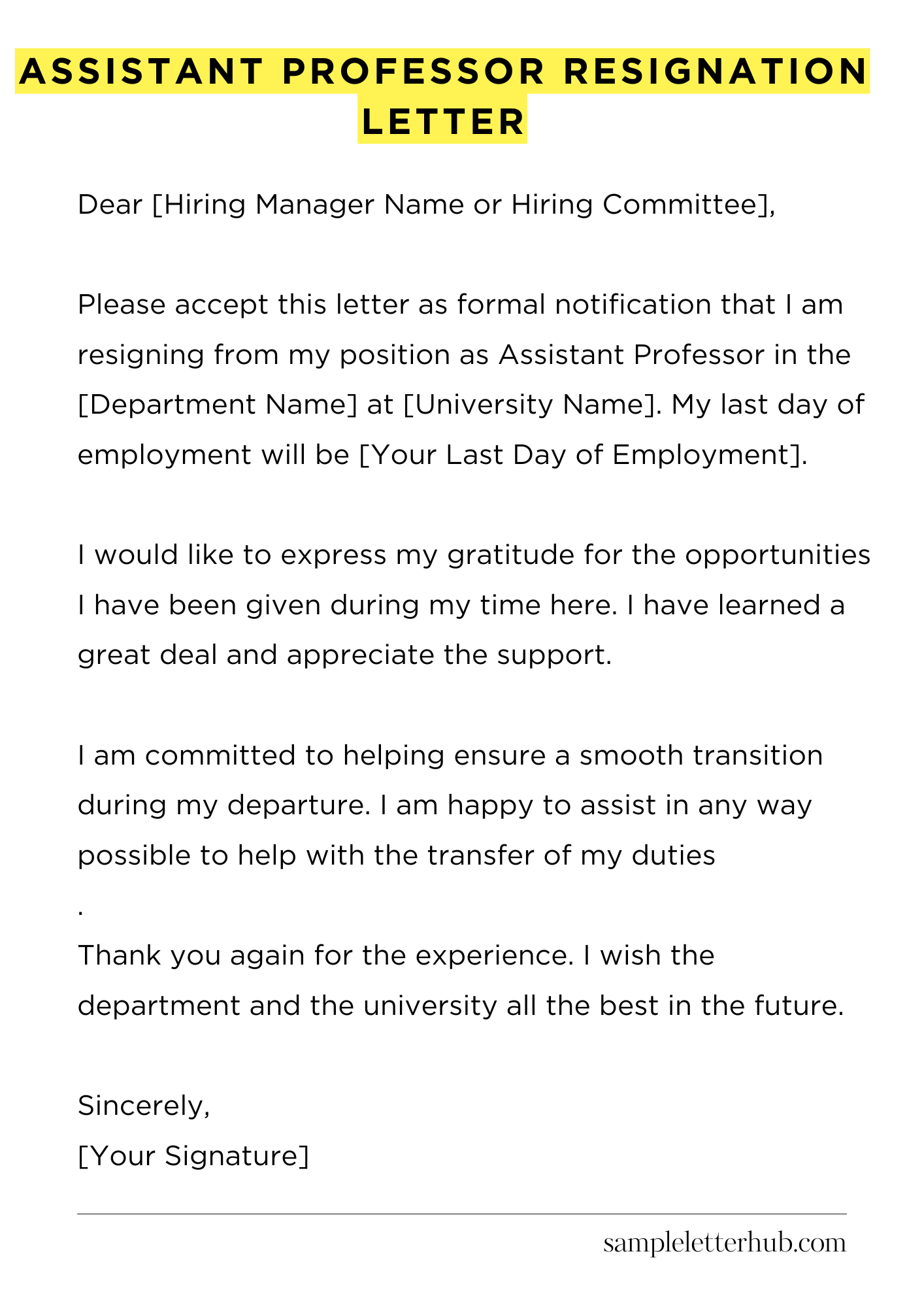
How to Write Assistant Professor Resignation Letter
1. Getting Started: The Basics You Need
So, you’re moving on. Leaving your assistant professor role requires a well-crafted resignation letter. It’s a crucial document; get it right! First, put in your full name, current title (Assistant Professor), and the department. Then, write the date.
Next, find out who the letter should be addressed to. Usually, this is the department chair or the Dean of the College. Always use their correct title and name. Clarity here is paramount, always remember this. You need to make a good impression.
A professional tone is the name of the game here. Do not write anything emotional. Your goal is to resign and move on to your next job.
2. The Core: Stating Your Intent
The first paragraph is where you state your resignation. Be direct! Use language like, “I am writing to formally resign from my position as Assistant Professor of [Department Name] at [University Name], effective [Your Last Day of Employment].” This needs to be crystal clear. Keep it simple and straightforward. Do not include any confusion to the reader.
Mentioning the effective date is absolutely vital. This is the date your employment officially ends. Double-check that this aligns with your contract and any university policies. It’s important to give adequate notice, usually a month or more. Make sure everything goes smoothly.
3. Expressing Gratitude and Professionalism
Now, let’s inject some positivity. Expressing gratitude is always appreciated. Acknowledge your time at the university. This is where you can mention positive experiences, mentors, or opportunities you have been given.
For example, “I am grateful for the opportunities I have been given to teach and conduct research during my time at [University Name].” It’s about remembering all the times you had and being thankful.
Keep the tone professional. This is not the time for grievances. Focus on the positive aspects of your employment. This is always a great way to move forward in any business.
4. Detailing the Handover Process and Support
Offer to assist with the transition. This shows consideration and professionalism. Indicate your willingness to help. For example, “I am committed to ensuring a smooth transition and am happy to assist in any way possible.” Always offer your best assistance.
Think about things like; completing ongoing projects or helping to train your replacement. You might offer to prepare materials for your classes. This proactive approach will leave a lasting positive impression. This is a very important step.
5. Final Touches: Closing and Submission
Close with a professional salutation, such as “Sincerely,” or “Respectfully.” Sign your name above your typed name. If you are submitting a physical letter, sign it in ink.
Proofread everything carefully! Check for any typos or grammatical errors. Before submitting, review all details. Be sure all dates and contact information is correct. Keep a copy of the letter for your records. The best way is to submit this letter via both email and a hard copy, if the university requires it. Keep everything safe.
FAQs about Assistant Professor resignation letter
How much notice should an Assistant Professor give when resigning?
The standard notice period for an Assistant Professor resignation typically aligns with the institution’s policy, often found in the employment contract or faculty handbook.
Commonly, a notice period of one to three months is expected. It’s crucial to review the specific guidelines provided by the university or college to ensure compliance and maintain a professional departure. Providing ample notice allows the institution time to find a replacement and facilitates a smooth transition for students and colleagues.
What should be included in an Assistant Professor resignation letter?
A well-crafted Assistant Professor resignation letter should include: a formal declaration of resignation, the effective date of departure, a concise statement of the reason for leaving (optional but sometimes necessary), a clear expression of gratitude for the opportunity, and any relevant details, such as the return of university property or outstanding obligations.
It is also common to offer assistance during the transition period. Maintain a professional tone throughout the letter.
Should an Assistant Professor state the reason for resigning in the letter?
Whether to state the reason for resignation is a matter of personal preference and circumstance. While it is not always required, briefly mentioning the reason can provide context.
If a reason is given, it’s best to keep it concise and professional. Common reasons include accepting another position, pursuing research opportunities, or personal considerations. Avoid negative comments about the institution or individuals.
What is the proper format for an Assistant Professor resignation letter?
The standard format for a resignation letter is a formal business letter format. This includes the sender’s contact information (name, address, email, phone number), the date, the recipient’s information (name, title, department, university), a professional salutation (e.g., “Dear Professor/Dean [Last Name]”).
Are there any specific legal considerations for Assistant Professor resignation letters?
Generally, resignation letters themselves don’t typically involve complex legal considerations. However, it’s important to be aware of any clauses in the employment contract or university policies regarding non-compete agreements, intellectual property rights, or the handling of research data.
If there are any concerns about potential legal implications, seeking advice from an attorney specializing in employment law is advisable. Ensure all obligations are met as outlined in the contract.
Related:
Resignation letter due to rude boss
Resignation letter moving to another state
Resignation letter due to illness of family member
Resignation letter due to study