

An Assistant Editor resignation letter is a formal document. It is written by an Assistant Editor. Its purpose is to officially announce your departure from a company. This letter informs your employer about your last day of work.
Planning your exit can feel overwhelming. We understand. Writing a resignation letter shouldn’t be complicated. That’s why we’re here to help.
We’ve compiled several templates and examples. Use these samples to craft your perfect letter. Each one is designed for ease. Find the right words to express your needs.
Assistant Editor Resignation Letter
Below is a sample of a Assistant Editor Resignation Letter:
[Your Name]
[Your Address]
[Your Phone Number]
[Your Email Address]
[Date]
[Editor’s Name] (If known, otherwise use title)
[Editor’s Title]
[Publication Name]
[Publication Address]
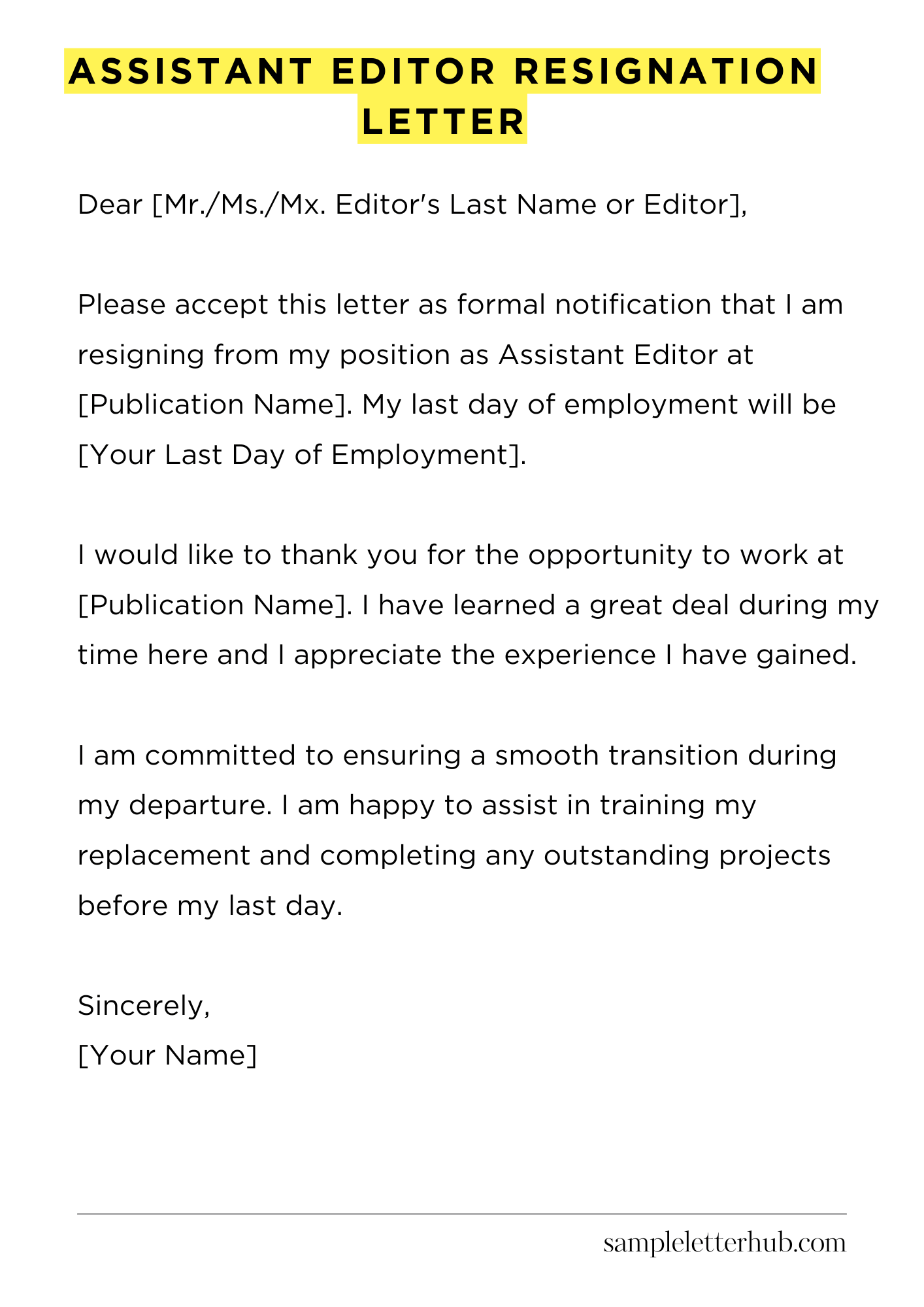
Dear [Mr./Ms./Mx. Editor’s Last Name or Editor],
Please accept this letter as formal notification that I am resigning from my position as Assistant Editor at [Publication Name]. My last day of employment will be [Your Last Day of Employment].
I would like to thank you for the opportunity to work at [Publication Name]. I have learned a great deal during my time here and I appreciate the experience I have gained.
I am committed to ensuring a smooth transition during my departure. I am happy to assist in training my replacement and completing any outstanding projects before my last day.
I wish you and [Publication Name] all the best in the future.
Sincerely,
[Your Name]
How to Write an Assistant Editor Resignation Letter
Know When to Jump Ship
So, you’re ready to move on. That’s perfectly okay! Life is all about new experiences and finding the right fit. Before you even think about penning that resignation letter, however, you need to be sure. Are you actually unhappy in your current position? Is a new opportunity truly better? Think carefully, really consider what you are seeking and what is driving your decision to leave.
This is a big decision, so take your time and do your research.
Formatting is Key: Get the Basics Right
Okay, you’ve made the decision, and it is time to write your letter. First impressions matter a lot. The formatting of your letter is a crucial part. Use a professional-looking font like Times New Roman or Arial, and stick to a standard font size, such as 12 points.
Make sure to include the date, your name, and your contact information at the top, along with the recipient’s information (your boss’s name, title, and the company address).
Keep it concise. Keep it clean. Keeping it neat will show respect for your employer and demonstrate your professionalism.
The Anatomy of a Great Resignation Letter
Now, let’s get down to the actual content. Start with a clear and direct statement of your intent to resign. State your position and the date of your last day of employment.
This is where you let them know the important information up front. After the opening statement, you can express your gratitude for the opportunity to have worked there, mentioning any specific experiences or skills you’ve gained during your time.
The middle of the letter is critical.
Keep your language positive and professional, even if you are leaving because of negative reasons. Keep it brief. You don’t need to go into too much detail about the reasons for your departure.
What to Include (and What to Leave Out)
Focus on expressing your gratitude and offer to assist with the transition. Offer assistance with training your replacement. This shows your commitment to a smooth handover.
Avoid any negativity or complaints about your job, colleagues, or the company. This isn’t the time to air grievances. Instead, maintain a respectful and professional tone throughout the letter. Do not include excessive personal details or emotional statements.
Be concise. Make it easy to read.
The Final Touch: Proofread and Submit
Before you send your letter, proofread it carefully. Check for any grammatical errors, spelling mistakes, or typos. This small step can make a big difference. Get a second pair of eyes to read it over as well. Finally, make sure to submit your letter according to your company’s policies (typically through email or in person). Good luck!
The job market is constantly evolving.
You are ready to move on. Take the next step!
FAQs about Assistant Editor resignation letter
How do I start my Assistant Editor resignation letter?
Begin your Assistant Editor resignation letter by clearly stating your intention to resign from your position. Include your name, the date, and the effective date of your resignation. It’s also important to address the letter to the appropriate person, usually your direct supervisor or the Human Resources department. Maintain a professional and respectful tone throughout the letter.
What should I include in the body of an Assistant Editor resignation letter?
In the body of your letter, briefly state the reason for your resignation if you feel comfortable doing so, although this isn’t always mandatory. You may simply state that you’re pursuing other opportunities. Express gratitude for the opportunities and experiences you’ve gained during your time as an Assistant Editor.
Mention any specific skills or knowledge you’ve acquired. You should also offer assistance with the transition process, such as training your replacement or completing any outstanding tasks.
What tone and language should I use in my Assistant Editor resignation letter?
Use a professional and courteous tone in your resignation letter. Avoid negative comments about your employer or colleagues. Keep your language clear, concise, and respectful.
Express your gratitude for the opportunity to work as an Assistant Editor and wish the company and your colleagues well in the future. Proofread the letter carefully to ensure there are no grammatical errors or typos.
Should I provide a reason for resigning in my Assistant Editor resignation letter?
You are not obligated to provide a specific reason for your resignation. However, if you feel comfortable doing so, you can briefly mention why you are leaving, such as pursuing a new job opportunity or career change.
If you choose to provide a reason, keep it brief and professional. If you prefer not to disclose the reason, it is perfectly acceptable to state that you are resigning to pursue other interests or opportunities.
What information should I include at the end of my Assistant Editor resignation letter?
Conclude your letter by reiterating your effective date of resignation and offering your assistance during the transition period. Express your gratitude for the opportunity to have worked as an Assistant Editor and wish your colleagues and the company continued success.
Include your full name, signature (if sending a hard copy), and contact information (phone number or email address).
Related:
Resignation letter due to rude boss
Resignation letter moving to another state
Resignation letter due to illness of family member
Resignation letter due to study