

An Application Manager resignation letter is a formal document. It informs your employer of your intention to leave your role. It states your last day of employment. The letter is a crucial step in the resignation process.
Leaving a job can be tricky. Writing a resignation letter can be daunting. We are here to help make it simple. We’ve compiled various templates and examples.
These samples provide a solid foundation. You can easily customize them. They cover various scenarios and situations. Craft your perfect application manager resignation letter with ease.
Application Manager Resignation Letter
Below is a sample of a Application Manager Resignation Letter:
[Your Name]
[Your Address]
[Your Phone Number]
[Your Email Address]
[Date]
[Hiring Manager Name] (If known, otherwise use title)
[Hiring Manager Title]
[Company Name]
[Company Address]
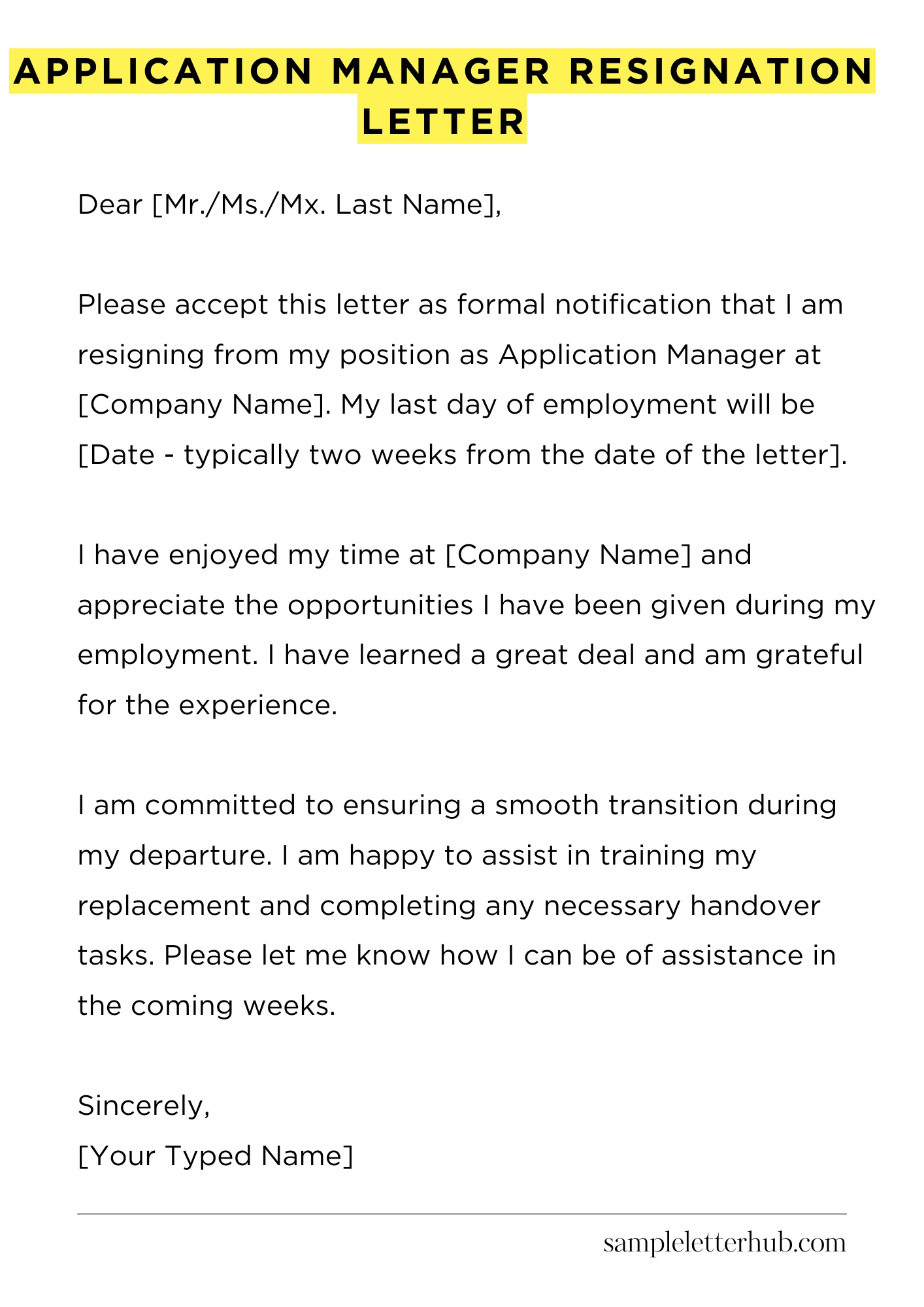
Dear [Mr./Ms./Mx. Last Name],
Please accept this letter as formal notification that I am resigning from my position as Application Manager at [Company Name]. My last day of employment will be [Date – typically two weeks from the date of the letter].
I have enjoyed my time at [Company Name] and appreciate the opportunities I have been given during my employment. I have learned a great deal and am grateful for the experience.
I am committed to ensuring a smooth transition during my departure. I am happy to assist in training my replacement and completing any necessary handover tasks. Please let me know how I can be of assistance in the coming weeks.
I wish you and [Company Name] all the best in the future.
Sincerely,
[Your Typed Name]
How to Write an Application Manager Resignation Letter
Resigning from a job is a big step. For an Application Manager, it requires a carefully crafted resignation letter. You want to leave on good terms, preserving your professional reputation. This letter is your official notice to your employer. Make it count.
1. Start with the Basics: Formatting and Formalities
First things first. You must get the formatting right. Your letter should be business-like and professional. Use a standard business letter format. Include your full name, address, and the date.
Below that, write the hiring manager’s name and title. Then, the company’s name and address. This ensures clarity and professionalism. Keep the tone respectful and polite. Remember, this letter is a reflection of you.
Always use a formal salutation. “Dear Mr./Ms. [Last Name]” is generally appropriate. If you’re unsure of the hiring manager’s name, try “Dear Hiring Manager.”
2. State Your Intentions Clearly and Concisely
The core of your letter should clearly and directly state your intention to resign. Don’t beat around the bush. State your resignation. You need to identify your position and your last day of employment. For example: “Please accept this letter as formal notification that I am resigning from my position as Application Manager, effective [Your Last Day of Employment].” Keep it simple, but specific.
Make sure your last day of employment aligns with your employment contract or any company policies. Give adequate notice, typically two weeks, unless your contract dictates otherwise. This shows respect for your employer and helps to ease the transition.
3. Express Gratitude and Offer Assistance
Even if you’re leaving for a challenging role, remember to express your gratitude. Acknowledge the opportunities you’ve been given. Briefly mention positive experiences you’ve had during your tenure. This is not the place to list your grievances. You can simply state that you have valued your time at the company.
Offering to assist with the transition is also a nice touch. It demonstrates your professionalism and your commitment. You can write something like: “I am committed to ensuring a smooth transition during my departure and am happy to assist in training my replacement.” Offer your help if needed. Good will goes a long way.
4. Keep It Brief and Positive
Your resignation letter should be concise. Get to the point. Aim for one page, if possible. Avoid lengthy explanations or justifications for your departure. Keep the focus on the essentials: your resignation, your last day, gratitude, and an offer of assistance. Maintain a positive tone throughout the letter. Do not criticize the company or your colleagues.
A positive attitude makes a good impression. Proofread your letter carefully before you send it. Ensure there are no grammatical errors or typos. This attention to detail reflects well on you. Ask someone to review it before submitting.
5. Closing and Next Steps
End your letter with a professional closing. “Sincerely,” or “Respectfully,” are both appropriate. Include your typed name and then your signature above it. Keep a copy for your records. Consider hand-delivering the letter to your manager if possible, or sending it via email, following company protocol.
After submitting the letter, be prepared to discuss your resignation. Your manager may want to meet to discuss your decision. Be polite and professional during this conversation. This is your chance to maintain your positive relationship. You’ll want to leave with a good reference and a strong professional image.
FAQs about Application Manager resignation letter
Resigning from a role as an Application Manager requires a well-crafted resignation letter. Here are some of the most common questions regarding this process:
What key information should be included in an Application Manager resignation letter?
An effective Application Manager resignation letter should contain: a clear statement of your intent to resign, the effective date of your resignation, a concise expression of gratitude for the opportunity (optional but recommended), any necessary handover details, and your contact information. It is also prudent to comply with any company-specific guidelines regarding the resignation process.
How much notice should I give when resigning as an Application Manager?
The standard notice period is typically two weeks, but it’s essential to check your employment contract and any company policies for specifics. Your contract will dictate the required notice period. Adhering to the stipulated timeframe is crucial to avoid any potential legal or professional repercussions. Giving more notice than required is always appreciated by your employer.
Should I provide a reason for my resignation in the letter?
While not mandatory, you may choose to briefly state your reason for leaving. If you choose to do so, keep it professional and concise. Examples include pursuing a new opportunity or personal reasons. Avoid negative comments about your current employer or colleagues. Focus on the positive aspects of the experience or future goals.
What should be included regarding handover responsibilities in the resignation letter?
If you have any handover responsibilities include a brief note in your letter about your willingness to assist with the transition. Suggest a timeframe for the handover and offer to train a replacement or document essential processes.
This demonstrates professionalism and helps ensure a smooth transition for your team and the company. Detailing specific areas of responsibility will also be beneficial.
Is it necessary to send a physical letter, or can I submit an Application Manager resignation letter electronically?
While digital submissions are common, always confirm the preferred method with your employer or Human Resources department. Check company protocol. If a physical letter is required, it should be printed and signed. Email is usually accepted but make sure you follow the company’s guidelines. For best practices, always retain a copy of your resignation letter for your records.
Related:
Resignation letter due to rude boss
Resignation letter moving to another state
Resignation letter due to illness of family member
Resignation letter due to study