


Ever had an insurance claim denied? It’s frustrating. An appeal letter for rejected claim is your chance to fight back. Its purpose? To convince the insurer to reconsider their decision. You provide more information. You present a strong case. You aim to overturn the denial.
Dealing with claim rejections can be a headache. That’s why we’re here to help. This article offers helpful samples and examples of appeal letters. We understand. Writing can be tough. We provide templates to guide you. Use these to draft your own.
Need to draft an appeal letter for a rejected claim? We got you. We have everything you need. This post simplifies the process. Explore our easy-to-use appeal letter samples. Get the information to succeed.
[Your Name/Your Company Name]
[Your Address]
[Your City, Postal Code]
[Your Email]
[Your Phone Number]
[Date]
[Insurance Company Name/Recipient Name]
[Recipient Address]
[Recipient City, Postal Code]
Subject: Appeal for Rejected Claim – Policy Number [Your Policy Number]
Dear [Claims Adjuster Name/Recipient Name],
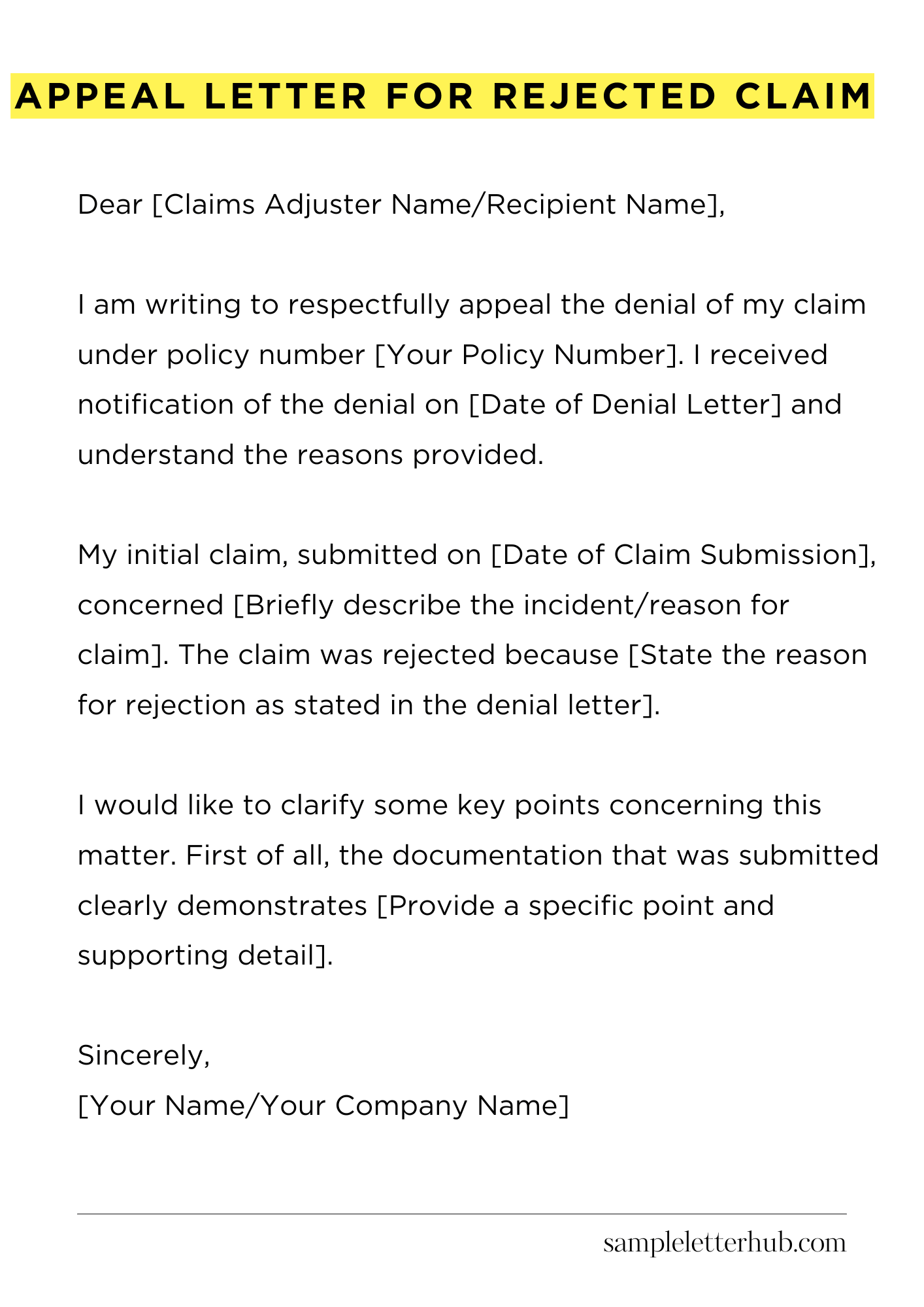
I am writing to respectfully appeal the denial of my claim under policy number [Your Policy Number]. I received notification of the denial on [Date of Denial Letter] and understand the reasons provided. However, I believe there are extenuating circumstances that warrant a review of this decision.
My initial claim, submitted on [Date of Claim Submission], concerned [Briefly describe the incident/reason for claim]. The claim was rejected because [State the reason for rejection as stated in the denial letter]. This is where I believe there might have been a misunderstanding.
I would like to clarify some key points concerning this matter. First of all, the documentation that was submitted clearly demonstrates [Provide a specific point and supporting detail].
Furthermore, evidence which could not be made immediately available, suggests that [Provide another specific point and supporting detail]. Also, it’s very important to note that [Provide another specific point and supporting detail].
I have attached copies of the following documents for your review: [List of attached documents – e.g., Original receipt, medical reports, police report]. These documents should further support my position. They will hopefully clarify any remaining issues.
I understand the importance of following policy guidelines, and I have always strived to do so. I firmly believe that this claim meets the requirements for coverage under my policy. I would be grateful if you could reconsider your decision.
Thank you for your time and attention to this appeal. I look forward to hearing from you soon regarding this matter. Please do not hesitate to contact me if you require any further information.
Sincerely,
[Your Name/Your Company Name]
How to Write an Appeal Letter for a Rejected Claim
Receiving a denial for a claim can be deflating, but it isn’t necessarily a final verdict. An appeal letter gives you a second chance. It’s your opportunity to eloquently articulate why you believe the initial decision was erroneous. Here’s a comprehensive guide to crafting a compelling appeal.
1. Understand the Rationale for Rejection
Before putting pen to paper (or fingers to keyboard), thoroughly scrutinize the rejection notice. The document will typically outline the specific reasons for denial.
Scrutinize the language, paying close attention to any cited policies, regulations, or documentation. Comprehending the basis of the denial is paramount to formulating a targeted and persuasive appeal. This will allow you to deconstruct their logic effectively.
2. Gather Supporting Documentation
An appeal letter is only as potent as the evidence you furnish. Assemble all pertinent documents that bolster your claim. This might encompass medical records, invoices, photographs, contracts, or any other material that substantiates your position.
Organize your documentation methodically; it demonstrates your commitment and aids the recipient in easily reviewing your substantiating materials.
3. Structure and Format Your Letter
A well-structured letter is crucial for effective communication. Begin with a formal salutation, addressing the relevant individual or department. In the opening paragraph, unequivocally state your intention to appeal the rejected claim and provide the claim number or reference.
The body of the letter should meticulously address the reasons for the denial, presenting your counterarguments with supporting evidence. Conclude with a clear request for reconsideration and express your gratitude for their time. Choose a professional, easy-to-read font, like Times New Roman or Arial, with standard margins and spacing.
4. Articulate Your Counterarguments Concisely
The core of your appeal lies in the counterarguments you construct. Address each reason for denial individually, presenting your evidence and reasoned rebuttals.
Avoid emotive language and maintain a professional tone throughout. Provide factual data to demonstrate why the initial decision should be overturned. Do not be hesitant to utilize medical terminology, legal jargon, or technical terms when necessary, but always ensure clarity.
5. Present Supporting Evidence Effectively
Integrate your supporting documentation seamlessly into your narrative. Instead of simply attaching documents, reference them explicitly within your letter.
For instance, you might write, “As evidenced by the attached medical report from Dr. Smith (Attachment A), the diagnosis was…”. This provides contextual clues and guides the reader through your proof. Highlight key information within the documents you cite for added clarity.
6. Maintain a Professional and Persuasive Tone
The tone of your appeal letter significantly influences its effectiveness. Adopt a composed, respectful, and assertive style. Refrain from accusatory language or personal attacks. Instead, focus on the facts and present your arguments cogently.
The goal is to persuade the reader by demonstrating the validity of your claim without being confrontational. Be confident in your claims and voice your argument.
7. Proofread and Submit Your Letter
Before dispatching your appeal, meticulously proofread it for grammatical errors, spelling mistakes, and factual inaccuracies. An error-free letter conveys professionalism and attention to detail.
Ensure that all attachments are included and clearly labeled. Make a copy of the letter and all attachments for your records. Send the appeal via certified mail with return receipt requested, to have verifiable proof of submission and arrival, ensuring there’s an acknowledgment of receipt.
FAQs about Appeal Letter for Rejected Claim
What is an appeal letter for a rejected claim, and why is it necessary?
An appeal letter is a formal document you submit to a company or organization to challenge their decision to deny your claim.
It’s necessary because it provides you with an opportunity to have the initial decision reconsidered, potentially overturning the denial and securing the benefits or compensation you initially sought. Without an appeal, the rejection stands, and you forgo any further chance of resolution.
What key information should I include in my appeal letter?
Your appeal letter should include your full name, contact information, the claim’s original reference number, a clear statement of why you believe the initial decision was incorrect, supporting evidence (medical records, receipts, witness statements, etc.), and a specific request (e.g., reconsideration of the denial, specific amount owed).
Always adhere to any specific guidelines provided by the organization in their denial notification.
What is the typical timeframe for submitting an appeal letter?
The timeframe varies depending on the organization and the type of claim. Most denial notifications specify a deadline for submitting an appeal, often within 30 to 180 days from the date of the denial. It is critical to adhere to this timeframe. Missing the deadline may result in the appeal being automatically rejected.
What types of evidence are most effective in supporting my appeal?
The most effective evidence strongly supports your claim. This includes any documents that contradict the reasons for denial, such as medical records, expert opinions, invoices, photographs, contracts, and relevant correspondence. Organize your evidence logically, making it easy for the recipient to understand how it supports your position.
What happens after I submit my appeal letter?
After you submit your appeal letter, the organization will review it, along with any supporting documentation. The review process can take a few weeks to several months, depending on the complexity of the claim and the organization’s procedures.
You will typically receive a written decision outlining the outcome of the appeal. This decision may uphold the denial, reverse it, or request further information.
Related:
Resignation letter due to rude boss
Resignation letter moving to another state
Resignation letter due to illness of family member
Resignation letter due to study