


Health insurance claims can get denied. A denial means your insurance won’t pay for a service. An appeal letter for health insurance claim denial challenges this decision. Its purpose? To convince your insurer to reconsider. You want them to cover the denied medical expense.
Dealing with denials can be stressful. Don’t worry, we’re here to help. We’ll give you appeal letter for health insurance claim denial templates. We’ll offer examples and samples, too. This way, writing your own letter is much easier. Use our guide to create a strong appeal.
Our goal is simple. We aim to empower you. Use these appeal letter samples to fight back. We will provide all the necessary tools. Get your claim paid and get the care you need. Your health is important.
[Your Name]
[Your Address]
[Your Phone Number]
[Your Email Address]
[Date]
[Insurance Company Name]
[Insurance Company Address]
Subject: Appeal for Health Insurance Claim Denial – [Claim Number]
Dear [Claims Department/Name of Adjuster],
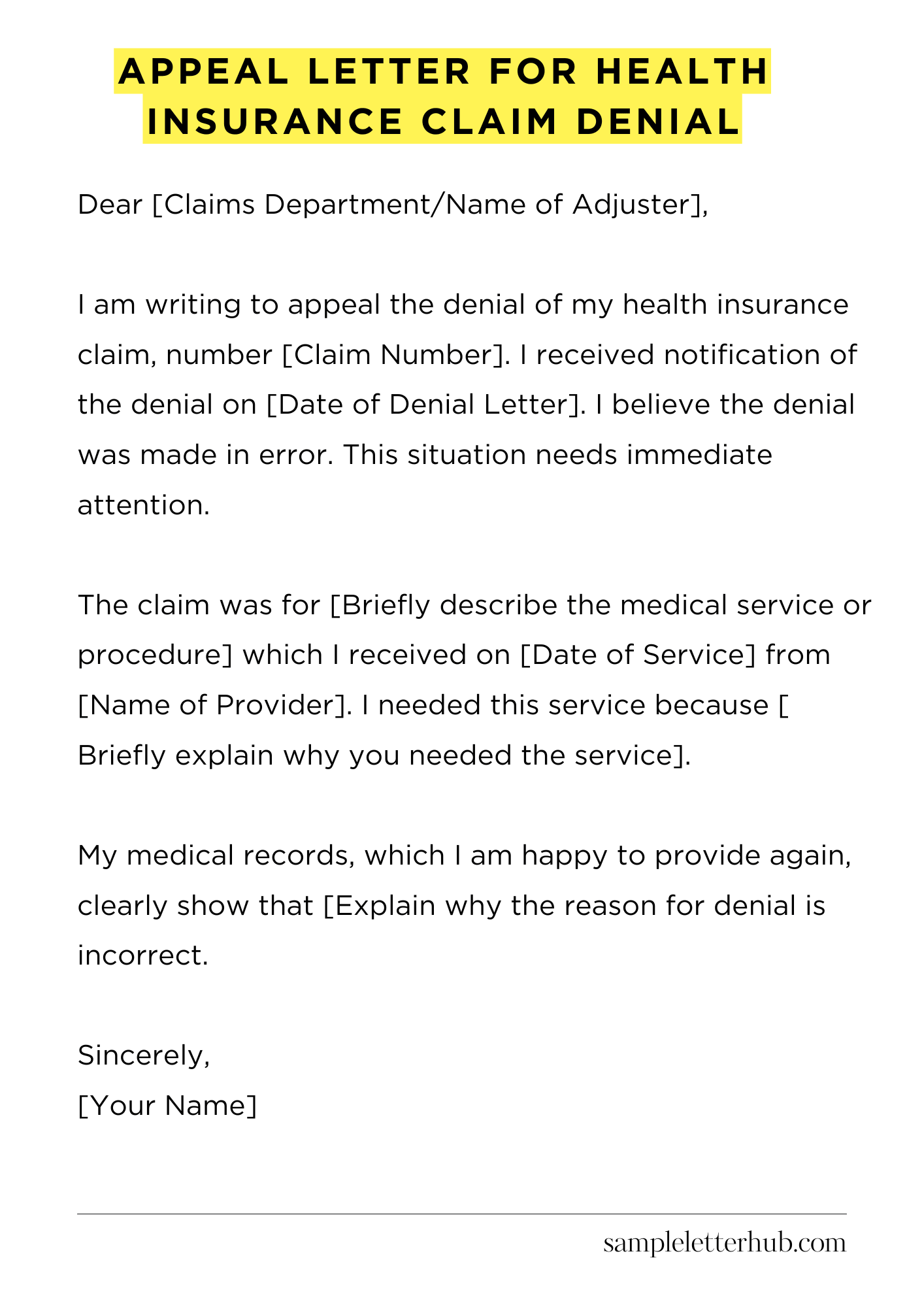
I am writing to appeal the denial of my health insurance claim, number [Claim Number]. I received notification of the denial on [Date of Denial Letter]. I believe the denial was made in error. This situation needs immediate attention.
The claim was for [Briefly describe the medical service or procedure] which I received on [Date of Service] from [Name of Provider]. I needed this service because [ Briefly explain why you needed the service]. The denial letter stated the reason for the denial was [State the reason given by the insurance company]. However, this is not accurate.
My medical records, which I am happy to provide again, clearly show that [Explain why the reason for denial is incorrect. Be specific and factual. Refer to the specific medical necessity or your policy details]. Consider this information carefully.
I have attached copies of [List any documents you are including, e.g., medical records, doctor’s notes, proof of pre-authorization, etc.]. They provide further evidence of the medical necessity of this treatment. These documents show a clear picture of my health needs.
I kindly request that you review my claim again. Please consider all the information I have provided. The medical service in question was absolutely necessary for my health and well-being. A favorable outcome would be greatly appreciated.
I would appreciate a prompt response to this appeal. Please let me know your decision as soon as possible. My health is important to me, and timely resolution of this is critical. You can reach me at the above address or phone number.
Thank you for your time and consideration.
Sincerely,
[Your Name]
How to Write Appeal Letter for Health Insurance Claim Denial
Receiving a denial for a health insurance claim can be disheartening, to put it mildly. However, this is not the ultimate end. You have recourse: the appeal letter. This crucial document is your advocate, your instrument, in challenging the insurer’s decision. Crafting a persuasive appeal letter takes deliberation and precision. Let’s delve into the process.
1. Understand the Denial – Deconstruct the Rejection Rationale
Before you begin the writing process, thoroughly examine the denial notice. Scrutinize the reasons for rejection. Insurance companies often cite specific clauses, pre-existing condition exclusions, or lack of medical necessity as grounds. Decipher the rationale. Pinpoint the precise grounds upon which the denial rests.
This constitutes the very nucleus of your counter-argument. Note the specific policy sections referenced and any procedural requirements for appeal, such as deadlines.
2. Gather Pertinent Documentation – Amass Your Evidential Arsenal
Your appeal letter is only as good as the supporting evidence. Gather all the documentation relevant to your case. This includes medical records, physician’s notes, lab results, billing statements, and any other evidence that bolsters your claim’s validity. Ensure your documentation is meticulously organized and easily accessible.
Obtain corroborating evidence from your healthcare provider. A letter from your physician explicitly supporting the medical necessity of the treatment is often crucial and carries considerable weight.
3. Compose a Clear and Concise Opening – Frame Your Case Persuasively
The opening paragraph is your opportunity to grab the reader’s attention and establish the tone. State your purpose immediately – to appeal the denial of a specific claim. Include essential information: your name, policy number, claim number, and the date of service. Concisely summarize the nature of the claim and the treatment received.
Express your disagreement with the denial in a professional and respectful manner. Avoid being acrimonious or excessively emotional. Focus on presenting a clear, concise, and compelling narrative.
4. Address the Denial Reason Directly – Combat the Impediment
This is the crux of your appeal. Address each reason cited for the denial directly. Counter the insurance company’s assertions with well-reasoned arguments, supported by the evidence you’ve gathered.
If the denial hinges on a specific policy exclusion, explain why it doesn’t apply to your situation. If the denial concerns medical necessity, provide a detailed explanation of why the treatment was, in fact, necessary, based on your medical condition and the physician’s recommendations.
Clearly connect your evidence to the denial reason, building a strong case for reconsideration.
5. Present Your Medical Justification – Substantiate the Merit
Devote a significant portion of your letter to providing a compelling medical justification for the treatment. Explain your medical condition in detail, using precise medical terminology (while still keeping it understandable). Elaborate on the symptoms, the severity of your illness, and the diagnostic process.
Explain how the denied treatment was instrumental in improving your health, alleviating symptoms, and preventing further complications. Reference the treatment guidelines and protocols relevant to your condition. Include quotes or excerpts from your physician’s notes that directly support the claim’s medical necessity.
6. Conclude with a Call to Action and a Professional Demeanor – Finalise the Appeal
Reiterate your appeal and state your desired outcome. Specifically request that the insurance company overturn the denial and authorize the payment of the claim.
Clearly state any deadlines or requirements for a response. Express your willingness to provide further information if necessary. End your letter with a polite but firm closing. Maintain a professional tone throughout.
Your appeal letter is a legal document; therefore, use proper grammar, spelling, and punctuation. Sign the letter and ensure you maintain a copy for your records.
7. Submission and Follow-Up – Ensure Your Plea is Received
Carefully review your letter before submitting it. Proofread for any errors.
Make sure you include all the required documentation. Send the letter via certified mail with return receipt requested to provide proof of delivery and the date it was received. Keep track of all communication, including copies of the letter, the receipt, and any responses from the insurance company.
If you don’t receive a response within the stipulated timeframe, follow up with the insurance company. If the appeal is denied, evaluate your options, which might include an internal review, an external review, or arbitration. Remember, tenacity is your ally in this process.
FAQs about Appeal Letter for Health Insurance Claim Denial
What is an appeal letter for a health insurance claim denial, and why is it important?
An appeal letter is a formal document you submit to your health insurance provider to challenge a decision denying coverage for a medical service, treatment, or prescription.
It’s crucial because it’s your primary means of contesting the denial and potentially securing coverage for necessary healthcare. Without appealing, you’re likely to be responsible for the full cost of the denied service.
What information should be included in an appeal letter for a denied health insurance claim?
A comprehensive appeal letter should include: your name, policy number, the claim number, a clear explanation of the denial, the specific service or item denied, supporting medical documentation (reports, test results, physician statements), a detailed explanation of why you believe the denial is incorrect (referencing policy terms).
What are the different types of health insurance claim appeal processes, and how do they work?
There are typically two main types of appeals: Internal and External. An internal appeal involves requesting a review from your insurance company itself. You’ll submit your appeal letter and supporting documents to them. If the internal appeal is denied, you may pursue an external appeal.
This involves submitting your case to an independent third-party reviewer or regulatory body. Both types have specific timelines and requirements that you must adhere to.
What are the common reasons for health insurance claim denials, and how can I address them in an appeal letter?
Common denial reasons include: lack of medical necessity, pre-existing conditions, experimental treatments, not following plan rules, and incorrect coding. In your appeal letter, address the specific denial reason. For example, if it’s medical necessity, provide medical documentation supporting the need.
If it’s a pre-existing condition, clarify the details of the pre-existing conditions. If it’s a procedural issue, make sure to show compliance with the insurance plan’s rules. If it’s coding error, provide the correct coding.
What are the deadlines for submitting an appeal letter, and what happens if I miss the deadline?
Health insurance companies have specific deadlines for submitting appeals, usually within 60 to 180 days of receiving the denial notice.
These deadlines are crucial; missing them can result in your appeal being rejected outright. Always refer to your denial notice for the exact deadline. If you miss the deadline, you may lose your right to appeal, and you’ll likely be responsible for the full cost of the denied services.
Related:
Resignation letter due to rude boss
Resignation letter moving to another state
Resignation letter due to illness of family member
Resignation letter due to study