

A fire can cause devastating damage. Your insurance policy is supposed to help. Sometimes, insurance companies deny fire damage claims. An appeal letter for fire damage claim denial is how you fight back. Its purpose is to overturn the denial. It asks the insurer to reconsider their decision.
This article is your guide to writing a winning appeal. We understand the stress of claim denials. That’s why we’re sharing appeal letter templates. We also include ready-made examples and samples. Use these fire damage claim denial appeal letter resources. Make the process easier.
These sample letters offer a great starting point. Customize them for your unique situation. This will boost your chances of success. Let’s get you back on track to getting your fire damage claim approved!
[Your Name]
[Your Address]
[Your Phone Number]
[Your Email Address]
[Date]
[Insurance Company Name]
[Insurance Company Address]
Subject: Appeal Regarding Fire Damage Claim – Policy Number [Your Policy Number]
Dear Claims Department,
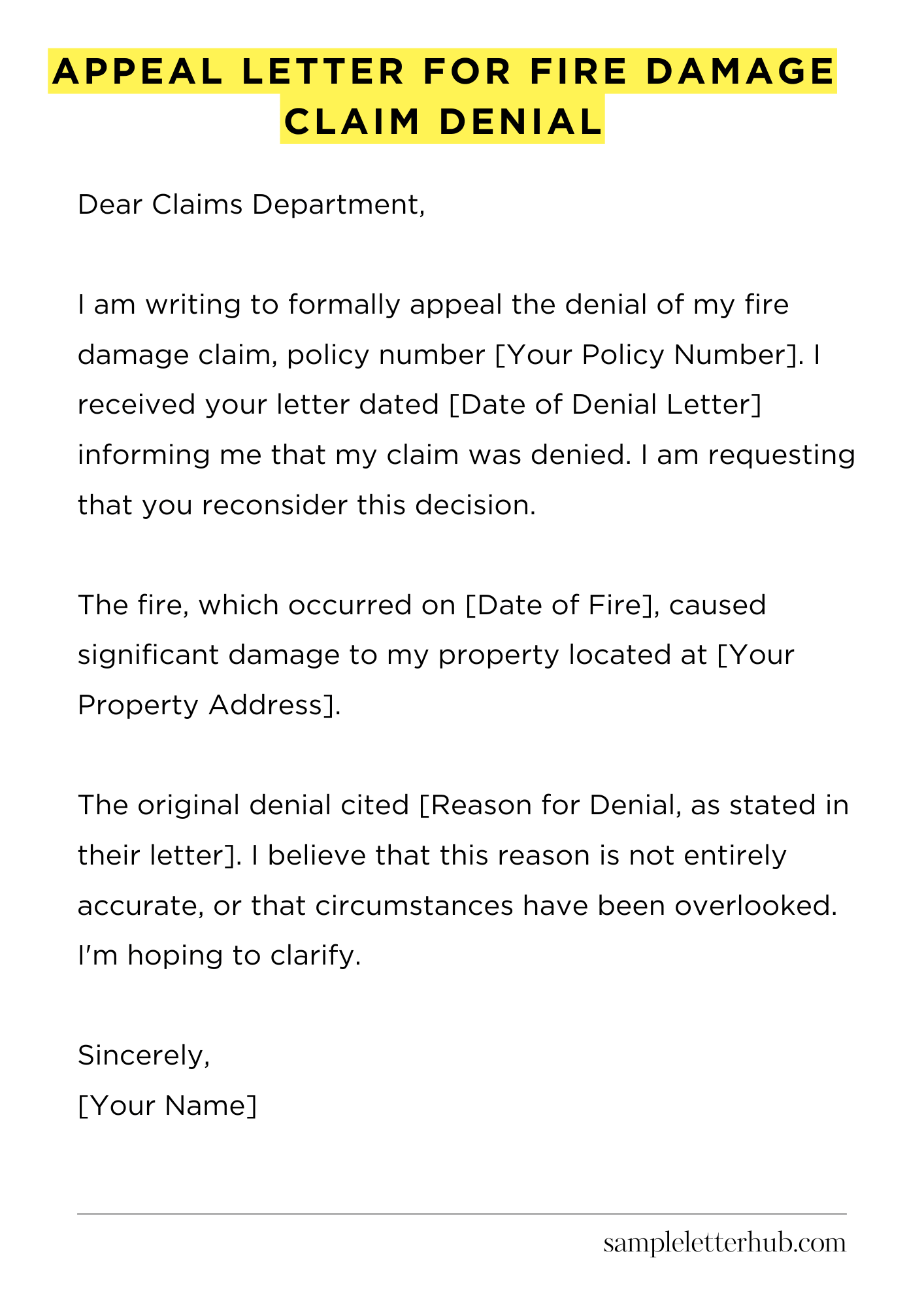
I am writing to formally appeal the denial of my fire damage claim, policy number [Your Policy Number]. I received your letter dated [Date of Denial Letter] informing me that my claim was denied. I am requesting that you reconsider this decision.
The fire, which occurred on [Date of Fire], caused significant damage to my property located at [Your Property Address]. It was a devastating event. I promptly reported the incident and submitted all required documentation as requested.
The original denial cited [Reason for Denial, as stated in their letter]. I believe that this reason is not entirely accurate, or that circumstances have been overlooked. I’m hoping to clarify.
Firstly, [Explain the first point disputing their reason for denial. Be clear and concise. Provide evidence if possible. Use 2-3 sentences max]. The situation needs further explanation.
Secondly, [Explain the second point disputing their reason for denial. Again, be brief and factual. Support your claim]. This is a crucial detail to consider.
I have attached [List of attachments, e.g., photos, witness statements, repair estimates]. These documents further support my claim and demonstrate the extent of the damages. They should help you reassess the case.
I have been a loyal customer of [Insurance Company Name] for [Number] years. I have always paid my premiums on time and have never had a previous claim denied. I believe this claim is valid.
I kindly request that you review my claim again, taking into account the information I have provided and the attached documentation. Please contact me at your earliest convenience to discuss this matter further. I am available at the phone number listed above. I would appreciate a prompt response regarding this important issue.
Thank you for your time and consideration.
Sincerely,
[Your Name]
How to Write Appeal Letter for Fire Damage Claim Denial
A fire can be devastating, leaving a trail of destruction and emotional upheaval. When your insurance claim for fire damage is denied, it’s not the end of the line. You have the right to appeal this decision, and crafting a compelling appeal letter is crucial. This guide provides a comprehensive roadmap for navigating this challenging process, ensuring you present your case effectively.
1. Scrutinizing the Denial: Unearthing the Underpinnings
The first step is a meticulous review of the denial letter. Scrutinize every word. Carefully dissect the reasons provided by the insurance company for rejecting your claim. What specific policy provisions are cited?
Are there factual inaccuracies, misinterpretations, or omissions in their assessment? Look for the *casus belli* – the stated reason for denial – and highlight it. Understanding their reasoning is paramount to formulating a robust counter-argument. You must address each point with precision.
2. Gathering Your Arsenal: Assembling Supporting Documentation
An effective appeal letter relies on concrete evidence. Compile all pertinent documentation to buttress your case.
This includes, but isn’t limited to: the original insurance policy, photographic evidence of the damage (before and after the fire), fire department reports, estimates from contractors, receipts for damaged or destroyed property, and any other correspondence with the insurance company.
Organize this information meticulously; your presentation needs to be both clear and comprehensive. This documentation forms the bedrock of your appeal.
3. Structuring Your Argument: Crafting a Persuasive Narrative
Your appeal letter is your opportunity to narrate your side of the story. Begin with a clear and concise introduction, restating the claim’s specifics and the reason for the denial.
Then, directly address each reason for denial cited by the insurance company. For each, provide a counter-argument backed by factual evidence from your supporting documents.
A well-structured argument builds a compelling case; avoid tangential discussions. Stay focused and keep it relevant. Your goal is to dismantle the insurance company’s reasoning.
4. Addressing Policy Exclusions and Limitations: Circumventing the Pitfalls
Insurance policies are riddled with exclusions and limitations. Identify any such provisions the insurance company might be leveraging to deny your claim. If possible, argue why the exclusion doesn’t apply to your specific situation.
This could involve demonstrating that the cause of the fire falls outside the exclusion, or that the exclusion is ambiguous and should be interpreted in your favor (known as the doctrine of *contra proferentem*). This step may require legal guidance.
5. Presenting Your Case: The Art of Persuasion
The language you use in your appeal letter is vital. Maintain a professional and respectful tone, even if you disagree vehemently with the denial. Be clear, concise, and persuasive. Avoid accusatory language or emotional outbursts.
Instead, present your facts in a logical and organized manner. Use strong verbs, descriptive adjectives, and persuasive language. Let the evidence speak for itself. Your demeanor needs to inspire confidence in your case.
6. Requesting Reconsideration and Remedy: Demanding Justice
Clearly state your desired outcome in the conclusion of your letter. Request that the insurance company reconsider its denial and approve your claim. Outline the specific amount of compensation you are seeking.
Provide a reasonable timeframe for a response. Reiterate your commitment to resolving this matter amicably. A compelling conclusion will ensure the reader understands your position and desires.
7. Seeking Professional Counsel: Navigating the Complexities
Dealing with insurance companies can be complex, and a denied fire damage claim can quickly become a legal quagmire. Consider consulting with an attorney experienced in insurance disputes.
An attorney can review your policy, analyze the denial, and provide invaluable guidance on the best course of action. They can also represent you in negotiations or litigation, increasing your chances of a successful appeal. Their expertise is a valuable asset.
FAQs about Appeal Letter for Fire Damage Claim Denial
What is the primary purpose of an appeal letter for a fire damage claim denial?
The primary purpose of an appeal letter is to formally request a reconsideration of the insurance company’s decision to deny your fire damage claim. It provides an opportunity to present additional information, contest the reasons for denial, and advocate for the reversal of the initial decision.
What key information should be included in an appeal letter?
An effective appeal letter should include: your policy information (policy number, etc.), the date of the denial, a clear statement of your disagreement with the denial, a detailed explanation of why the denial is incorrect (with supporting evidence such as photos, videos, expert reports, etc.)
What are common reasons for fire damage claim denials, and how can they be addressed in an appeal?
Common reasons for denial include: arson or intentional damage, lack of coverage (e.g., specific exclusions in the policy), pre-existing damage, and insufficient documentation.
To address these, you must provide compelling evidence to disprove the reason for denial. For example, if arson is suspected, present evidence from the fire department or investigation proving accidental causes. If it is coverage related, show why the exclusion does not apply to your situation, and provide additional documentation if needed.
What is the importance of deadlines when appealing a fire damage claim denial?
Insurance policies typically set deadlines for filing appeals, usually 30-60 days. Missing this deadline can result in the loss of your right to appeal, regardless of the validity of your claim.
Carefully review your denial letter for appeal deadlines and adhere to them. If you need more time, request an extension in writing and provide a reason why you need an extension.
Should I consult with legal or insurance professionals before writing an appeal letter?
Consulting with an attorney or public adjuster who specializes in insurance claims is highly advisable.
They can review your policy, the denial letter, and your supporting documentation to provide expert guidance on the strengths and weaknesses of your claim, the most effective arguments to present, and help to ensure the appeal letter is thorough and legally sound. Their experience can significantly improve your chances of a successful appeal.
Related:
Resignation letter due to rude boss
Resignation letter moving to another state
Resignation letter due to illness of family member
Resignation letter due to study