


Facing a disability insurance denial is stressful. An appeal letter is your chance to fight back. It’s a formal document. You use it to challenge the insurance company’s decision. The goal is to get your disability benefits approved.
Writing an appeal letter for disability insurance denial can feel overwhelming. Don’t worry, we’re here to help. We’ll share appeal letter templates. You’ll find examples and samples. Use these disability appeal letter samples to create your own.
Our sample appeal letters are easy to adapt. They cover different scenarios. Whether it is your long term disability claim or short term disability claim denial, we’ve got you covered. Craft your appeal letter confidently. Get ready to win your benefits.
[Your Name]
[Your Address]
[Your Phone Number]
[Your Email Address]
[Date]
Disability Insurance Company
[Insurance Company Address]
Subject: Appeal for Disability Insurance Claim Denial – Policy Number [Your Policy Number]
Dear Sir/Madam,
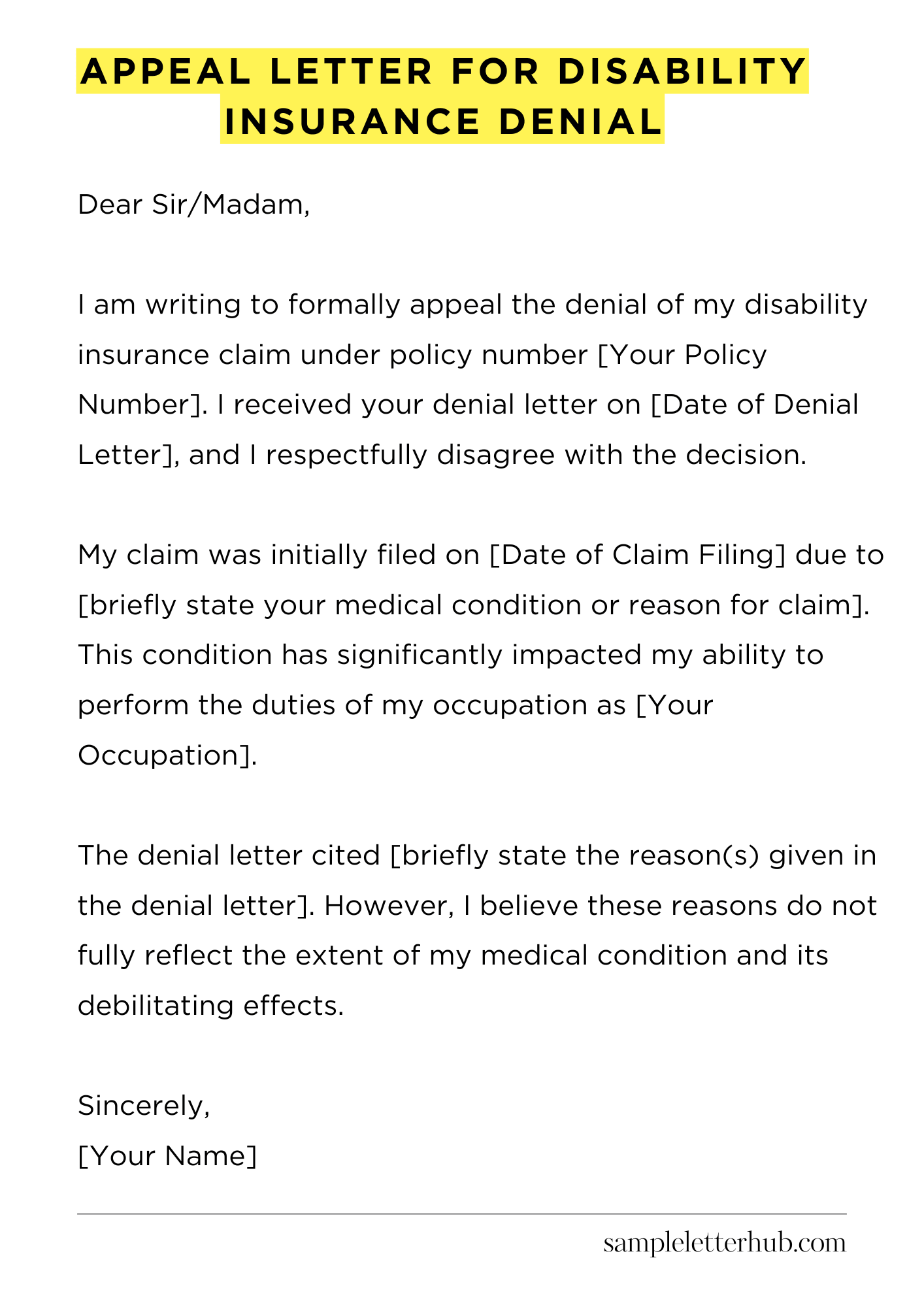
I am writing to formally appeal the denial of my disability insurance claim under policy number [Your Policy Number]. I received your denial letter on [Date of Denial Letter], and I respectfully disagree with the decision.
My claim was initially filed on [Date of Claim Filing] due to [briefly state your medical condition or reason for claim]. This condition has significantly impacted my ability to perform the duties of my occupation as [Your Occupation]. The severity of the condition has made it difficult, if not impossible, for me to work in my previous capacity.
The denial letter cited [briefly state the reason(s) given in the denial letter]. However, I believe these reasons do not fully reflect the extent of my medical condition and its debilitating effects.
My medical records, which I previously submitted with my claim, provide comprehensive documentation supporting my disability. They clearly show the limitations I experience daily.
I am attaching additional supporting documentation, including updated medical reports from [Doctor’s Name/Specialty] and [Doctor’s Name/Specialty], which further substantiate my claim. These new reports include [briefly mention what the new reports contain, e.g., updated diagnoses, specific functional limitations].
I understand that the review process is thorough, and I am confident that a reevaluation of my case, considering the new information, will lead to a different conclusion. My goal is to receive the disability benefits I am entitled to under my policy. This financial support is crucial for me during this challenging time.
I request that you reconsider my claim and provide a positive outcome. I am available to answer any questions or provide further documentation that you may require. Please contact me at your earliest convenience to discuss this matter further.
Thank you for your time and consideration. I look forward to your positive response.
Sincerely,
[Your Name]
How to Write an Appeal Letter for Disability Insurance Denial
Receiving a denial for your disability insurance claim can be a disheartening experience. However, a denial is not necessarily the final word. You have the right to appeal the decision.
This is where your meticulously crafted appeal letter comes into play. It is your opportunity to persuade the insurance company to reconsider their stance, providing them with compelling evidence and arguments.
1. Understanding the Denial and Gathering Imperative Documentation
Before you begin penning your appeal, the first step is to thoroughly examine the denial letter. Scrutinize the reasons cited for the rejection. What specific information or documentation did they deem insufficient? Pinpoint the lacunae, the areas where they found your claim lacking.
Simultaneously, amass all pertinent documentation. This encompasses medical records, physician statements, test results, and any other evidence that buttresses your claim. Think of this as your ammunition, your arsenal of proof.
2. Crafting a Compelling Salutation and Introductory Statement
Begin your letter with a formal, yet professional salutation. Address it to the specific claims adjuster or the appeals department, if known. In the introductory paragraph, succinctly state the purpose of your letter: to appeal the denial of your disability insurance claim. Briefly reiterate the date of your initial claim and the policy number for easy reference.
Concisely state that you disagree with the denial and that you are providing further information to elucidate your disability and its impact on your ability to work.
3. Presenting a Cogent Narrative of Your Disability
Here, you need to articulate a lucid, detailed account of your disability. Avoid technical jargon unless absolutely necessary. Instead, tell your story in a way that is easily understood.
Describe the onset of your condition, the symptoms you experience, and how they affect your daily life and your ability to perform the duties of your occupation. Include specific examples.
How does your condition prevent you from working? Be explicit and emphatic, leaving no room for ambiguity. This is where you bring your disability to life for the reader.
4. Addressing the Insurer’s Specific Reasons for Denial
This section is crucial. Directly address each reason the insurance company provided for denying your claim. If they stated a lack of medical evidence, present the relevant records, highlighting specific findings that substantiate your condition.
If they claimed you were not disabled, explain why their assessment is incorrect, and provide counter-evidence, such as limitations from your physician. Systematically dismantle their arguments, one by one. This demonstrates you’ve done your homework.
5. Providing Supporting Medical Evidence and Expert Opinions
This is where you marshal your scientific support. Include copies of all relevant medical records, test results, and physician statements. Organize these documents in a logical manner, with clear headings and labels.
Obtain a written statement from your treating physician(s), explicitly outlining your diagnosis, prognosis, treatment plan, and the functional limitations imposed by your condition. If possible, seek a supporting opinion from a specialist. Such expert testimony can greatly strengthen your appeal.
6. Highlighting the Impact on Your Ability to Perform Essential Job Functions
Focus specifically on how your disability prevents you from performing the essential duties of your occupation.
Provide detailed descriptions of those duties and explain, with clarity, how your symptoms and limitations render you incapable of fulfilling them. If necessary, provide a functional capacity evaluation (FCE) that shows what you can and cannot do. This section directly addresses the core issue of the claim—your ability to work.
7. Concluding Your Appeal with a Strong Call to Action
In your concluding paragraph, reiterate your request for the insurer to reverse their decision and approve your claim. State that you have provided all necessary evidence and information to substantiate your disability and your entitlement to benefits.
Express your unwavering belief in the validity of your claim and your commitment to securing the benefits you deserve. Include your contact information.
End with a polite, yet assertive closing, such as “Sincerely,” or “Respectfully,” followed by your name and signature. Remember to retain a copy of the entire letter and all accompanying documents for your records. The perseverance in this process is important.
FAQs about Appeal Letter for Disability Insurance Denial
What is the primary purpose of an appeal letter for disability insurance denial?
The primary purpose of an appeal letter is to formally challenge the insurance company’s decision to deny your disability claim. It aims to persuade the insurer to reconsider their denial by presenting additional evidence, clarifying information, and arguing why you meet the policy’s definition of disability.
The ultimate goal is to overturn the denial and secure the disability benefits you are entitled to.
What key information should be included in an appeal letter?
An effective appeal letter should include several key components. It should start with a clear reference to the original denial letter, including the claim number and denial date.
It must provide detailed explanations addressing the reasons the insurance company gave for the denial, offering counterarguments and presenting supporting evidence, such as medical records, doctor’s opinions, and vocational assessments. The letter should also clearly state the specific benefits you are seeking.
What types of evidence are most helpful to include with an appeal letter?
Compelling evidence is crucial to a successful appeal. This often includes detailed medical records documenting your diagnosis, treatment, and functional limitations. Statements from your treating physicians outlining the impact of your condition on your ability to work are very important.
Any relevant medical tests, imaging reports, and witness statements from colleagues, friends, or family members who can speak to your limitations can be added as well. If applicable, vocational assessments from a specialist can demonstrate how your medical condition prevents you from performing your job or any other job.
What is the typical timeframe for filing an appeal, and what happens if I miss the deadline?
The timeframe for filing an appeal is strictly defined by your disability insurance policy and the insurance company’s instructions. Usually, the appeal period ranges from 60 to 180 days from the date of the denial letter. It is critical to adhere to this deadline; otherwise, you may forfeit your right to appeal.
If you miss the deadline, your options for challenging the denial may be limited, potentially requiring a new claim or legal action.
Should I seek legal counsel when appealing a disability insurance denial?
Whether to seek legal counsel depends on the complexity of your case, the amount of benefits at stake, and your comfort level with the appeals process.
An attorney specializing in disability insurance can help you understand your rights, gather evidence, draft a strong appeal letter, and represent you if the appeal is denied and legal action becomes necessary. They have expertise in navigating the intricacies of insurance policies and legal procedures.
Related:
Resignation letter due to rude boss
Resignation letter moving to another state
Resignation letter due to illness of family member
Resignation letter due to study