


Dealing with a denied warranty claim can be frustrating. An appeal letter for denied warranty claim is your chance to fight back. It’s a formal document you send to the warranty provider. Its purpose? To convince them to reconsider their decision and honor your warranty. You’re essentially stating your case.
This article is your guide to writing a compelling appeal. We’ve got you covered. We’ll share appeal letter examples, appeal letter templates, and sample appeal letters. You can use them to craft your own winning letter. These tools will help you. They make the writing process much easier.
We understand the process can seem daunting. That’s why we’ve simplified things. Our resources are designed for easy use. Use our samples for a strong start. Get your denied warranty claim reviewed again. Let us help you get what you deserve.
[Your Name]
[Your Address]
[Your Phone Number]
[Your Email Address]
[Date]
[Warranty Company Name]
[Warranty Company Address]
Dear Sir/Madam,
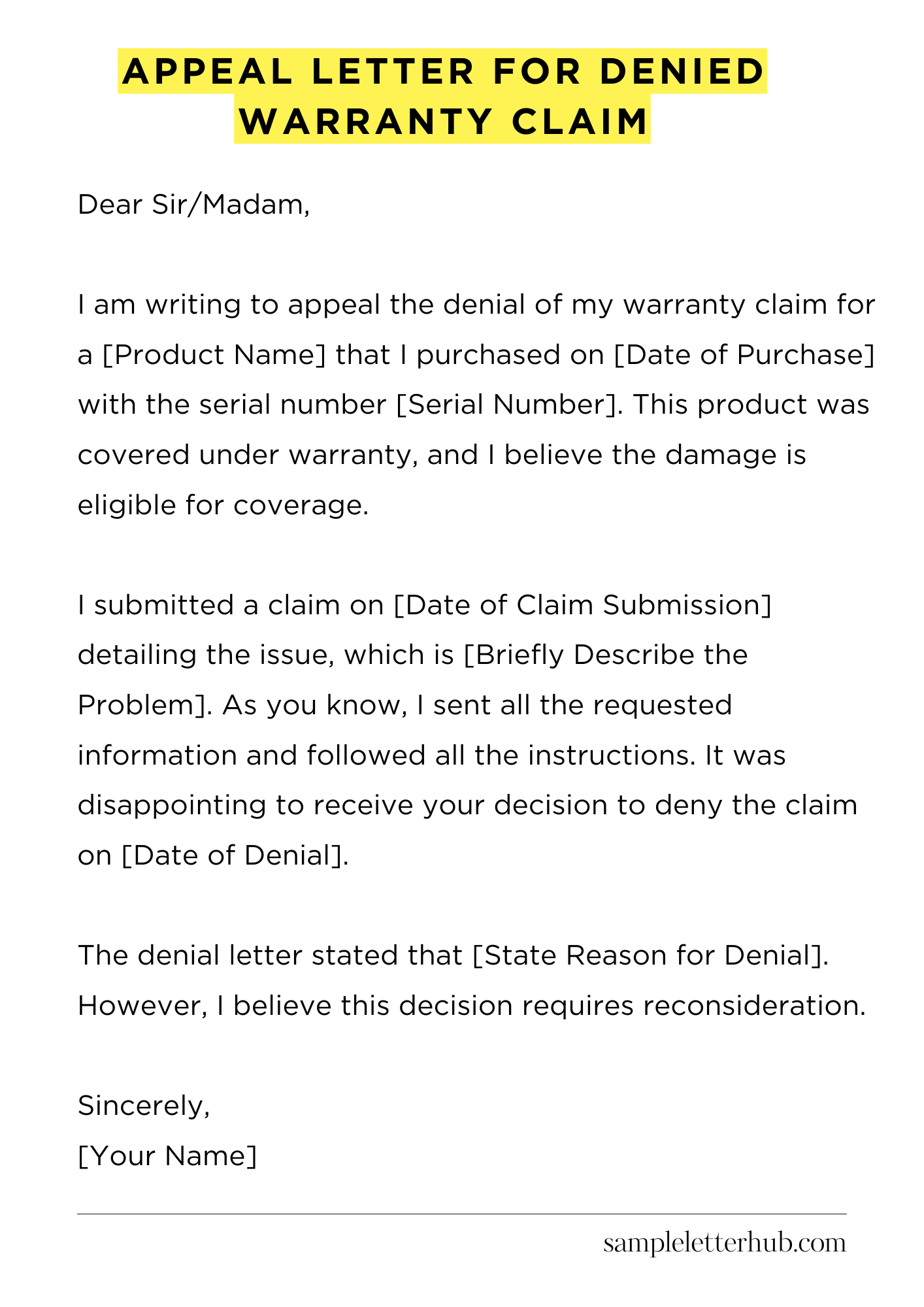
I am writing to appeal the denial of my warranty claim for a [Product Name] that I purchased on [Date of Purchase] with the serial number [Serial Number]. This product was covered under warranty, and I believe the damage is eligible for coverage.
I submitted a claim on [Date of Claim Submission] detailing the issue, which is [Briefly Describe the Problem]. As you know, I sent all the requested information and followed all the instructions. It was disappointing to receive your decision to deny the claim on [Date of Denial].
The denial letter stated that [State Reason for Denial]. However, I believe this decision requires reconsideration. The problem I am experiencing aligns with the terms of my warranty.
Specifically, the warranty document states that [Quote a relevant section of the warranty that supports your claim]. My situation directly relates to this clause. It clearly covers the type of failure that occurred with my product.
I have included [List any supporting documentation, e.g., photos, videos, repair estimates]. These documents further illustrate the nature of the damage and why it falls under warranty.
I kindly request that you review my claim again with the provided information. I am confident that upon further examination, you will find that the damage is covered by my warranty. Resolving this issue promptly would be greatly appreciated.
Thank you for your time and attention to this matter. I look forward to your positive response and resolution of this claim. I hope we can resolve this matter amicably.
Sincerely,
[Your Name]
How to Write Appeal Letter for Denied Warranty Claim
A warranty claim denial can be frustrating, but a well-crafted appeal letter can often reverse the decision. It is an opportunity to advocate your case and bring forth the necessary proof, resulting in a favorable outcome. Follow these steps to maximize your chances of success.
1. Commence with Decorum and Identification
Begin your appeal with a formal salutation, addressing the appropriate representative or department. State your full name, address, and contact information.
Moreover, include the original claim number, the product’s model number, and the date the warranty claim was initially submitted. This preliminary section establishes your identity and provides essential context. Be precise and clear.
2. Articulate the Grievance with Clarity
This is where you clearly and concisely state why you are disputing the denial. Avoid superfluous language and emotional outbursts. The main purpose is to present your case logically. Specify the reason for the initial warranty claim, then detail why you believe the denial is unjustified.
For instance, did the denial stem from a perceived user error? Was it from the product’s intended use? Provide specific details and cite the warranty’s terms and conditions you believe have been misinterpreted.
3. Furnish Supporting Empirical Evidence
Here’s the crux of your appeal. Gather all supporting documentation. This may encompass purchase receipts, warranty documentation, service records, and any evidence that corroborates your claim.
Photographs or videos illustrating the product’s defect or malfunction can be compelling, particularly if the defect is visually evident. Organize your evidence meticulously, and cross-reference each piece with your claims in the body of the letter. Be thorough, and leave no stone unturned.
4. Analyze the Warranty Denial’s Rationale
Carefully review the denial letter to understand the specific reasons for rejection. Acknowledge and address each reason head-on, providing a counter-argument backed by your evidence.
If the denial cites improper use, rebut the assertion with facts. If the denial references a specific clause in the warranty, provide a reasonable interpretation to suggest why the clause does not apply to your situation. This shows your deep understanding of the situation.
5. Reference Pertinent Warranty Stipulations
Directly quote and refer to the relevant clauses in the warranty agreement that support your claim. Explain how the defect or malfunction falls under the warranty’s coverage.
Highlight the section that covers the type of issue you’re experiencing. Use this section to showcase the validity of your argument. This demonstrates to the manufacturer that you are well informed.
6. Propose a Pragmatic Resolution
Clearly state what you seek as a resolution. Do you want a repair, a replacement, or a refund? Be specific. If you’re willing to accept alternatives, state them. Indicate the desired outcome in the most professional manner. Your clarity on this issue will help the manufacturer resolve it fast.
7. Conclude with a Professional Closing
End your letter with a polite and professional closing, such as “Sincerely” or “Respectfully.” Reiterate your name and contact information. Also, consider including a sentence expressing your hope for a favorable resolution. Proofread your entire letter meticulously before sending it.
Errors can undermine your credibility. The letter should be free of grammatical errors and typos. Finally, send the letter via certified mail with a return receipt requested to ensure proof of delivery. Good luck, and may your appeal be granted.
FAQs about Appeal Letter for Denied Warranty Claim
What is the primary purpose of an appeal letter for a denied warranty claim?
The primary purpose of an appeal letter is to formally challenge a warranty claim denial and provide additional information or evidence to support the original claim. This aims to persuade the warranty provider to reconsider their decision and approve the requested service, repair, or replacement.
What key information should be included in an appeal letter?
An effective appeal letter should include: the original claim details (claim number, product information, date of purchase); a clear explanation of why the denial is being disputed; detailed evidence supporting the claim (photos, repair records, expert opinions).
What are common reasons for warranty claim denials, and how should these be addressed in the appeal?
Common denial reasons include: product misuse or damage not covered by the warranty; failure to follow proper maintenance procedures; the warranty period has expired.
Addressing these requires a specific response: for misuse, provide evidence demonstrating proper usage; for maintenance failures, provide documentation of proper maintenance; for the expired warranty period, verify the warranty coverage by providing proof of purchase and warranty terms.
How can I increase the chances of a successful appeal?
To increase your chances, be thorough and organized. Provide all supporting documentation, clearly explain the issue, and reference specific clauses in the warranty that support your claim.
Maintain a polite and professional tone. Consider seeking professional advice or assistance if the claim involves a significant amount of money or is complex.
What should I do if my appeal is denied?
If your appeal is denied, consider your options. You might have the option for further internal appeal processes outlined by the warranty provider, or you could pursue mediation, arbitration, or legal action, depending on the circumstances, the value of the claim, and your rights outlined in the warranty and any applicable laws. Document all communications and decisions thoroughly.
Related:
Resignation letter due to rude boss
Resignation letter moving to another state
Resignation letter due to illness of family member
Resignation letter due to study