

An “Analista resignation letter” is a formal document. It is written by an analyst. The purpose? To officially inform their employer of their decision to leave their job. It’s the first step in moving on to a new opportunity. It should be concise and professional.
Need to resign from your analyst role? This article is for you. We understand writing these letters can be tricky. We have you covered.
We’ll share helpful letter samples. These templates will simplify the process. They’re designed to make writing your resignation as straightforward as possible.
Analista Resignation Letter
Below is a sample of a Analista Resignation Letter:
[Your Name]
[Your Address]
[Your Phone Number]
[Your Email Address]
[Date]
[Hiring Manager Name] (If known, otherwise use title)
[Hiring Manager Title]
[Company Name]
[Company Address]
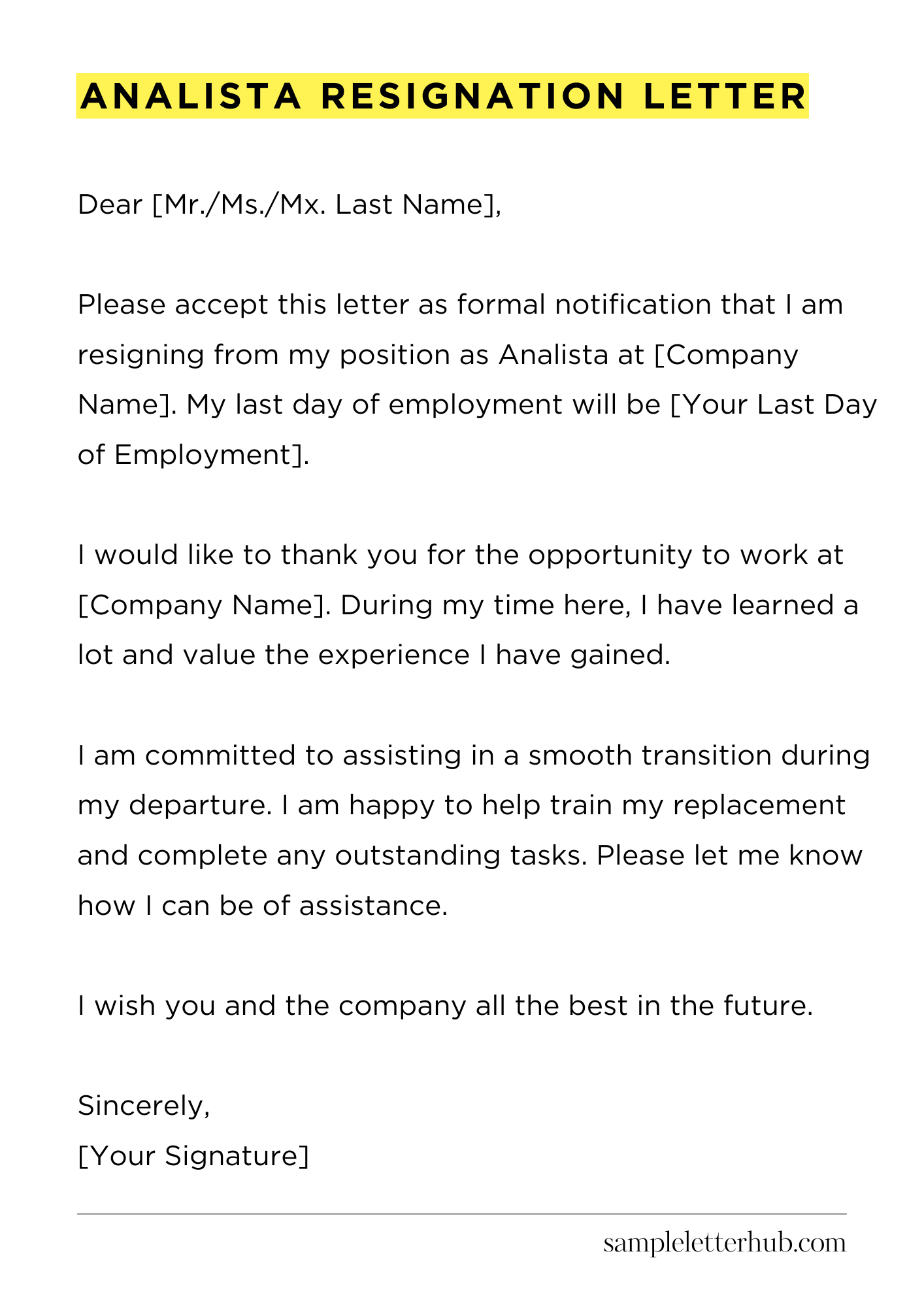
Dear [Mr./Ms./Mx. Last Name],
Please accept this letter as formal notification that I am resigning from my position as Analista at [Company Name]. My last day of employment will be [Your Last Day of Employment].
I would like to thank you for the opportunity to work at [Company Name]. During my time here, I have learned a lot and value the experience I have gained.
I am committed to assisting in a smooth transition during my departure. I am happy to help train my replacement and complete any outstanding tasks. Please let me know how I can be of assistance.
I wish you and the company all the best in the future.
Sincerely,
[Your Signature]
How to Write an Analyst Resignation Letter
Leaving a job, especially one you’ve likely spent a good chunk of time in, can feel daunting. It’s essential to do it right. Your resignation letter is more than just a formality; it’s a critical document.
It shapes your final impression, which matters for future references and opportunities. Let’s break down how to craft an analyst resignation letter that’s both professional and effective.
1. Essential Components: What to Include
Every solid resignation letter needs key elements. Start with the date. Follow this with your name and current job title. Crucially, state your intent to resign, and make it very clear. Specify your last day of employment. This is important to avoid confusion and sets the clock. Express gratitude for the opportunity. This shows professionalism.
Offer assistance with the transition. Finally, include your contact information. This is very straightforward. You might need to be contacted about final details.
2. Formatting for Clarity and Impact
Formatting is key for a well-received letter. Keep it concise. A one-page letter is generally ideal. Use a professional font like Times New Roman or Arial. Keep the font size between 10 and 12 points. Use a standard letter format. You’ll want to address it to your direct supervisor or the appropriate HR representative.
Use clear and simple language, avoiding jargon or overly complicated phrasing. Proofread meticulously. Typos and grammatical errors don’t reflect well on anyone. Consider a formal tone throughout the letter.
3. Crafting the Content: Specific Phrases and Tone
Specific phrases can convey your message effectively. Instead of simply saying, “I quit,” try, “Please accept this letter as formal notification that I am resigning from my position as Analyst.” Express appreciation for the experience, for example, “I am grateful for the opportunities I have been given during my time at [Company Name].”
When offering assistance, state, “I am committed to ensuring a smooth transition and am happy to assist in any way possible to train my replacement.” Keep the tone positive and professional, even if your experience hasn’t always been positive.
Stick to the facts. Avoid negativity or complaints about your work. You are making an exit, and keeping it positive is to your advantage.
4. Addressing Common Questions and Scenarios
What if you’re unsure of your last day? Consult your employment contract or HR policies. Always adhere to the required notice period. What if you have to explain the reason for leaving? You are not generally required to disclose this. If you feel compelled to explain, keep it brief and positive.
Common reasons include “to pursue new opportunities,” or “to focus on personal and professional growth.” What if you’re leaving for a competitor? Avoid mentioning the competitor directly. Keep it about your career goals. Always prioritize confidentiality. This is often an important factor in your next role.
5. Final Touches and Review: Before You Submit
Before sending your resignation letter, take a final look. Read it aloud. Does it sound professional? Ask a trusted colleague or mentor to review it. They might spot errors or suggest improvements you missed. Ensure all the information is accurate and up-to-date. Keep a copy for your records.
Once submitted, that’s it! Be prepared for an exit interview, and be professional throughout the final stages of your employment. Your reputation matters. You want to leave with your professional standing intact. It’s about respecting the process and taking care of your future.
FAQs about Analista Resignation Letter
What is the primary purpose of an Analista resignation letter?
The primary purpose of an Analista resignation letter is to formally notify an employer of an employee’s intent to leave their position. It serves as a written record, providing a clear date of departure and formally ending the employment relationship. The letter is crucial for official documentation and initiates the offboarding process.
What key elements should be included in an Analista resignation letter?
Key elements include a clear statement of resignation, the specific date of the last day of employment, a brief expression of gratitude (optional but recommended), and any necessary information regarding the handover of responsibilities. It is also wise to include contact information for future communication.
Some may include a reason for leaving, though it’s not always necessary.
How should an Analista format their resignation letter?
An Analista resignation letter should be professional in tone and format. It typically begins with the date, followed by the employer’s and recipient’s information. The body should be concise and direct. The letter should be typed, well-formatted, and free of grammatical errors. Closing with a professional sign-off and your printed name is essential.
When is the best time to submit an Analista resignation letter?
The best time to submit an Analista resignation letter is when the employee is ready to leave and has all their plans arranged. As the employee is a professional, it is wise to hand it in person or as instructed by the employee handbook.
The letter should align with the notice period as stated in the employment contract. It’s often advisable to hand it in during a meeting with the supervisor or HR representative.
Can an Analista change their mind after submitting a resignation letter?
Yes, but it is at the discretion of the employer. Once submitted, a resignation letter is a formal declaration. If an Analista wishes to withdraw their resignation, they must communicate this intention immediately to their employer.
The employer is not obligated to allow the employee to retract the resignation. Approval would depend on company policy, the relationship with the employee, and the current business needs.
Related:
Resignation letter due to rude boss
Resignation letter moving to another state
Resignation letter due to illness of family member
Resignation letter due to study