

An Ambassador resignation letter is a formal document. It announces an Ambassador’s decision to leave their position. The letter serves as an official notice. It is sent to the appropriate authorities.
This article simplifies the process. We provide various templates. These are samples of Ambassador resignation letters. You can use them as a starting point. Need to write your own letter? We have got you covered.
Our examples help you articulate your message. Adapt the templates to fit your specific situation. Craft a clear and professional resignation letter with ease. Let’s dive in and start writing!
Ambassador Resignation Letter
Below is a sample of a Ambassador Resignation Letter:
[Your Name/Address]
[Your City, Postal Code]
[Your Email]
[Your Phone Number]
[Date]
[Recipient’s Name/Title]
[Embassy Address]
[City, Postal Code]
Dear [Recipient’s Name],
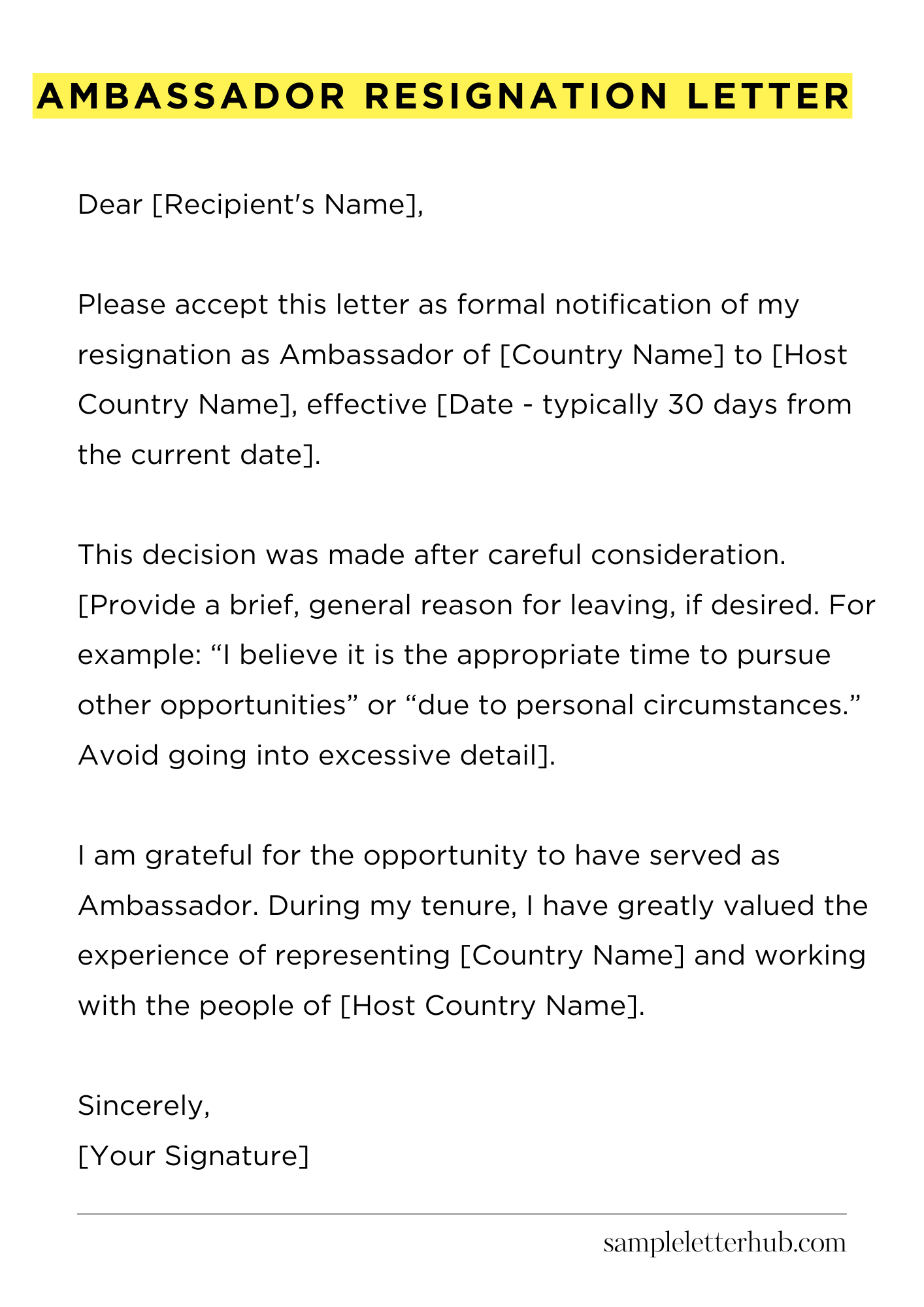
Please accept this letter as formal notification of my resignation as Ambassador of [Country Name] to [Host Country Name], effective [Date – typically 30 days from the current date].
This decision was made after careful consideration. [Provide a brief, general reason for leaving, if desired. For example: “I believe it is the appropriate time to pursue other opportunities” or “due to personal circumstances.” Avoid going into excessive detail].
I am grateful for the opportunity to have served as Ambassador. During my tenure, I have greatly valued the experience of representing [Country Name] and working with the people of [Host Country Name]. I am proud of the accomplishments we have achieved together.
I am committed to ensuring a smooth transition. I am available to assist in any way possible to facilitate the handover of my responsibilities.
I wish you, and the entire staff of the embassy, continued success in all your future endeavors.
Sincerely,
[Your Signature]
How to Write an Ambassador Resignation Letter
Serving as an ambassador is a significant responsibility. It involves representing a country, fostering international relations, and navigating complex diplomatic landscapes. But, what happens when it’s time to move on? Resigning from such a prestigious position requires careful consideration and a well-crafted letter.
A resignation letter isn’t just a formality; it’s a critical document that can impact your future opportunities and reflect on your service. Here’s a guide to help you compose a professional and effective resignation letter.
1. Start with the Basics: Formatting and Tone
First things first, let’s look at the structure. Your letter should begin with your contact information, followed by the date, and then the recipient’s information. This clarity is important.
Always address the letter to the appropriate authority – typically the Head of State or the Minister of Foreign Affairs. Keep the tone formal and respectful throughout. Remember, you’re leaving a high-profile position, and your professionalism should shine through.
Use a professional font, such as Times New Roman or Arial, and maintain a standard font size (12 points is generally suitable). Proofread meticulously. Typos and grammatical errors are unacceptable.
2. The Opening: Announcing Your Decision
The first paragraph clearly states your intention: to resign. Directly and unequivocally state that you are resigning from your position as Ambassador, specifying the date your resignation takes effect. Avoid ambiguity. For example: “I am writing to formally resign from my position as Ambassador of [Your Country] to [Host Country], effective [Date].” Keep it concise.
Avoid overly emotional language. Focus on the facts. This establishes a sense of authority.
3. Expressing Gratitude and Acknowledging Service
This is a crucial section. Acknowledge your tenure and express gratitude for the opportunity to serve. Highlight your accomplishments and express your appreciation for the people you’ve worked with. Mention any specific initiatives or successes you’re proud of. Acknowledge the support you received from the government and your staff.
For instance: “I am deeply grateful for the opportunity to have served as Ambassador for the past [Number] years. During this time, I have been privileged to [mention a specific achievement or two, e.g., strengthen bilateral relations, promote cultural exchange, etc.].
I am particularly proud of [mention another specific achievement]. I am also indebted to the dedicated team at the embassy and the unwavering support of the Ministry of Foreign Affairs.”
4. Providing a Reason (Optional)
You are not always required to give a specific reason for your resignation. However, depending on the circumstances, it may be appropriate to offer a brief explanation. If you choose to do so, keep it professional and straightforward. Do not engage in negativity or dwell on any issues.
Common reasons to include are: “To pursue new opportunities,” “To focus on family matters,” or “Due to personal reasons.” Avoid going into excessive detail. Focus on the positive.
If you are leaving due to a policy disagreement, for instance, you may be tempted to use strong language. Avoid that, even though you might want to. You can consult with a lawyer on the language. A brief, neutral statement is often the best approach.
5. The Closing: Finalizing the Letter
In the closing paragraph, reiterate your effective resignation date. Offer assistance with the transition, if appropriate. Express your best wishes for the future of the embassy and the continued success of your country’s diplomatic efforts. You may include a sentence about how to handle this transition.
For example: “I am available to assist with the transition process as needed. I wish the embassy and the government continued success in their endeavors.
Thank you, once again, for the opportunity. Sincerely, [Your Name].” Remember to sign your letter. Consider typing your name under your signature. Double-check everything one last time before sending it. Your ambassadorial resignation is now complete!
FAQs about Ambassador Resignation Letter
What are the essential elements of an Ambassador resignation letter?
An Ambassador resignation letter should typically include: a clear and concise statement of resignation, the effective date of resignation, a formal expression of gratitude to the appointing authority (often the President or Head of State), a brief explanation of the reason for resignation (optional, but can be beneficial), and a professional and respectful closing.
It should also include the ambassador’s name, title, and contact information. The letter needs to be formatted in a professional manner, using appropriate business letter etiquette.
What is the proper etiquette for delivering an Ambassador resignation letter?
The standard practice is to deliver the resignation letter directly to the Head of State or the relevant official who appointed the ambassador. This can often be done through a designated channel, such as the Minister of Foreign Affairs or the Chief of Staff.
It’s usually a formal process, potentially involving a meeting to discuss the resignation. Copies of the letter should also be given to the relevant Ministry of Foreign Affairs departments and possibly the ambassador’s staff.
What are the common reasons for an Ambassador to resign?
Ambassadors may resign for several reasons. These include: personal reasons (family matters, health concerns), a change in political leadership, policy disagreements with the government, desire for retirement, or accepting another professional opportunity. Occasionally, resignations can occur due to ethical concerns or scandals, although this is less common.
How does an Ambassador’s resignation affect diplomatic relations?
An Ambassador’s resignation can have various effects. While not always immediately disruptive, a resignation can sometimes cause a temporary disruption in diplomatic activities. If the ambassador is well-respected and has strong relationships, their departure might require the new ambassador to re-establish those connections.
Depending on the reasons for resignation, it could be a signal to the other country, particularly if it’s due to policy disagreements. It prompts the host country and the ambassador’s home country to nominate and accept a new ambassador.
What is the typical timeframe for an Ambassador’s resignation to take effect?
The effective date of resignation is usually stipulated in the letter itself. The timeframe can vary depending on various factors, the most important being the diplomatic relations, pending or ongoing negotiations, the necessity of appointing a successor, and the desire of the ambassador to ensure a smooth transition. It is normal to see a timeframe from two weeks to three months.
Related:
Resignation letter due to rude boss
Resignation letter moving to another state
Resignation letter due to illness of family member
Resignation letter due to study