

An “Airline Pilot Resignation Letter” is a formal document. It informs the airline of a pilot’s decision. The letter officially ends the pilot’s employment. This letter is crucial for a smooth departure.
Crafting the perfect resignation letter can be tricky. We understand. Finding the right words matters. We’ve got you covered.
Here, you’ll find examples. We’ll share various templates. These samples will help you. Write your resignation with ease.
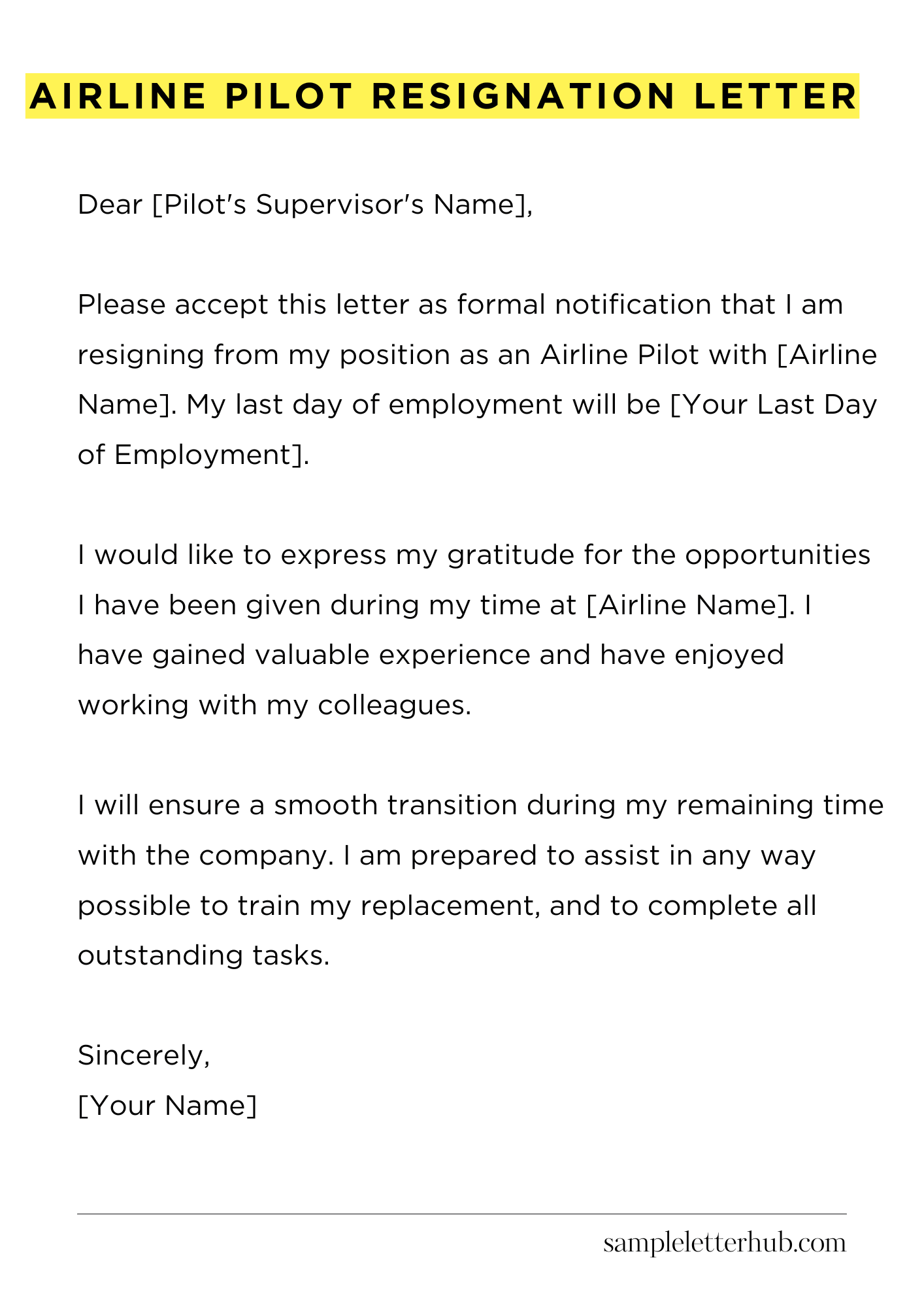
Airline Pilot Resignation Letter
Below is a sample of a Airline Pilot Resignation Letter:
[Your Name]
[Your Address]
[Your Phone Number]
[Your Email Address]
[Date]
[Pilot’s Supervisor’s Name]
[Airline Name]
[Airline Address]
Dear [Pilot’s Supervisor’s Name],
Please accept this letter as formal notification that I am resigning from my position as an Airline Pilot with [Airline Name]. My last day of employment will be [Your Last Day of Employment].
I would like to express my gratitude for the opportunities I have been given during my time at [Airline Name]. I have gained valuable experience and have enjoyed working with my colleagues.
I will ensure a smooth transition during my remaining time with the company. I am prepared to assist in any way possible to train my replacement, and to complete all outstanding tasks.
Thank you for your understanding. I wish you and [Airline Name] all the best in the future.
Sincerely,
[Your Name]
How to Write Airline Pilot Resignation Letter
Know Your Contractual Obligations First
Before you even think about putting pen to paper (or fingers to keyboard), understand the fine print. You’ve got a contract, right? That agreement outlines your employment terms, including the notice period you are required to give your airline. This is crucial.
Failing to adhere to this can have some serious consequences, so do your homework. Carefully review your employment contract. Look specifically for clauses addressing resignation, notice periods, and any potential penalties for early departure.
These are often buried in dense legal jargon, so take your time and read them very carefully. Consider consulting with an aviation attorney if you’re confused. This helps avoid potential legal issues. It is always a good idea.
Ignoring this part is the biggest mistake you can make.
Keep it Concise and Professional
Keep your resignation letter short, sweet, and to the point. No need for flowery language or lengthy explanations. A professional tone is a must.
Get straight to the point of your intention. The letter’s primary purpose is to formally notify your employer of your decision to leave. Include the date and a clear, unambiguous statement of your resignation. Avoid rambling.
Here’s a basic template:
- Start with a professional salutation (e.g., “Dear [Manager’s Name],”)
- Clearly state your intention to resign.
- Specify your last day of employment.
- Briefly express gratitude (optional, but recommended).
- End with a professional closing (e.g., “Sincerely,” or “Respectfully,”).
Focus on the Essentials: Dates and Clarity
The core of your letter needs to be the crucial information. Don’t get distracted by what you think you should write. Be clear about the essential pieces of information: the date, your intent, and the end of employment.
You need to provide your official resignation date, aligned with your contract’s requirements. Clearly state when your employment with the airline will end. Make sure the date is accurate. This is really important to avoid any confusion or future issues. Always proofread your letter before you send it.
Unambiguous language is key. There should be no doubt about your decision. Make it very clear, what you want to do.
Express Gratitude (If You Wish)
While not strictly necessary, including a brief expression of gratitude is often a good idea. This is for professional courtesy. Acknowledge your experience with the airline.
You can simply thank the company for the opportunities you’ve been given or the experiences you’ve gained. This helps maintain a positive relationship. Even if you’re leaving on less than ideal terms, a gracious note can go a long way.
This is where you can be sincere. Keep it brief. You don’t need to gush, just a simple expression of thanks is fine.
Review and Delivery is the Final Step
Before you send your letter, reread it carefully. Check for any grammatical errors or typos. Double-check the dates. Ensure it is correct. Make sure everything is clear and concise.
Consider the delivery method. Find out the correct person or department to send it to. Understand their process.
Follow your airline’s protocol for submitting resignations. Once you have submitted your letter, consider keeping a copy for your records. This is your proof.
Good luck!
FAQs about Airline Pilot resignation letter
What is the typical format and structure of an airline pilot resignation letter?
A typical airline pilot resignation letter should begin with a clear statement of resignation, followed by the pilot’s name, employee ID (if applicable), and the date of resignation. It should then include the pilot’s intended last day of employment, often adhering to the terms outlined in their employment contract or union agreement.
The letter should express gratitude to the airline and its management, and potentially offer a brief, professional explanation for the resignation. It should conclude with a statement of willingness to assist with the transition, contact information, and a formal signature.
What key information must be included in an airline pilot resignation letter?
Crucial information includes a clear statement of resignation, the effective date of resignation, the pilot’s name and employee ID (if applicable), and contact information. Pilots should also acknowledge any contractual obligations, such as notice periods.
Though not always mandatory, it is advised to express gratitude for the employment opportunity. The letter should provide confirmation that the pilot will adhere to all necessary exit procedures and handover tasks, and the pilot must sign it.
How much notice should an airline pilot give when resigning?
The notice period for an airline pilot’s resignation is typically dictated by their employment contract or union agreement. Common notice periods range from 30 to 90 days, or sometimes longer, depending on the airline and the pilot’s seniority or role.
It’s imperative that pilots consult their specific employment contracts and any applicable union agreements to determine the required notice period to avoid any potential legal or financial repercussions.
What are the legal considerations for airline pilots resigning, and what should they be aware of?
Legal considerations for resigning airline pilots often involve adhering to their employment contracts, including notice periods and any clauses related to non-compete agreements. Pilots must also be aware of any financial obligations, such as repayment of training costs or other benefits provided by the airline.
Additionally, pilots must comply with any relevant regulations regarding their certifications and licenses to ensure that all necessary steps are taken for their transition to their next role. Consulting with a legal professional specializing in aviation employment can be extremely helpful.
What are some common reasons cited in airline pilot resignation letters?
Common reasons cited in airline pilot resignation letters often include accepting a position with another airline (potentially offering better opportunities or pay), pursuing a career in a different area of aviation (like corporate aviation), or relocating for personal reasons.
Sometimes, pilots may resign due to retirement, dissatisfaction with work conditions or scheduling, or seeking more work-life balance. Professionalism is paramount, so the tone tends to be positive.
Related:
Resignation letter due to rude boss
Resignation letter moving to another state
Resignation letter due to illness of family member
Resignation letter due to study