

Sometimes, advocates decide to leave their positions. They need to formally notify their employers. This is where an advocate resignation letter comes in. It’s a crucial document. It officially announces the advocate’s departure. The letter is a professional courtesy. It ensures a smooth transition.
This article offers help. We provide examples. You’ll find templates here too. These are for an advocate resignation letter. Consider them your starting point. You can customize them. This makes the writing process easier.
We have included different formats. You can adapt these samples. They fit various situations. Need to resign quickly? There’s a template. Want to express gratitude? We have you covered. Let’s get started.
Advocate Resignation Letter
Below is a sample of a Advocate Resignation Letter:
[Your Name]
[Your Address]
[Your Phone Number]
[Your Email Address]
[Date]
[Recipient’s Name] (If applicable)
[Recipient’s Title] (If applicable)
[Organization Name] (If applicable)
[Organization Address] (If applicable)
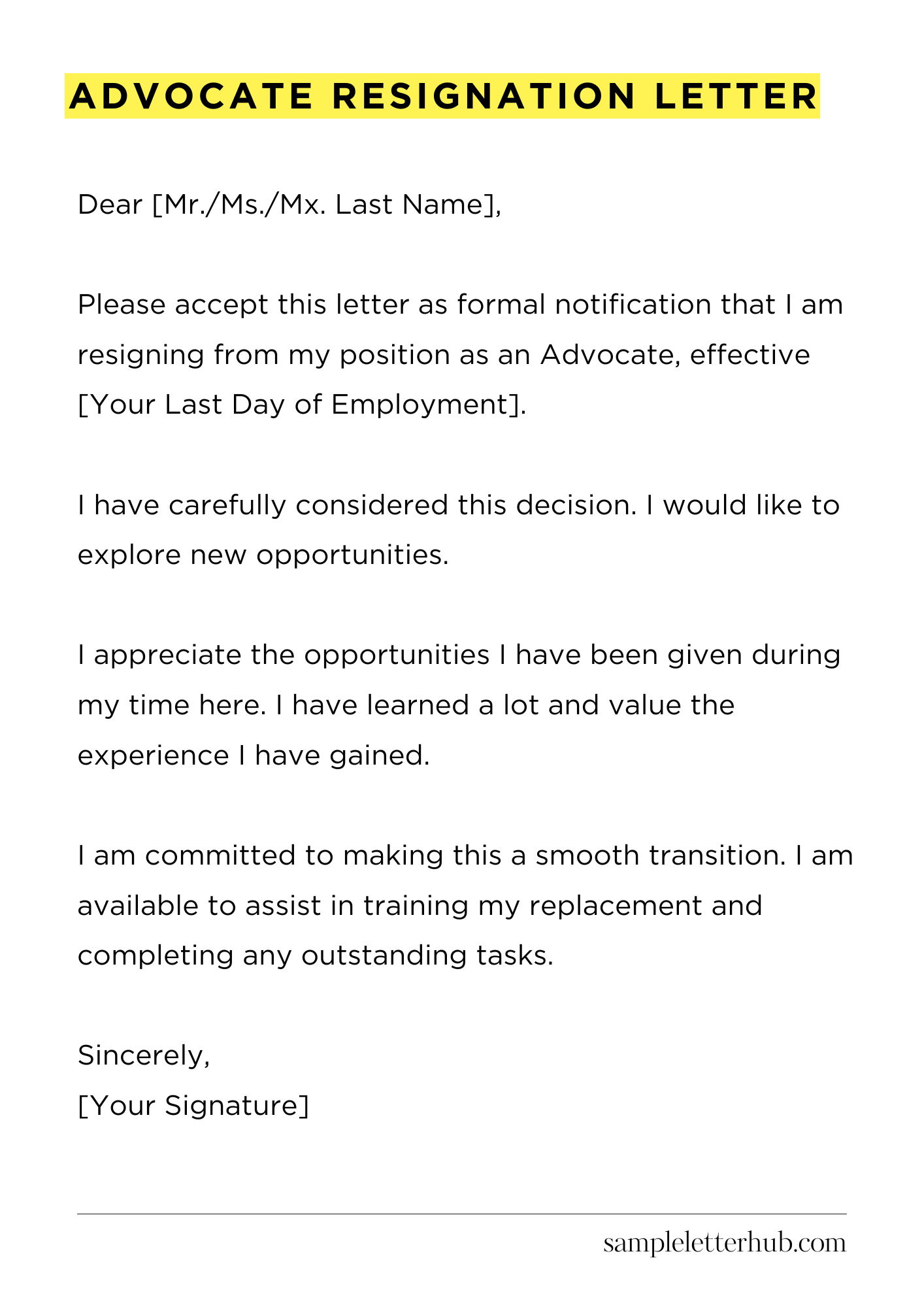
Dear [Mr./Ms./Mx. Last Name],
Please accept this letter as formal notification that I am resigning from my position as an Advocate, effective [Your Last Day of Employment].
I have carefully considered this decision. I would like to explore new opportunities.
I appreciate the opportunities I have been given during my time here. I have learned a lot and value the experience I have gained.
I am committed to making this a smooth transition. I am available to assist in training my replacement and completing any outstanding tasks.
Thank you for your understanding. I wish you and the organization continued success in the future.
Sincerely,
[Your Signature]
How to Write Advocate Resignation Letter
1. Why Resign, Anyway?
Leaving the legal profession? It’s a big decision. Maybe you’re seeking a career change. Perhaps a better opportunity has presented itself. Or, possibly, the demands of the job are no longer sustainable.
\There are many valid reasons for an advocate to resign. Whatever your motivation, a professional and well-crafted resignation letter is crucial. It’s the official document that signals your departure, so make sure you get it right!
A poorly written letter can damage your reputation, and maybe even lead to potential issues down the road. It might seem like a formality, but it’s essential for a smooth transition. Think of it as your final formal communication with your current firm.
2. The Essential Elements: What to Include
Your resignation letter needs to be clear, concise, and professional. First and foremost, you need to state your intention: to resign. Next, you must clearly state your last day of employment. This is usually determined by your employment contract or local regulations. Make sure you adhere to the notice period specified.
A brief expression of gratitude is also a nice touch. Acknowledge your time at the firm and express appreciation for the opportunities you’ve had. Keep it sincere but avoid lengthy emotional statements. Finally, include your contact information for any necessary follow-up. This includes your phone number and personal email address.
3. Formatting for Success
The layout of your letter matters. Use a standard business letter format. Start with your contact information, followed by the date, and then the recipient’s information (the managing partner or relevant supervisor). Keep the font size and style consistent and easy to read, such as Arial or Times New Roman, and font size of 11 or 12.
Address the recipient appropriately, using “Dear Mr./Ms./Mx. [Last Name]”. Avoid slang or casual language. Keep paragraphs short and to the point. Proofread, proofread, and proofread again! Check for any spelling or grammatical errors. A typo-free letter demonstrates professionalism and attention to detail.
4. Crafting the Perfect Wording
Be direct and professional. State your intent to resign clearly and without ambiguity. Avoid excessive details about your reasons for leaving, unless you feel it’s necessary for a specific situation. Focus on the facts. Keep the language polite and respectful.
For example, you could write: “Please accept this letter as formal notification that I am resigning from my position as an Advocate at [Law Firm Name], effective [Your Last Day of Employment].” You can then add a sentence of gratitude. For example, “I am grateful for the opportunities I have been given during my time here.”
5. After the Letter: The Next Steps
Once you’ve submitted your letter, be prepared for follow-up conversations. Your employer might want to discuss your departure, conduct an exit interview, or clarify any outstanding issues. Remain professional and cooperative during this process.
Be prepared to help with the transition. Offer to assist in training your replacement. Leave a positive impression and build professional bridges. Remember, you never know when your paths may cross again. After all, you have to ensure a smooth transition and maintain your professional reputation.
FAQs about Advocate resignation letter
What is the primary purpose of an Advocate resignation letter?
The primary purpose of an Advocate resignation letter is to formally communicate an advocate’s intention to leave their position with a law firm, organization, or any entity they represent. This letter serves as a legal document, providing written notice of their departure and the effective date of their resignation.
What key elements should be included in an Advocate resignation letter?
Essential components of an Advocate resignation letter typically include a clear statement of resignation, the advocate’s name, the name of the recipient (usually a partner or supervisor), the specific date of resignation, the effective date of the resignation, and a brief expression of gratitude for the opportunity.
It is also common to state the reasons for leaving, if the advocate chooses to share them. Ensure the letter is professionally formatted and signed.
How much notice should an Advocate typically provide in their resignation letter?
The standard notice period for an Advocate varies depending on the employment agreement, firm policy, and local regulations. However, generally, it’s common to provide at least two to four weeks’ notice. Always refer to your employment contract or any applicable guidelines to determine the required notice period.
Adhering to the stipulated notice period helps ensure a smooth transition and avoids any potential legal complications.
Can an Advocate include their reasons for resigning in their letter, and is it advisable?
An Advocate has the option to include their reasons for resigning, but it’s not mandatory. The inclusion of reasons depends on the advocate’s personal preference and the relationship with their employer. If included, reasons should be expressed professionally and constructively. Avoid expressing negativity or making accusations.
Focus on future career plans, personal considerations, or other professional factors. Sometimes, it’s preferable to keep the reason succinct or omit it entirely to maintain a positive and professional image.
What should an Advocate do after submitting their resignation letter?
After submitting the resignation letter, the Advocate should confirm receipt and begin the process of transitioning their cases, files, and responsibilities. Cooperate fully with the employer during the transition period. This may involve training colleagues, preparing summaries, and ensuring the smooth transfer of ongoing matters.
Maintain professionalism and continue to fulfill responsibilities until the effective date of resignation. Finally, make arrangements for the retrieval of personal belongings and the completion of any exit procedures outlined by the employer.
Related:
Resignation letter due to rude boss
Resignation letter moving to another state
Resignation letter due to illness of family member
Resignation letter due to study