

So, you’re looking for information on an “Admissions Counselor resignation letter”? It’s exactly what it sounds like. It’s a formal document. It is written by an admissions counselor. The purpose? To officially inform an employer of their intention to leave their job.
Writing this letter can feel daunting. We understand. You need to be professional, clear, and concise. But where do you even start?
Luckily, we’ve got you covered. We’ll share several templates. These templates are here to help. You can easily adapt them. They are designed to make the process smoother. Let’s get you started!
Admissions Counselor Resignation Letter
Below is a sample of a Admissions Counselor Resignation Letter:
[Your Name]
[Your Address]
[Your Phone Number]
[Your Email Address]
[Date]
[Hiring Manager Name] (If known, otherwise use title)
[Hiring Manager Title]
[University/Institution Name]
[University/Institution Address]
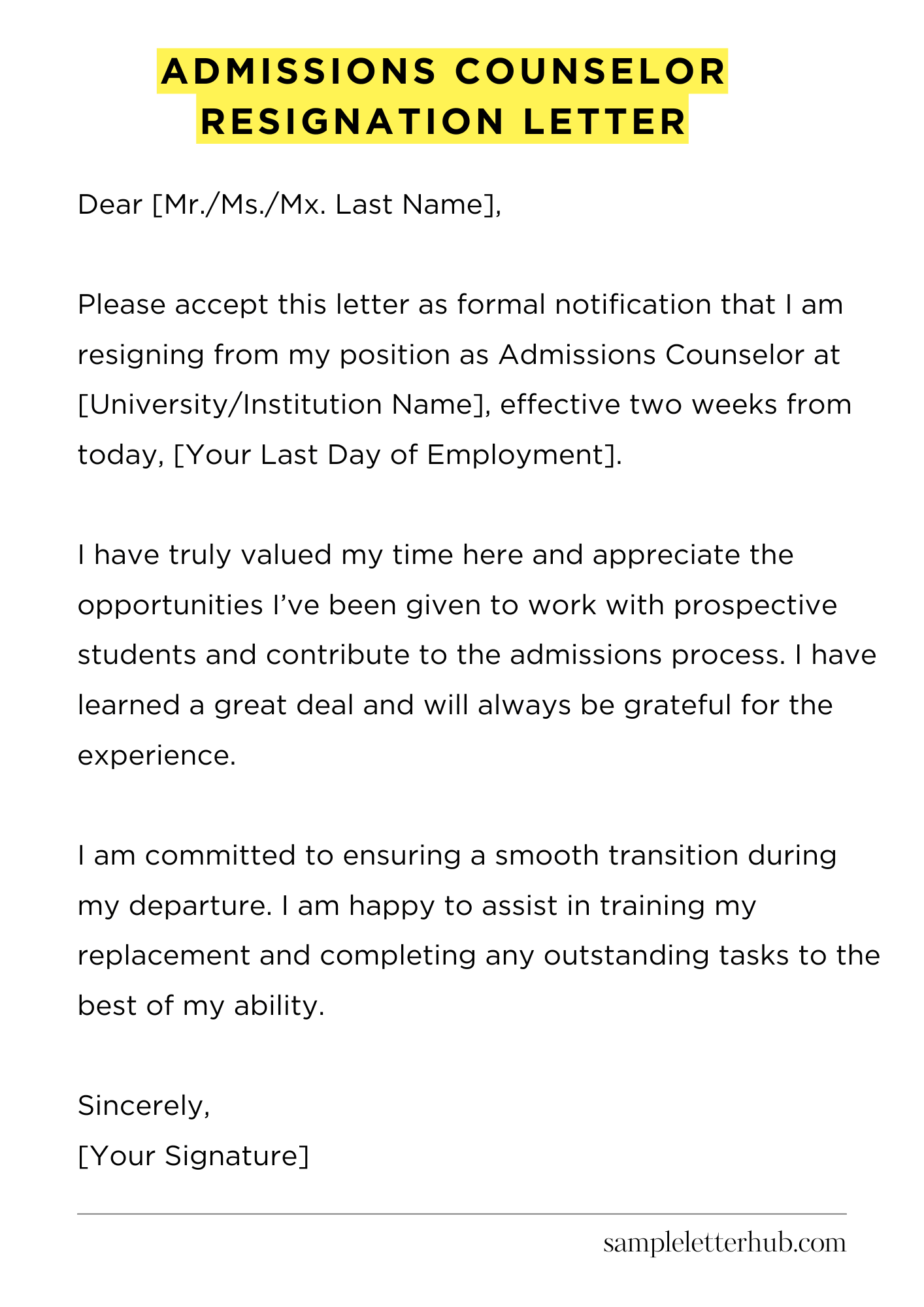
Dear [Mr./Ms./Mx. Last Name],
Please accept this letter as formal notification that I am resigning from my position as Admissions Counselor at [University/Institution Name], effective two weeks from today, [Your Last Day of Employment].
I have truly valued my time here and appreciate the opportunities I’ve been given to work with prospective students and contribute to the admissions process. I have learned a great deal and will always be grateful for the experience.
I am committed to ensuring a smooth transition during my departure. I am happy to assist in training my replacement and completing any outstanding tasks to the best of my ability.
Thank you again for the experience. I wish you and [University/Institution Name] all the best in the future.
Sincerely,
[Your Signature]
How to Write an Admissions Counselor Resignation Letter
1. Why You Need a Resignation Letter (And Why It Matters)
So, you’ve made the difficult decision. You’re ready to move on from your role as an Admissions Counselor. Congratulations on this next step! But before you dust off your resume and get ready for a new chapter, you need something important: a formal resignation letter.
It may seem like just a formality, but a well-crafted letter is crucial. It’s the official record of your departure. It’s a professional courtesy that can leave a lasting positive impression. This letter protects you.
Leaving on good terms is always a smart move. You never know when you might need a reference or a connection down the line. Plus, a thoughtful letter reflects well on you and your professionalism. Seriously, who wants to burn bridges?
2. Essential Elements: What to Include
Now, let’s get down to brass tacks. What exactly should you include in your resignation letter? Think of it like a recipe – you need all the right ingredients. First and foremost, clearly state your intent to resign. Be direct and unambiguous. Next, specify your last day of employment. This is critical for the university or college’s records and planning.
Keep your tone positive. Acknowledge your time at the institution and express your gratitude. Mention anything positive from your experience. Offer to help with the transition. Offer to train the new candidate. Be helpful and professional. Consider a brief thank you to a key person like your manager or the Dean.
You may also state why you are leaving, but it’s not always necessary. Keep it brief if you do. Finally, end with a polite closing, like “Sincerely” or “Best regards,” followed by your typed name.
3. Crafting the Perfect Letter: A Step-by-Step Guide
Okay, let’s assemble your letter. It is easier than you think. Start with a professional header. Include your name, address, phone number, and email. Then, add the date. Next, address the letter to your direct supervisor or the appropriate hiring manager. Use their formal title. Now, get to the core of the letter.
In the first paragraph, clearly state your resignation and effective date. Keep it short. In the second paragraph, express your thanks for the opportunity. Mention any positive experiences or skills you gained.
Offer to help with the transition. The third paragraph can be brief. Keep it simple and professional. In the final paragraph, end with a polite closing and your typed name. Proofread meticulously! This is extremely important.
4. Keeping It Professional: Dos and Don’ts
Professionalism is key here. Avoid negativity at all costs. Don’t complain about your colleagues, the workload, or anything else. Resist the urge to vent. Stick to the facts. Be positive and appreciative. Be respectful. Keep the letter concise and focused. Do not get too lengthy.
Proofread everything carefully before you send it. Ensure there are no typos, grammatical errors, or formatting issues. Send the letter via email and consider delivering a physical copy to your supervisor. Finally, be prepared for a potential meeting. Your supervisor may want to discuss your departure further.
5. Sample Resignation Letter: A Template to Get You Started
Need a little help visualizing the finished product? Here’s a basic template you can adapt:
[Your Name]
[Your Address]
[Your Phone Number]
[Your Email]
[Date]
[Supervisor’s Name]
[Supervisor’s Title]
[University/College Name]
[University/College Address]
Dear [Supervisor’s Name],
Please accept this letter as formal notification that I am resigning from my position as Admissions Counselor at [University/College Name]. My last day of employment will be [Your Last Day].
I am grateful for the opportunity to have worked at [University/College Name]. I have truly valued my time here and appreciate the experiences I’ve gained.
I am happy to assist in the transition process. Please let me know how I can be of help.
Sincerely,
[Your Typed Name]
FAQs about Admissions Counselor Resignation Letter
What is the primary purpose of an admissions counselor resignation letter?
The primary purpose of an admissions counselor resignation letter is to formally notify your employer of your intention to leave your position. It serves as an official record of your departure and provides essential information regarding your last day of employment.
What key components should be included in an admissions counselor resignation letter?
A well-crafted resignation letter typically includes a clear statement of your intention to resign, the effective date of your resignation, a brief expression of gratitude for the opportunity, and any relevant details regarding the handover of your responsibilities. It may also include a statement about your willingness to assist in the transition process.
How far in advance should an admissions counselor submit their resignation letter?
The standard practice is to submit your resignation letter at least two weeks before your intended last day of employment. However, this may vary depending on your employment contract or company policy. Reviewing your employment agreement is crucial to ensure compliance with any specific notice requirements.
Is it necessary to provide a reason for resigning in the admissions counselor resignation letter?
While not mandatory, briefly stating your reason for leaving can be beneficial, particularly if it’s a positive reason, like pursuing a different career path or a significant life change. However, you are not obligated to disclose detailed reasons, and you can keep it brief and professional. Always keep it professional.
How should an admissions counselor handle the handover of responsibilities after submitting their resignation letter?
After submitting your resignation letter, it’s essential to proactively assist in the transition process. This includes completing any outstanding tasks, documenting key processes, training your replacement (if applicable), and responding to questions from colleagues. Providing a smooth handover ensures a positive and professional departure.
Related:
Resignation letter due to rude boss
Resignation letter moving to another state
Resignation letter due to illness of family member
Resignation letter due to study