

An administration resignation letter is a formal document. It informs your employer of your intention to leave your job. The purpose is to officially announce your departure. It also states your last day of employment.
Leaving a job can be stressful. We’re here to help make it easier. We’ll share various templates. These include examples and samples. Use them to write your own letter.
Need to say goodbye to your administrative role? We’ve got you covered. These samples are easy to adapt. Create a professional resignation letter quickly.
Administration Resignation Letter
Below is a sample of a Administration Resignation Letter:
[Your Name]
[Your Address]
[Your Phone Number]
[Your Email Address]
[Date]
[Recipient’s Name]
[Recipient’s Title]
[Company Name]
[Company Address]
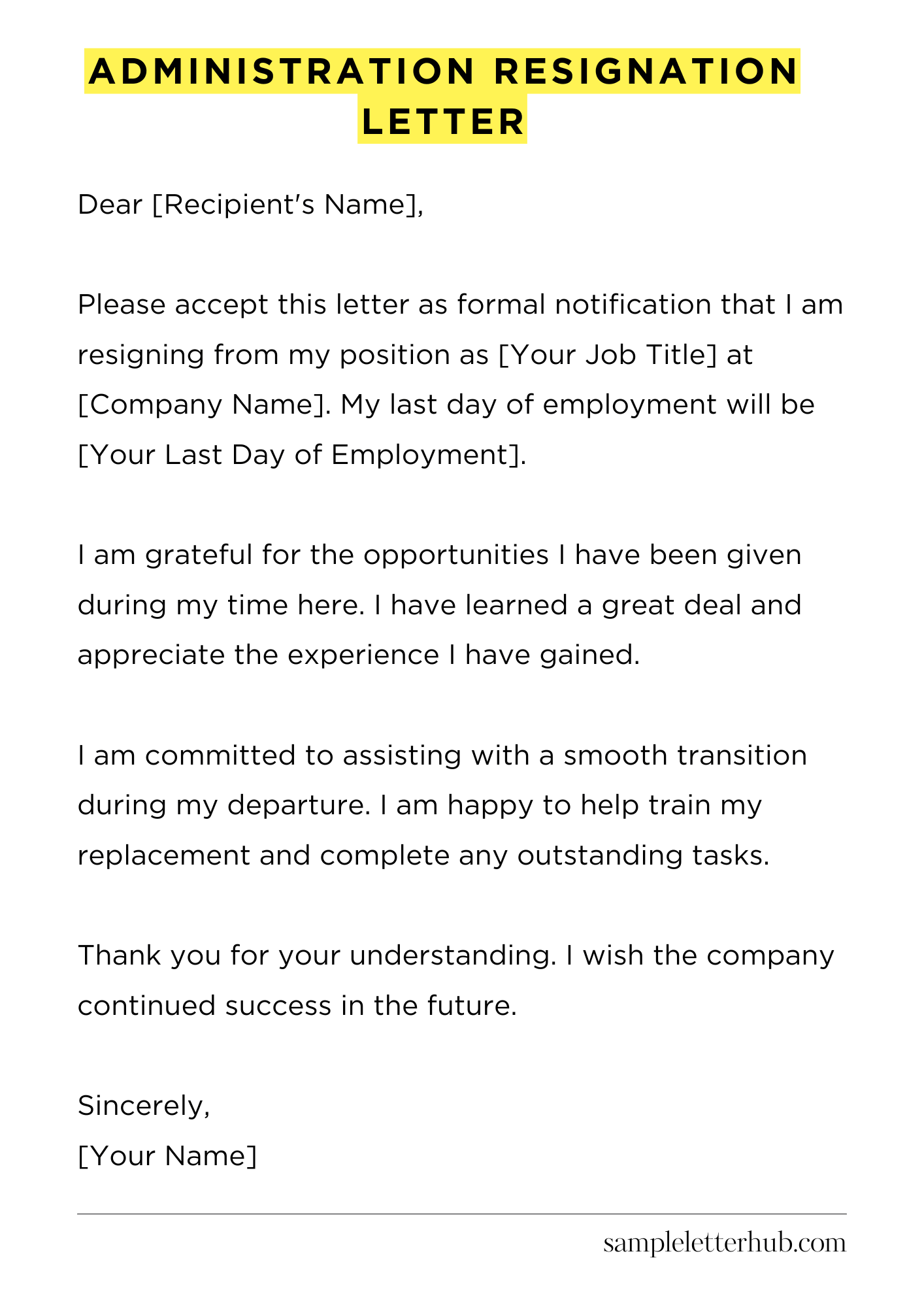
Dear [Recipient’s Name],
Please accept this letter as formal notification that I am resigning from my position as [Your Job Title] at [Company Name]. My last day of employment will be [Your Last Day of Employment].
I am grateful for the opportunities I have been given during my time here. I have learned a great deal and appreciate the experience I have gained.
I am committed to assisting with a smooth transition during my departure. I am happy to help train my replacement and complete any outstanding tasks.
Thank you for your understanding. I wish the company continued success in the future.
Sincerely,
[Your Name]
How to Write an Administration Resignation Letter
Leaving a job is a big deal, and when it comes to administration roles, professionalism is key. You need a resignation letter. This document is your official notice to your employer. It’s also your last chance to make a good impression. Let’s delve into the crucial steps involved in crafting a solid and respectful administration resignation letter.
1. Get Started: The Basics First
Before you start typing, make sure you have the basics down. Find out who your letter should be addressed to. This is usually your direct supervisor, or sometimes a Human Resources representative.
Next, consider your tone. You want to remain professional, polite, and avoid negativity. Keep the language clear and concise. This shows respect for the recipient’s time.
Begin by writing your full name and contact information. Below that, include the date. Then, formally address the recipient. “Dear [Manager’s Name],” is a great way to start. Remember, a well-formatted letter looks professional right away.
2. The Core of the Matter: Stating Your Intent
The first paragraph is where you clearly state your intention: to resign. Directly state that you are resigning from your position. Include the job title you hold. Also, provide the effective date of your resignation.
This is the date you’ll no longer be employed. This date is crucial for both you and your employer. Make it very clear. Ensure the date aligns with any company policy regarding notice periods.
For example, you might write: “Please accept this letter as formal notification that I am resigning from my position as Administrative Assistant, effective October 26, 2024.” Keep it simple and to the point.
3. Expressing Gratitude: Showing Appreciation
Even if you’re leaving for a challenging reason, it’s always wise to express gratitude. You can do this in the second paragraph. Acknowledge the opportunities you’ve been given during your time there.
Briefly mention any skills you’ve gained or experiences you’ve valued. This positive sentiment leaves a lasting impression. It also helps to maintain a positive relationship with your employer.
Something like: “I am grateful for the opportunities I’ve had during my tenure at the company. I have greatly appreciated the chance to develop my skills in [mention specific skills/areas].” can work perfectly.
4. Offering Assistance: Providing Support
Offer your assistance during the transition. Indicate your willingness to help with the handover process. This shows professionalism and consideration for your colleagues. You could offer to train your replacement. You can also offer to document any crucial procedures you handle. This is the kind of detail that is very much appreciated.
Consider writing something along these lines: “I am committed to ensuring a smooth transition. I am happy to assist in training my replacement and to complete all outstanding tasks before my departure.”
5. The Final Touch: Closing and Sign-Off
End the letter with a polite closing, such as “Sincerely,” or “Respectfully,” followed by your full name. If you’re submitting a physical copy, ensure that you sign the letter above your typed name. If submitting electronically, a typed name is usually sufficient.
Before submitting, always proofread your letter.
Check for any grammatical errors or typos. Double-check the dates and the recipient’s name. A well-written letter reflects your professionalism. A poorly written letter is bad. Sending a polished resignation letter allows you to exit on a high note, leaving a positive and lasting impact.
FAQs about Administration Resignation Letter
What is the primary purpose of an administration resignation letter?
The primary purpose of an administration resignation letter is to formally notify an employer of an employee’s voluntary departure from their position.
It serves as a legal record of the employee’s intent to leave and provides a clear date for their last day of employment. It also opens the door for a smooth transition of duties and potential for positive references.
What key elements should be included in an administration resignation letter?
Essential components of an administration resignation letter include a clear and concise statement of resignation, the employee’s official job title, the intended last day of employment, a brief expression of gratitude for the opportunity, and the employee’s signature.
Optional elements might include a reason for leaving (though not always necessary), an offer to assist with the transition, and contact information.
How much notice should be given when submitting an administration resignation letter?
The amount of notice required varies based on company policy, the terms of the employment contract, and local labor laws. Typically, two weeks’ notice is standard practice in many regions.
However, for administrative roles, the required notice might be longer depending on the level of responsibility and the time it takes to find a replacement. It’s crucial to review the employment contract or employee handbook to determine the correct notice period.
Should I provide a reason for resigning in my administration resignation letter?
While not mandatory, including a brief and professional reason for leaving can be beneficial. It helps provide context to the employer. However, the reason need not be overly detailed.
A simple statement such as “to pursue other opportunities” or “for personal reasons” is generally sufficient. Avoid negativity or making critical remarks about the company or colleagues.
How should I handle the delivery of my administration resignation letter?
The preferred method of delivery is usually in writing, either on paper or via email. If submitting a physical letter, it’s best to hand it to your supervisor or a relevant HR representative directly.
If emailing, consider including the letter as an attachment and requesting confirmation of receipt. Keep a copy of your letter for your records. Furthermore, it’s also a good idea to discuss the resignation verbally with your supervisor before formally submitting the letter.
Related:
Resignation letter due to rude boss
Resignation letter moving to another state
Resignation letter due to illness of family member
Resignation letter due to study