

So, you’re an adjunct professor, and you’re thinking about moving on. A resignation letter is your official way of saying goodbye to your current role. It’s a formal document. Its main purpose is to communicate your decision to leave. You provide details like your last day of employment. It also offers a chance to express gratitude.
Crafting the perfect resignation letter can be tricky. It needs to be professional and clear. That’s where we come in. This article is all about helping you write one. We’ve gathered helpful samples. These templates will simplify the process. They’ll give you a great starting point.
Whether you need to explain your reason or keep it simple, we have options. We’ll guide you through it. These examples cater to various situations. So, let’s get started. Get ready to create a letter that reflects your experience.
Adjunct Professor Resignation Letter
Below is a sample of a Adjunct Professor Resignation Letter:
[Your Name]
[Your Address]
[Your Phone Number]
[Your Email Address]
[Date]
[Hiring Manager Name (if known), or “Hiring Manager”]
[Department Name]
[University Name]
[University Address]
Dear [Mr./Ms./Mx. Last Name, or “Hiring Manager”],
Please accept this letter as formal notification that I am resigning from my position as an Adjunct Professor in the [Department Name] department at [University Name]. My last day of employment will be [Your Last Day of Employment].
I would like to thank you for the opportunity to have taught at [University Name]. I have enjoyed my time here, and I appreciate the experience I have gained.
I am available to assist with the transition process in any way I can, including helping to find a replacement or providing any necessary materials.
I wish you and the university all the best in the future.
Sincerely,
[Your Signature]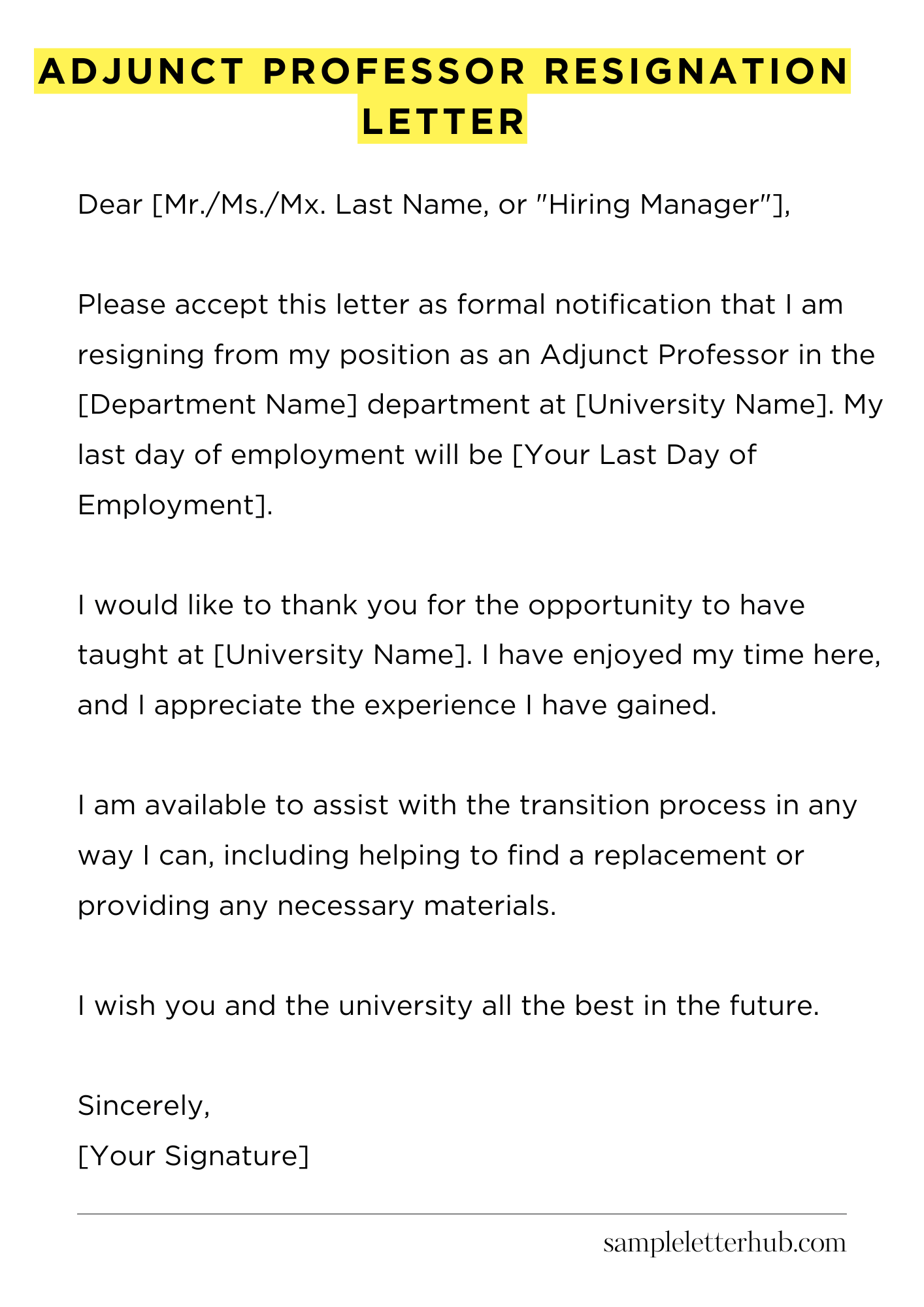
How to Write Adjunct Professor Resignation Letter
So, you’ve decided to move on. Maybe a better opportunity has presented itself, or perhaps you’re simply ready for a change. Whatever the reason, resigning from your adjunct professor position requires a well-crafted letter. This isn’t just about saying goodbye; it’s about leaving a positive impression and ensuring a smooth transition.
1. Start with a Professional Salutation and Clear Statement
First impressions matter, even in a resignation. Begin your letter with a formal salutation, addressing the appropriate person, usually the department head or the person who hired you. “Dear Professor [Last Name]” is a safe bet. Immediately after the salutation, make your intentions clear.
State that you are resigning from your position as an adjunct professor. Be direct and concise. For example: “Please accept this letter as formal notification that I am resigning from my position as an Adjunct Professor of [Subject] at [University Name], effective [Your Last Day of Employment].” This leaves no room for misinterpretation.
2. Provide a Concise Reason (Optional, But Recommended)
While not strictly necessary, briefly mentioning the reason for your resignation is often a good practice. This shows professionalism and consideration. Keep it brief. You don’t need to provide a detailed explanation. You could simply state, “I am resigning to pursue another opportunity” or “I have accepted a full-time position elsewhere.”
If you’re leaving for personal reasons, a simple “Due to personal reasons, I am resigning…” is perfectly acceptable. Avoid negativity or complaints. The goal is to maintain a positive and professional tone. A positive note will help you in the future.
3. Express Gratitude and Offer Assistance
This section is crucial for leaving a positive legacy. Express your gratitude for the opportunity to have worked at the university. Acknowledge any support you received from colleagues or the institution.
For example: “I am grateful for the opportunity to have taught at [University Name] and for the support I have received from the faculty and staff.” Furthermore, offer assistance during the transition period.
This shows consideration and professionalism. Offer to help with tasks like preparing lesson plans, assisting with finding a replacement, or providing any necessary documentation. “I am happy to assist in the transition process in any way I can, including providing lesson plans and materials.” This helps them, but also helps you.
4. Include Necessary Details: Date, Signature and Contact Information
Now, let’s nail down those essential details. Ensure your letter includes the date. Sign your name clearly, and if you’re submitting a digital version, consider adding a digital signature. Include your contact information—phone number and email address—so the department can easily reach you with any questions. This ensures easy communication.
5. Review and Proofread Before Submitting
Before hitting that “send” button or printing the letter, read it again. Proofread carefully for any typos or grammatical errors. Ensure that the tone is professional, and the message is clear.
A well-written letter reflects positively on you and can help maintain a strong professional relationship with the university. Always double-check names, dates, and other important information. Make the final decision, and go with it. Good luck in your next endeavors.
FAQs about Adjunct Professor resignation letter
How do I write a resignation letter as an adjunct professor?
A resignation letter for an adjunct professor should be professional, concise, and respectful. Begin by stating your intent to resign, followed by your name and the effective date of your resignation. Express gratitude for the opportunity to teach. Briefly mention your reason for leaving if you wish, but it’s not required.
Offer to assist with the transition. Conclude by reiterating your thanks and offering contact information if needed. Proofread carefully before submitting.
What information should be included in an adjunct professor resignation letter?
Essential information includes your clear statement of resignation, the specific effective date of your resignation, your name and the department you’re resigning from, and an expression of gratitude for the opportunity.
While not required, you may optionally include a brief reason for your departure. It’s often helpful to offer assistance during the transition period, such as helping with lesson plans or student support.
What are some good reasons to give when resigning as an adjunct professor?
Common reasons include accepting a full-time position elsewhere, seeking better opportunities for career advancement, relocating, or a desire for a different work-life balance. Other factors might be related to the compensation, the commute, insufficient support from the department, or personal reasons. It is your choice to be specific or general in your letter.
How much notice should I give when resigning as an adjunct professor?
The standard notice period varies by institution and any existing employment contracts. Generally, giving at least two to four weeks’ notice is considered professional and courteous. Review your contract or consult with the department chair to clarify the required notice period. Providing more notice is always appreciated and can help ensure a smooth transition.
Can I use a template for an adjunct professor resignation letter?
Yes, using a template is perfectly acceptable and can be a great starting point. Numerous templates are available online and through professional organizations. However, make sure to customize the template to fit your specific situation and circumstances. Tailoring it to your role, the department, and your personal reasons for leaving ensures it is both accurate and appropriate.
Related:
Resignation letter due to rude boss
Resignation letter moving to another state
Resignation letter due to illness of family member
Resignation letter due to study