

So, you’re an Accounts Receivable Specialist ready to move on. A resignation letter is your formal notice. It informs your employer of your departure. This letter officially ends your employment. It’s a crucial step in the process.
Crafting the perfect resignation letter can be tricky. Don’t worry. We’ve got you covered. We’ll share several templates. These are examples. Use them to create your own letter.
Need a quick and easy way out? Looking for a specific tone? Browse our samples. Find the one that fits your situation. Make your exit smooth and professional.
Accounts Receivable Specialist Resignation Letter
Below is a sample of a Accounts Receivable Specialist Resignation Letter:
[Your Name]
[Your Address]
[Your Phone Number]
[Your Email Address]
[Date]
[Employer’s Name]
[Company Name]
[Company Address]
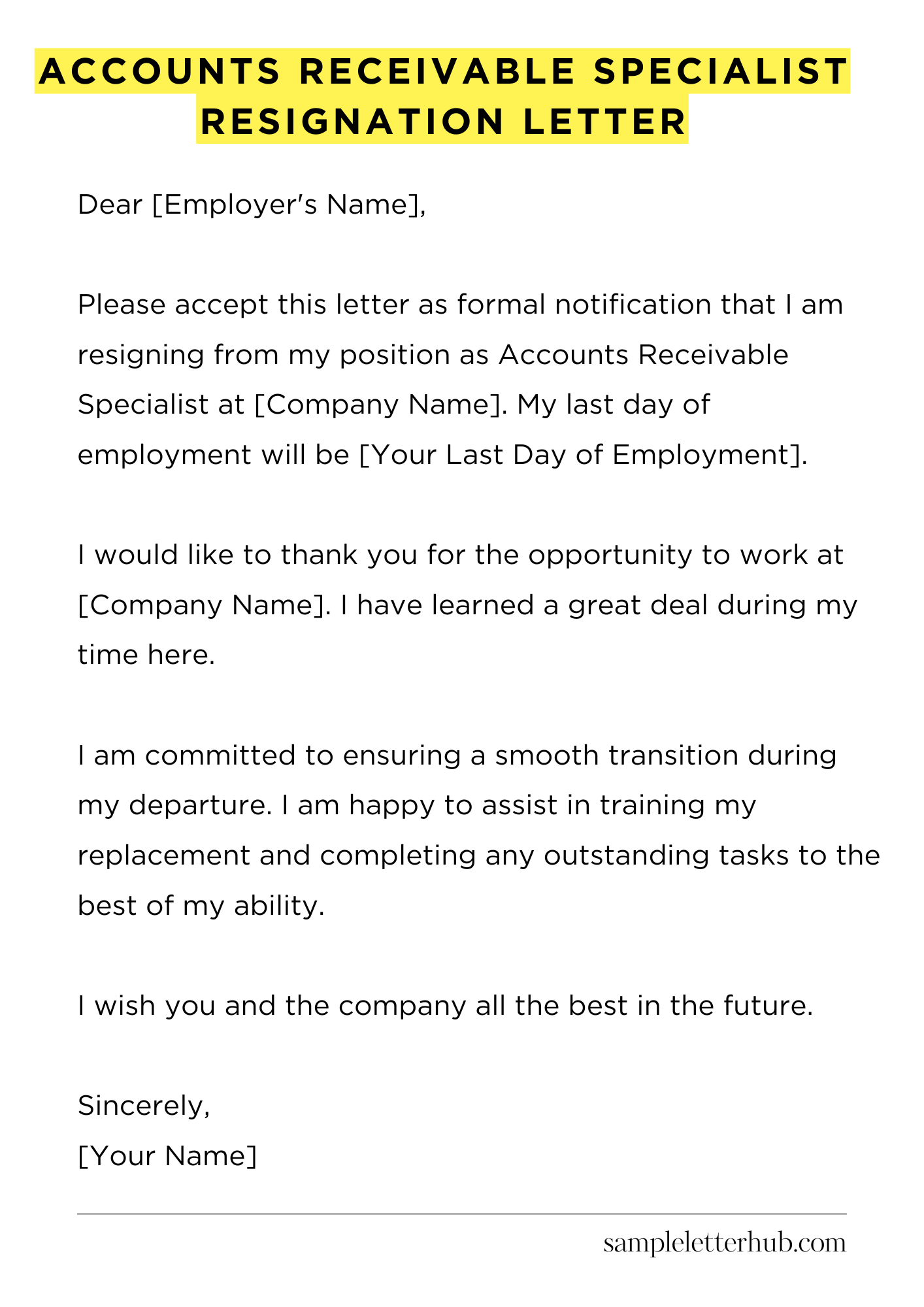
Dear [Employer’s Name],
Please accept this letter as formal notification that I am resigning from my position as Accounts Receivable Specialist at [Company Name]. My last day of employment will be [Your Last Day of Employment].
I would like to thank you for the opportunity to work at [Company Name]. I have learned a great deal during my time here.
I am committed to ensuring a smooth transition during my departure. I am happy to assist in training my replacement and completing any outstanding tasks to the best of my ability.
I wish you and the company all the best in the future.
Sincerely,
[Your Name]
How to Write Accounts Receivable Specialist Resignation Letter
1. The Initial Salutation and Introduction: Make it Clear
So, you’ve made the decision to move on. That’s a big step! Now, you need to inform your employer, and the first impression matters. Begin with a formal salutation, like “Dear [Manager’s Name]”.
Then, state your intention clearly and directly in the first paragraph. Don’t beat around the bush. Use straightforward language. This is where you declare your resignation from the Accounts Receivable Specialist position. It’s important to state your intention without ambiguity.
For example, you could write: “Please accept this letter as formal notification that I am resigning from my position as Accounts Receivable Specialist, effective [Your Last Day of Employment].” Keep it simple and professional.
2. Expressing Gratitude and Highlighting Your Contributions: Be Positive
Even if you’re leaving, there’s no need to burn bridges. This section is a great place to show appreciation for your time at the company. Reflect on what you’ve learned and experienced. Mentioning specific projects or achievements will show you were engaged. These details add weight to your message.
Consider something like: “I am grateful for the opportunities I’ve been given during my time here. I have particularly enjoyed [mention a specific project or responsibility] and appreciate the experience I’ve gained in [mention a specific skill]. The team helped a lot to do my daily job.” This creates a more positive tone and leaves a good lasting impression.
3. Providing a Smooth Transition: Your Responsibilities
The goal is to leave on good terms. Demonstrate your professionalism by offering assistance during the transition. Consider how you can help your colleagues. Mention your willingness to help train your replacement, if possible. Offering to help with the handover process shows your commitment and consideration.
You can write: “I am committed to ensuring a smooth transition during my departure. I am happy to assist in training my replacement and completing any outstanding tasks. I am available to discuss my duties and provide necessary documentation to help with the transfer of responsibilities.” This shows your commitment.
4. Formal Closing and Contact Information: Keeping it Professional
End your letter with a formal closing, such as “Sincerely” or “Respectfully”. Double-check the spelling of the closing and your name. Make sure everything looks clean and presentable. After your signature, include your contact information. This can be helpful if your employer needs to reach you after your departure.
Include your phone number and personal email address. This allows for any future communication.
5. Proofreading and Sending: Double Check Everything
Before you send your resignation letter, proofread it carefully. Check for any grammatical errors or typos. Ensure the tone is professional and positive. Get a second pair of eyes to review it. After all, first impressions matter, and a polished letter reflects well on you.
Print a hard copy for your records, too. Then, submit the letter according to your company’s policy. Following these steps ensures a respectful and professional departure.
FAQs about Accounts Receivable Specialist Resignation Letter
Navigating the process of resigning from your position as an Accounts Receivable Specialist requires careful planning and execution. Understanding the common questions surrounding resignation letters can help ensure a smooth transition.
How do I format an Accounts Receivable Specialist resignation letter?
Your resignation letter should follow a standard business letter format. Include your contact information at the top (name, address, phone number, email) followed by the date, and the recipient’s information (name, title, company, address).
The body of the letter should clearly state your intention to resign, your last day of employment, and express gratitude for the opportunity. You may optionally include a brief explanation, though it’s not required. End with a professional closing (e.g., “Sincerely,” or “Regards,”) and your typed name.
What key information should be included in the letter?
The most crucial information includes a clear statement of your resignation, the effective date of your resignation (your last day of employment), and a brief expression of appreciation for the opportunity to work in the role.
The effective date is essential, as it officially marks the end of your employment. You may also choose to mention your willingness to assist with the transition.
Is it necessary to provide a reason for resigning?
While not mandatory, you can choose to include a brief, positive explanation for your resignation. This might include stating you’ve accepted another role, pursuing further education, or are relocating. Keep it concise and avoid negativity. If you prefer, you can simply state your resignation without providing a reason.
Should I offer to help with the transition?
Offering assistance with the transition is a professional courtesy that can leave a positive impression. You can state your willingness to train a replacement or assist with outstanding tasks, such as closing out the month-end or assisting with critical client communications.
This demonstrates your commitment and professionalism. However, this is optional and depends on your availability.
When should I submit my resignation letter?
The timing of your resignation should align with your employer’s policies and any contractual obligations, typically a notice period of two weeks. Submit the letter to your direct supervisor or the appropriate HR representative. Ensure that you have a private meeting to discuss your departure before providing the formal written letter.
Related:
Resignation letter due to rude boss
Resignation letter moving to another state
Resignation letter due to illness of family member
Resignation letter due to study