

The “Accounts Administrator resignation letter” is a formal document. It is written by an Accounts Administrator. The letter officially announces their departure from a company. It informs the employer of their last working day.
Need to resign? This article is for you. We understand writing a resignation letter can be tricky. We’ve got you covered. We’ll share several templates. You can use these examples. They are easy to modify.
We offer various sample letters. You will find different scenarios. There’s a template for every situation. You’ll find options for expressing gratitude. There are also examples for leaving on good terms. Craft your perfect letter with ease.
Accounts Administrator Resignation Letter
Below is a sample of a Accounts Administrator Resignation Letter:
[Your Name]
[Your Address]
[Your Phone Number]
[Your Email Address]
[Date]
[Employer’s Name]
[Company Name]
[Company Address]
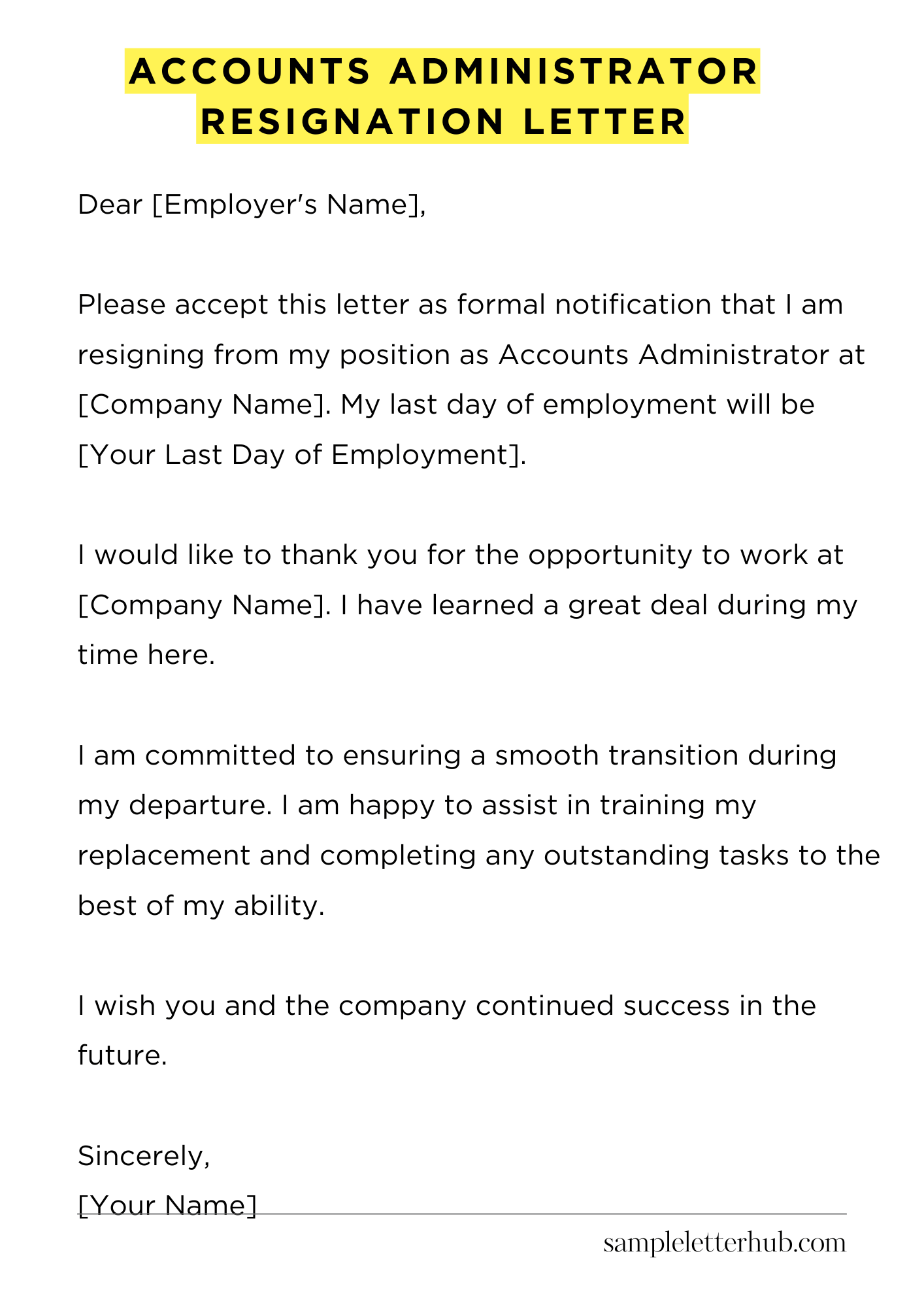
Dear [Employer’s Name],
Please accept this letter as formal notification that I am resigning from my position as Accounts Administrator at [Company Name]. My last day of employment will be [Your Last Day of Employment].
I would like to thank you for the opportunity to work at [Company Name]. I have learned a great deal during my time here.
I am committed to ensuring a smooth transition during my departure. I am happy to assist in training my replacement and completing any outstanding tasks to the best of my ability.
I wish you and the company continued success in the future.
Sincerely,
[Your Name]
How to Write Accounts Administrator Resignation Letter
1. Grasping the Basics: Why Your Letter Matters
Leaving a job is a big deal, and the Accounts Administrator role demands a professional departure. Your resignation letter isn’t just about saying “I quit.” Think of it as your final, official communication. It sets the tone for your legacy and can impact future references. Moreover, it’s a critical piece of paperwork for your employer.
You want to make a good impression, right? A well-written letter minimizes any potential workplace issues and helps ensure a smooth transition. Consider this carefully: This is about more than just you. It’s about maintaining a positive reputation in the professional world. Get it right, and you’re golden.
2. Structure is Key: Formatting Your Resignation
Let’s talk structure. Formatting is essential. Start with your contact information (name, address, phone, and email) at the top. Follow this with the date, and then the employer’s details (name, title, company address).
Next comes the salutation: “Dear [Manager’s Name],” or if you’re unsure, “Dear Hiring Manager,” is usually best. The body of your letter is where the real work happens.
Keep your sentences short and to the point. State your intent to resign, the effective date of your last day, and a brief expression of gratitude for the opportunity. Provide information on assisting with the transition like training your replacement. Avoid negativity and focus on moving forward.
3. Content That Counts: Crafting Your Message
Now, let’s look at the content. Keep it clear and concise. The first paragraph is critical; be direct and state your resignation. For instance, “Please accept this letter as formal notification that I am resigning from my position as Accounts Administrator, effective [Date].” In the next paragraph, briefly thank your employer for the experience and opportunities provided.
You can also offer to assist with the handover process. This demonstrates professionalism. For example, “I am committed to ensuring a smooth transition and am happy to assist in training my replacement or completing any outstanding tasks.” Finally, end with a polite closing, such as “Sincerely” or “Best regards,” followed by your name and signature.
4. Showcasing Professionalism: Important Do’s and Don’ts
Professionalism is the name of the game. Let’s list some key do’s and don’ts. Do be polite and professional at all times, even if you had a negative experience. Do keep it brief and focused on the essentials. Do proofread carefully for any spelling or grammatical errors. And remember to sign your letter.
Now for the don’ts! Don’t include personal grievances or complaints about your job. Avoid lengthy explanations for your departure. Do not burn any bridges. Don’t forget to keep a copy of your letter for your records. Do not be vague about your departure date. Clarity is key.
5. Examples and Templates: Putting It All Together
Here’s a basic template to get you started. Remember to customize this with your specific details:
[Your Name]
[Your Address]
[Your Phone Number]
[Your Email Address]
[Date]
[Employer’s Name]
[Employer’s Title]
[Company Name]
[Company Address]
Dear [Manager’s Name],
Please accept this letter as formal notification that I am resigning from my position as Accounts Administrator, effective [Date].
I am grateful for the opportunity to have worked at [Company Name] and for the experiences I have gained during my time here.
I am committed to ensuring a smooth transition and am happy to assist in training my replacement or completing any outstanding tasks.
Sincerely,
[Your Signature]
[Your Typed Name]
Use this as your base. Adapt it. Be yourself. You got this.
FAQs about Accounts Administrator Resignation Letter
What is the most important information to include in an Accounts Administrator resignation letter?
The most crucial elements of an Accounts Administrator resignation letter are a clear and concise statement of your intent to resign, the effective date of your resignation, and a professional tone.
Other important pieces of information include a brief expression of gratitude for the opportunity to work at the company and, optionally, a reason for leaving (though this is not always required). Ensure all dates are accurate.
How much notice should an Accounts Administrator give when resigning?
The standard notice period for an Accounts Administrator typically aligns with the employment contract or company policy. Commonly, this is two weeks’ notice. However, it can vary, so you should review your employment agreement or consult with your Human Resources department to clarify the specific requirements.
Should I include the reason for my resignation in my Accounts Administrator resignation letter?
While not mandatory, including a brief reason for your resignation can be helpful. It’s generally recommended to keep the reason positive and professional. Options include stating that you’re pursuing a new opportunity or mentioning a desire for a change in career direction. Avoid negative comments about the company or colleagues.
What tone and style should I use in my Accounts Administrator resignation letter?
Maintain a professional and respectful tone throughout your letter. Use clear, concise language. Express gratitude for your experience and avoid any negativity. Your letter serves as a final professional representation of yourself to your employer. Proofread carefully before submitting.
Is it necessary to mention the status of ongoing projects or tasks in my resignation letter?
While not strictly required, offering a brief note about the status of ongoing projects or tasks, and a willingness to assist in the handover process is highly recommended. This shows professionalism and a commitment to ensuring a smooth transition during your departure. It is essential to offer your cooperation to make the transition less difficult.
Related:
Resignation letter due to rude boss
Resignation letter moving to another state
Resignation letter due to illness of family member
Resignation letter due to study