


An Accident Circumstances Explanation Letter is a formal document. It explains what happened during a car accident or any other type of accident. The purpose is to provide a clear and concise account of the event. This helps insurance companies and legal authorities understand the situation.
Writing such a letter can feel tricky. Don’t worry, we’re here to help! We’ll provide you with various Accident Circumstances Explanation Letter samples. You can use them as a starting point. We have templates for various accident scenarios.
Our goal is to make it easy for you. These accident explanation letter templates will guide you. You can easily adapt them to your specific needs. Get ready to craft a well-written explanation. We have sample accident letters ready for you.
[Your Name/Company Name (if applicable)]
[Your Address]
[Your Phone Number]
[Your Email Address]
[Date]
[Recipient’s Name/Company Name (if applicable)]
[Recipient’s Address]
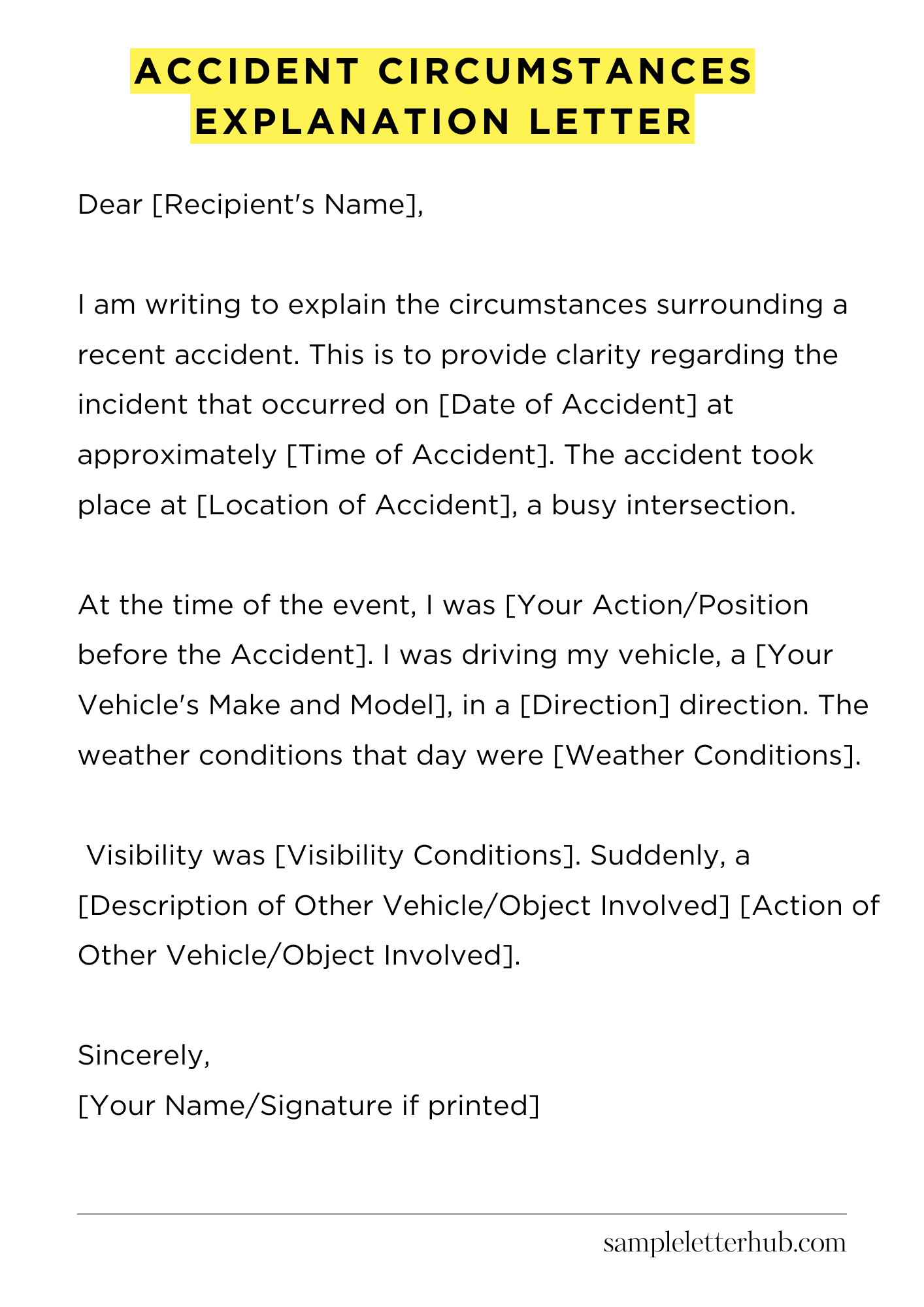
Dear [Recipient’s Name],
I am writing to explain the circumstances surrounding a recent accident. This is to provide clarity regarding the incident that occurred on [Date of Accident] at approximately [Time of Accident]. The accident took place at [Location of Accident], a busy intersection.
At the time of the event, I was [Your Action/Position before the Accident]. I was driving my vehicle, a [Your Vehicle’s Make and Model], in a [Direction] direction. The weather conditions that day were [Weather Conditions]. Visibility was [Visibility Conditions]. Suddenly, a [Description of Other Vehicle/Object Involved] [Action of Other Vehicle/Object Involved].
This unexpected action caused me to react quickly. I [Your Actions to Avoid the Accident – e.g., applied the brakes, steered left]. Despite my best efforts to prevent a collision, a collision occurred. The point of impact was [Describe the point of impact on both vehicles/objects].
Following the impact, I immediately [Your Actions After the Accident – e.g., checked for injuries, contacted the authorities]. The police were notified, and they arrived at the scene shortly afterward. A police report, number [Police Report Number, if applicable], was filed. I cooperated fully with the investigating officers.
There were [Number] parties involved in the accident, including myself. Fortunately, there were no serious injuries reported. However, there was some damage to both vehicles. My vehicle sustained damage to the [Location of Damage]. The other vehicle involved had damage to its [Location of Damage].
I am providing this explanation to ensure a complete understanding of the circumstances. I am available to answer any further questions you may have. I trust this information is helpful in resolving this matter.
Sincerely,
[Your Name/Signature if printed]
How to Write an Accident Circumstances Explanation Letter
An accident, whether minor or momentous, frequently necessitates a formal explanation. Crafting a cogent and persuasive “Accident Circumstances Explanation Letter” is crucial.
This document serves as your official account of the incident, potentially impacting legal proceedings, insurance claims, and personal relationships. It’s not merely a formality; it’s a vital tool for safeguarding your interests and elucidating the truth.
1. Preambling Prolegomena: Setting the Stage
Begin with a meticulous recitation of basic details. This introductory paragraph sets the tone. Clearly state the date, time, and precise location of the accident. Also, explicitly identify all parties involved.
A concise yet comprehensive opening builds credibility. Include any reference numbers associated with the incident, such as a police report number or insurance claim reference. This meticulous groundwork lays a solid foundation for your subsequent explanation.
2. The Chronological Narrative: Weaving the Tale
Now, recount the events that transpired. This is the heart of your letter. Structure your narrative chronologically. Start with what you were doing before the accident, and progress step-by-step. Include every relevant detail without embellishment.
Stick to the facts, avoid speculative language. This includes the weather conditions, visibility, and any obstructions that could have influenced the accident. Precise articulation strengthens your position.
3. Deconstructing the Dynamics: Unraveling the ‘How’
Elucidate the immediate cause of the accident. This demands pinpoint accuracy. Describe precisely how the incident occurred. Specify your actions and the actions of others involved.
Detail the sequence of events. Use clear and unambiguous language to convey the dynamics. Were there any mechanical failures? Note them. Were road signs missing? Include them. Be as thorough as humanly possible.
4. Identifying the Immediate Ramifications: Assessing the Damage
Provide a detailed account of the damages. Specify the nature of the damage. Describe the nature of any injuries sustained. This includes vehicle damage, property damage, and personal injuries.
Be specific about the extent of the damage. Include any medical evaluations and treatment received. Note any witnesses and their contact information. This documentation provides a clear picture of the consequences of the accident.
5. The Act of Accountability: Owning Your Involvement
Acknowledge your role in the accident. If you bear any responsibility, address it directly. Express genuine remorse, if appropriate. However, do not admit liability without consulting with legal counsel.
The goal is to provide a truthful account, not necessarily to accept blame. A clear and honest assessment fosters trust and facilitates a more equitable resolution.
6. Subsequent Action and Resolution: Laying the Groundwork
Outline the actions you’ve taken since the accident. Describe any steps taken to mitigate further damage or injury. Explain if you contacted the authorities and reported the incident.
Detail the status of any insurance claims. Express your willingness to cooperate fully with any investigations. Proactive steps demonstrate your commitment to resolving the situation.
7. Final Salutations and Securing the Letter: The Formal Closure
Conclude with a professional closing. Reiterate your contact information. Express your availability for further inquiries. Sign and date the letter. Consider sending the letter via certified mail with return receipt requested.
This provides proof of delivery and ensures accountability. This final act solidifies the importance of the document.
FAQs about Accident Circumstances Explanation Letter
What is an Accident Circumstances Explanation Letter, and why is it needed?
An Accident Circumstances Explanation Letter, often referred to as a statement or report, is a written document that details the events leading up to, during, and after a vehicle accident. It’s a formal account of what happened, providing information about the involved parties.
What information should be included in an Accident Circumstances Explanation Letter?
A comprehensive explanation letter should include the date, time, and location of the accident. It should also identify all parties involved, including their names, contact information, and insurance details. You must describe the weather and road conditions at the time.
A step-by-step account of the accident, including vehicle movements and impacts is crucial. Finally, any damages to vehicles or injuries sustained by any individuals should be documented.
Who needs to write an Accident Circumstances Explanation Letter?
Typically, all drivers involved in a vehicle accident are expected to write an Accident Circumstances Explanation Letter. However, passengers who witnessed the accident may also be asked to provide a statement.
In some cases, witnesses may be required to submit their account. The purpose of this letter is to provide insurance companies and/or law enforcement with an understanding of what took place.
How should the Accident Circumstances Explanation Letter be formatted?
There is no universally mandated format. However, it’s generally recommended to write in a clear, concise, and chronological manner. Begin by stating the date, time, and location. Identify all involved parties.
Describe the events leading up to the accident, the accident itself, and the aftermath. Maintain an objective tone, avoiding speculation or admissions of fault. Ensure the letter is signed and dated, with your printed name. Provide contact details.
What are the legal implications of the Accident Circumstances Explanation Letter?
The letter serves as a legal document that can be used as evidence in insurance claims or legal disputes. Accuracy is critical, as any false or misleading information could have severe consequences.
Statements made in the letter could impact the determination of fault and the payout of insurance claims. Therefore, it is important to be truthful and precise in the account of the events. Additionally, consult with a legal professional when needed, and before submitting your letter.
Related:
Resignation letter due to rude boss
Resignation letter moving to another state
Resignation letter due to illness of family member
Resignation letter due to study