

Need your home insurance policy information? A “Letter to Request Home Insurance Policy Information” is a formal way to ask your insurance provider for details. It’s often needed for things like refinancing, legal matters, or simply understanding your coverage. This letter ensures you get the necessary home insurance documents and avoids confusion.
Sometimes, writing such letters can feel tricky. Don’t worry, though. We’ve got you covered. This article offers helpful letter templates and examples for requesting your home insurance policy. Use these samples to draft your own. It’s designed to make the process simple.
We’ll provide a variety of formats. You can adapt them to your specific needs. Easily request your home insurance policy with confidence. Get the documents you need quickly and efficiently. Let’s get started.
[Your Name/Your Company Name]
[Your Address]
[Your Phone Number]
[Your Email Address]
[Date]
[Insurance Company Name]
[Insurance Company Address]
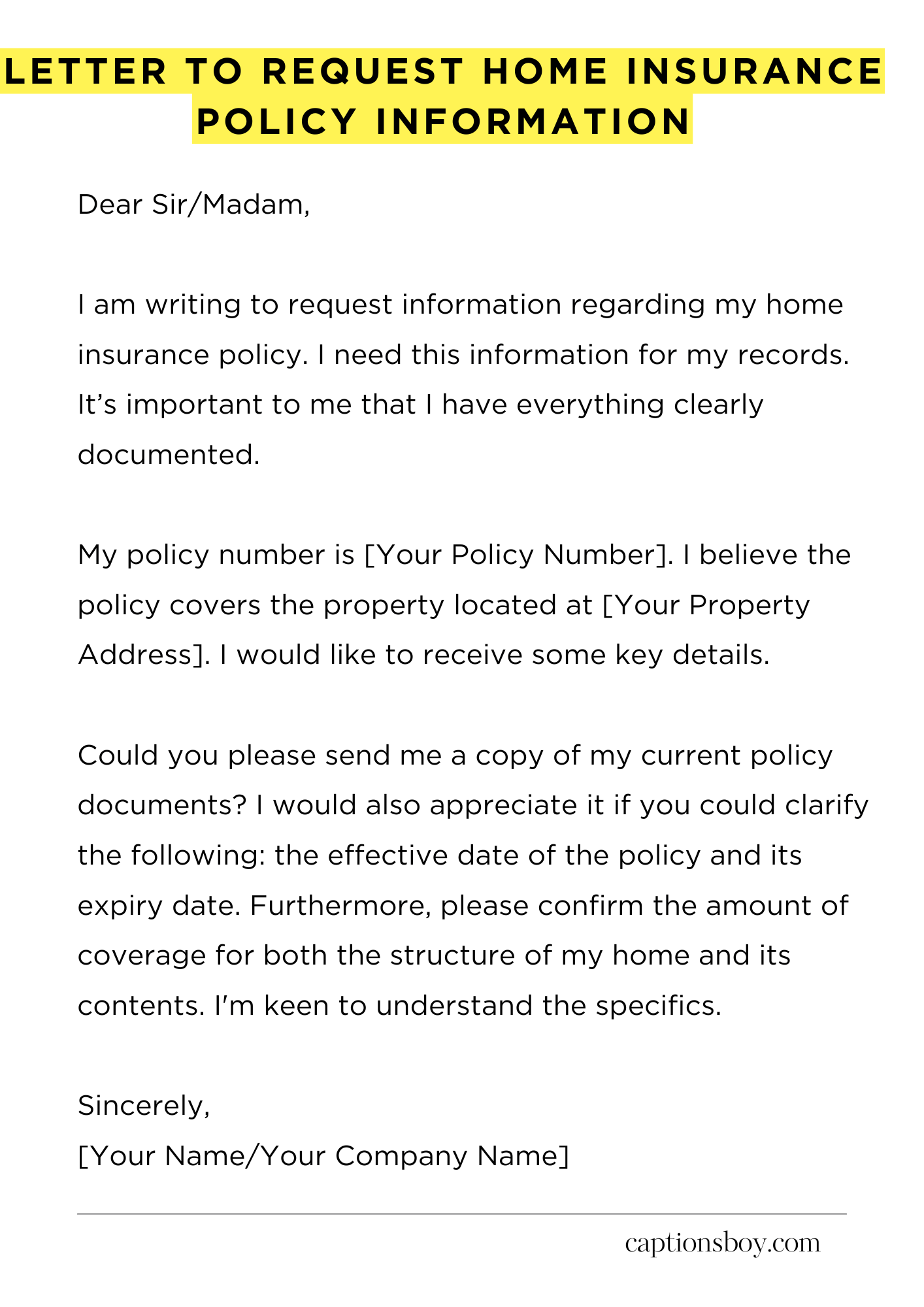
Dear Sir/Madam,
I am writing to request information regarding my home insurance policy. I need this information for my records. It’s important to me that I have everything clearly documented.
My policy number is [Your Policy Number]. I believe the policy covers the property located at [Your Property Address]. I would like to receive some key details.
Could you please send me a copy of my current policy documents? I would also appreciate it if you could clarify the following: the effective date of the policy and its expiry date. Furthermore, please confirm the amount of coverage for both the structure of my home and its contents. I’m keen to understand the specifics.
Also, it would be extremely helpful to receive a list of the covered perils. This is particularly relevant. Please include any deductibles that apply to my policy. I want to make sure I’m fully aware of my coverage.
Finally, if possible, I’d like to know how to file a claim. Please provide clear instructions. I would also appreciate any contact information for the claims department.
Thank you for your time and assistance. I look forward to receiving this information as soon as possible. Your prompt response is greatly appreciated.
Sincerely,
[Your Name/Your Company Name]
How to Write a Letter to Request Home Insurance Policy Information
1. Pre-Letter Protocol: Assembling Your Arsenal
Before even touching a quill (or keyboard), you must meticulously gather the requisite information. Scrutinize your existing records. Identify your insurer, your policy number, and the specific information you seek. This preparatory phase is not merely administrative; it’s a strategic maneuver designed to optimize the letter’s efficacy. A well-prepared request minimizes back-and-forth, expediting the receipt of the desired documents. This upfront diligence is critical.
2. The Opening Salvo: Crafting a Compelling Salutation
Begin with a professional and direct salutation. Avoid overly casual greetings. Use “Dear [Insurance Company Name],” or “To Whom It May Concern,” if a specific contact isn’t known. Ensure clarity and precision from the outset. This sets the tone for a serious and professional communication. It reflects a considered approach.
3. Deconstructing the Body: Articulating Your Demands
The body of your letter is where you articulate your specific request. Start by explicitly stating that you are writing to request information regarding your home insurance policy. Mention your policy number prominently. Then, be explicit about what information you need: coverage details, claim history, premium payment records, or any other pertinent data. Remember to be exceptionally clear. Avoid ambiguous language. Ambiguity is the enemy of clarity, and in this context, it may engender delay.
4. Pinpointing the Premise: Providing Your Identifying Information
Include your full name, address, and contact information. This is essential for the insurer to locate your policy and send the information to the correct place. If possible, provide additional identifying details, such as a date of birth. This will facilitate efficient verification. The more information you provide, the faster the process.
5. Deciphering the Delivery: Stipulating Your Preferred Method
Specify how you prefer to receive the requested information. State whether you prefer a physical mailing, email, or other means. Provide the relevant addresses or email addresses. Providing a preference will accelerate response times. Proactive specification helps.
6. The Concluding Couplet: Formulating a Formal Closure
Conclude with a formal closing. Use phrases such as “Sincerely,” “Respectfully,” or “Yours faithfully” (if you began with “Dear Sir/Madam”). Then, type your full name and sign above your typed name. This is a crucial element. This reinforces the legitimacy and validity of your request. This concluding etiquette is necessary.
7. The Prophylactic Measure: Proofreading and Dispatch
Before sealing the envelope (or clicking send), meticulously proofread your letter. Check for grammatical errors, typos, and factual inaccuracies. A polished letter demonstrates professionalism and attention to detail. Make a copy of the letter for your records. Then, dispatch it through a traceable method, such as certified mail. This ensures proof of delivery. This is a crucial final step.
FAQs about Letter to Request Home Insurance Policy Information
What information should I include in a letter requesting home insurance policy information?
When writing a letter to request your home insurance policy information, you should include the following: Your full name, current address, and contact information; the property address covered by the policy; the policy number; the specific information you are requesting (e.g., a copy of the policy, coverage details, declarations page, claim history); the date of the request; and your signature. If you are not the policyholder but are authorized to receive information (e.g., through power of attorney), include documentation of your authorization.
Who should I address the letter to?
The letter should be addressed to your insurance company. The specific department will depend on the information you are requesting, but generally, it is best to address the letter to the “Customer Service Department” or the “Policy Information Department.” You can find the correct mailing address on your policy documents or on the insurance company’s website. If you are unsure, contact your insurance provider by phone to confirm the appropriate recipient and address.
What is the purpose of requesting this information?
You might request your home insurance policy information for various reasons. Common reasons include: Filing an insurance claim, reviewing your coverage, providing information to a mortgage lender, obtaining proof of insurance, shopping for a new policy, or simply updating your records. The specific reason will help you determine what details you need to request in the letter.
How should I send the letter, and what is the best way to ensure it’s received?
It is generally recommended to send the letter via certified mail with return receipt requested. This provides proof that the insurance company received your request and the date it was received. You can also send the letter via email if the insurance company accepts requests this way, and in this case, you may receive a quicker response. Always keep a copy of the letter for your records. If sending an email, retain the sent email as proof.
How long does it typically take to receive a response to the request?
The response time can vary depending on the insurance company and the information requested. Generally, you should expect to receive a response within 10-30 business days. It is advisable to specify a reasonable timeframe within your letter to ensure the documents are sent at a required time. If you haven’t received a response within the expected timeframe, you should follow up with the insurance company by phone or email to inquire about the status of your request.
Related:
Resignation letter due to rude boss
Resignation letter moving to another state
Resignation letter due to illness of family member
Resignation letter due to study
Resignation letter due to long commute