

Facing an overdue insurance premium can be stressful. A hardship letter for overdue insurance premium is a formal request. Its purpose is to explain your financial situation. You aim to convince your insurance provider to offer assistance. This assistance could include a payment plan or waived fees.
We understand navigating this can be tough. We’re here to help! This article provides you with hardship letter examples. You’ll find samples and templates to guide you. Use these to draft your own hardship letter. Make the process simple.
Our goal is to assist you. These resources simplify writing your letter. We’ll offer various letter examples. Each addresses different situations. Use them to craft your perfect hardship letter for your overdue insurance.
[Your Name/Insurance Policy Holder Name]
[Your Address]
[Your Phone Number]
[Your Email Address]
[Date]
[Insurance Company Name]
[Insurance Company Address]
Subject: Hardship Letter Regarding Overdue Insurance Premium – Policy Number [Your Policy Number]
Dear [Insurance Company Representative Name or “To Whom It May Concern”],
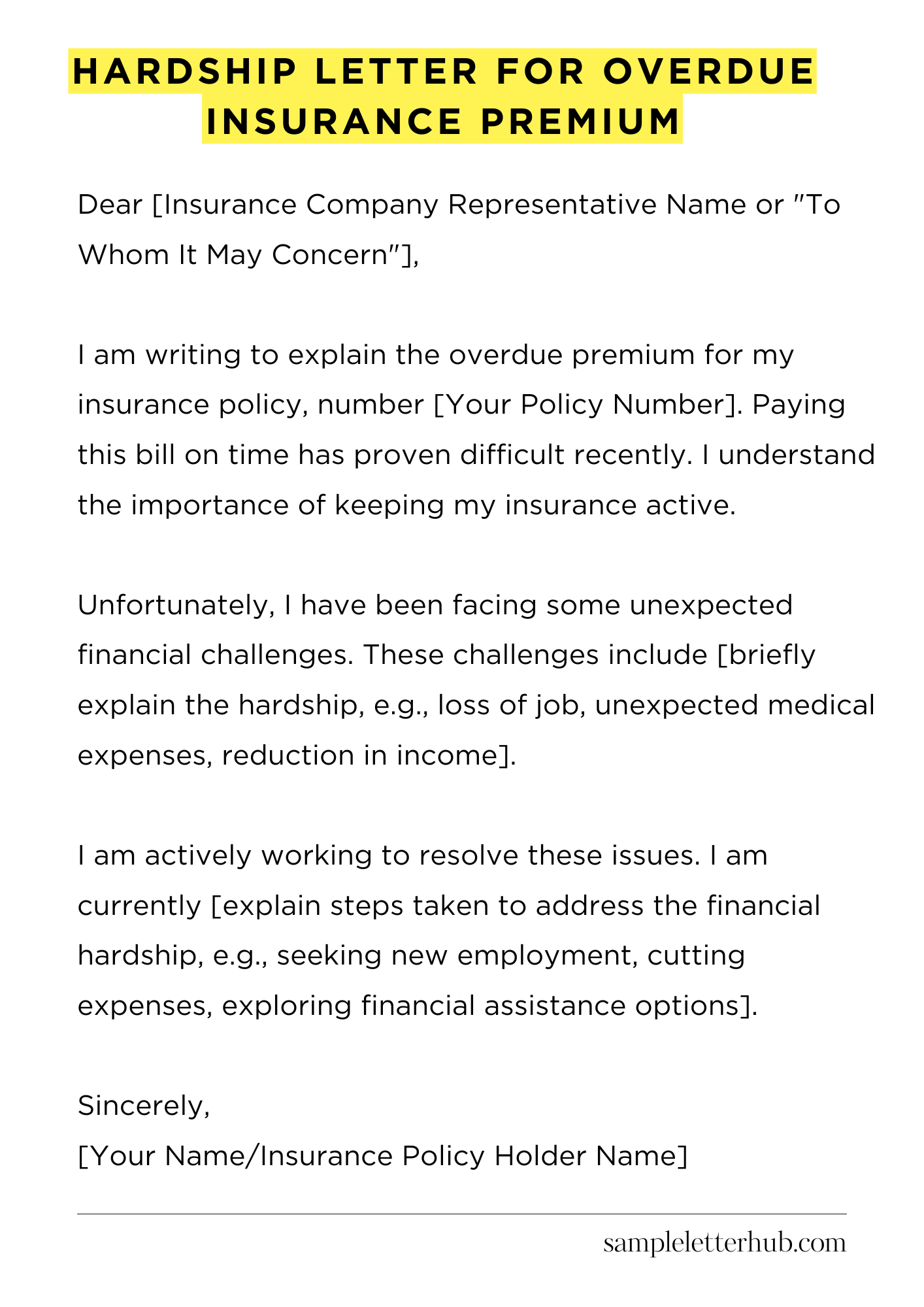
I am writing to explain the overdue premium for my insurance policy, number [Your Policy Number]. Paying this bill on time has proven difficult recently. I understand the importance of keeping my insurance active.
Unfortunately, I have been facing some unexpected financial challenges. These challenges include [briefly explain the hardship, e.g., loss of job, unexpected medical expenses, reduction in income]. These issues have significantly impacted my ability to manage my finances effectively. This has, regrettably, affected my ability to make timely payments, including this insurance premium.
I am actively working to resolve these issues. I am currently [explain steps taken to address the financial hardship, e.g., seeking new employment, cutting expenses, exploring financial assistance options]. I am also dedicated to catching up on my payments as soon as possible.
I would greatly appreciate it if you would consider my situation. I would be very grateful for any assistance you could offer. Would it be possible to discuss a payment plan to bring my account current? Or, perhaps, a temporary extension on the due date? Any flexibility would be a tremendous help during this difficult period.
I value my insurance coverage and intend to maintain it. I am committed to resolving this issue promptly. Please let me know what options are available to me. I look forward to hearing from you soon and resolving this matter.
Thank you for your time, consideration, and understanding.
Sincerely,
[Your Name/Insurance Policy Holder Name]
How to Write Hardship Letter for Overdue Insurance Premium
Falling behind on your insurance premiums? Don’t panic. A well-crafted hardship letter can significantly influence your insurer’s decision. This guide equips you with the crucial elements to draft a compelling letter. Let’s get started!
1. Initiate: Framing Your Plight
The commencement is paramount. Begin with a clear and concise salutation, addressing the appropriate department or individual at your insurance provider. State the policy number and the dates the premium payments are overdue.
Then, immediately and frankly, detail the specific reason behind your financial predicament. Was it a sudden job loss, unexpected medical expenses, or perhaps a family emergency? Be explicit and direct. Ambiguity weakens your case.
2. Explicate: Detailing the Causative Factors
Now, delve deeper into the precipitating circumstances that led to your inability to meet your financial obligations. Provide concrete examples and support your claims with documentation, like medical bills, unemployment notices, or bank statements.
These artifacts serve as irrefutable evidence. Avoid hyperbole and maintain a professional tone, demonstrating both your understanding of the situation and your genuine desire to resolve it. This is your chance to really show that you understand what’s happening.
3. Substantiate: Providing Supporting Evidence
This is where the rubber meets the road. Append copies of any pertinent documentation. Medical bills, employment termination notices, or records of significant financial setbacks all strengthen your plea.
Be meticulous; ensure all documents are legible and clearly labeled. If possible, consider organizing your attachments and providing a brief summary of each document in your letter. This showcases your conscientiousness.
4. Articulate: Proposing a Remedial Action
Don’t just lament your situation; offer solutions. What specific steps have you undertaken or will undertake to rectify the situation? Can you propose a modified payment plan? Are you willing to make a lump-sum payment at a later date? Demonstrate your proactive approach to managing the debt. Your willingness to collaborate is important.
5. Acknowledge: Accepting Responsibility and Assurance
Show that you understand the seriousness of the situation. Acknowledge your past due payments and reiterate your commitment to the policy. Assure the insurance provider of your intention to maintain coverage. Expressing a sense of responsibility can demonstrate credibility. It will definitely benefit you.
6. Request: A Plea for Consideration
Formulate a clear and unambiguous request for assistance. Whether it’s a temporary waiver of late fees, a revised payment schedule, or the reinstatement of your policy, make your specific needs known. Avoid being overly demanding; instead, emphasize the hardship you’re experiencing and your commitment to resolving the issue. This is all about what you can get, so make it clear.
7. Conclude: Polished Submission
Conclude your letter with a polite closing, such as “Sincerely” or “Respectfully.” Include your full name, address, phone number, and email address. Proofread your letter meticulously for any grammatical errors or typos.
Submit the letter via certified mail or another method that provides confirmation of delivery. This ensures a record of your communication and helps demonstrate your commitment. Remember, presentation matters as much as the content.
FAQs about Hardship Letter for Overdue Insurance Premium
What is a hardship letter for an overdue insurance premium?
A hardship letter is a formal written request sent to your insurance provider explaining the specific circumstances that have made it difficult for you to pay your insurance premiums on time. It seeks leniency or a temporary adjustment to your payment schedule due to unforeseen financial difficulties.
What kind of information should I include in a hardship letter?
Your hardship letter should clearly outline the reasons for your financial difficulty. This includes the date the hardship began, the specific event causing the hardship (e.g., job loss, medical expenses), a description of your financial situation (e.g., reduced income, increased expenses), and any supporting documentation (e.g., pay stubs, medical bills). Be clear, honest, and concise.
What types of hardships are typically considered valid for a hardship letter?
Valid hardships often include job loss or reduction in work hours, unexpected medical expenses, natural disasters impacting your property or finances, death of a primary wage earner, divorce, or other significant, documented financial difficulties beyond your control. Policies vary between insurance providers.
What are the possible outcomes after submitting a hardship letter?
The insurance provider will review your letter and supporting documentation. Possible outcomes include approval of a payment plan, temporary premium reduction, waiver of late fees, or continuation of coverage despite the overdue premiums. Denial is also possible if the provider deems the hardship insufficient or if your policy terms prevent accommodations.
What should I do if my hardship letter is rejected?
If your hardship letter is rejected, you can try to understand the reasons for the denial. You can then try to negotiate a revised payment plan or explore other options such as switching to a lower-cost plan or seeking assistance from a consumer credit counseling service.
Carefully review the reasons provided by the insurer, and consider providing any missing information. You may also contact your state’s insurance commission for further guidance.
Related:
Resignation letter due to rude boss
Resignation letter moving to another state
Resignation letter due to illness of family member
Resignation letter due to study