

Dealing with job loss is tough. It often brings financial struggles. One of the biggest concerns is paying for insurance. A “Letter Explaining Job Loss and Insurance Payment Difficulty” addresses this. Its purpose is clear: to inform your insurance provider about your situation and request help.
Writing this type of letter can feel overwhelming. We understand. That’s why we’ve created helpful templates. You’ll find letter examples and samples here. These job loss letter formats are ready to adapt. They can make the writing process easier.
We want to empower you. These insurance payment focused letters are designed to assist. Our goal is to simplify the communication process. Use these job loss insurance letter examples as your guide. Good luck!
[Your Name]
[Your Address]
[Your Phone Number]
[Your Email Address]
[Date]
[Insurance Company Name]
[Insurance Company Address]
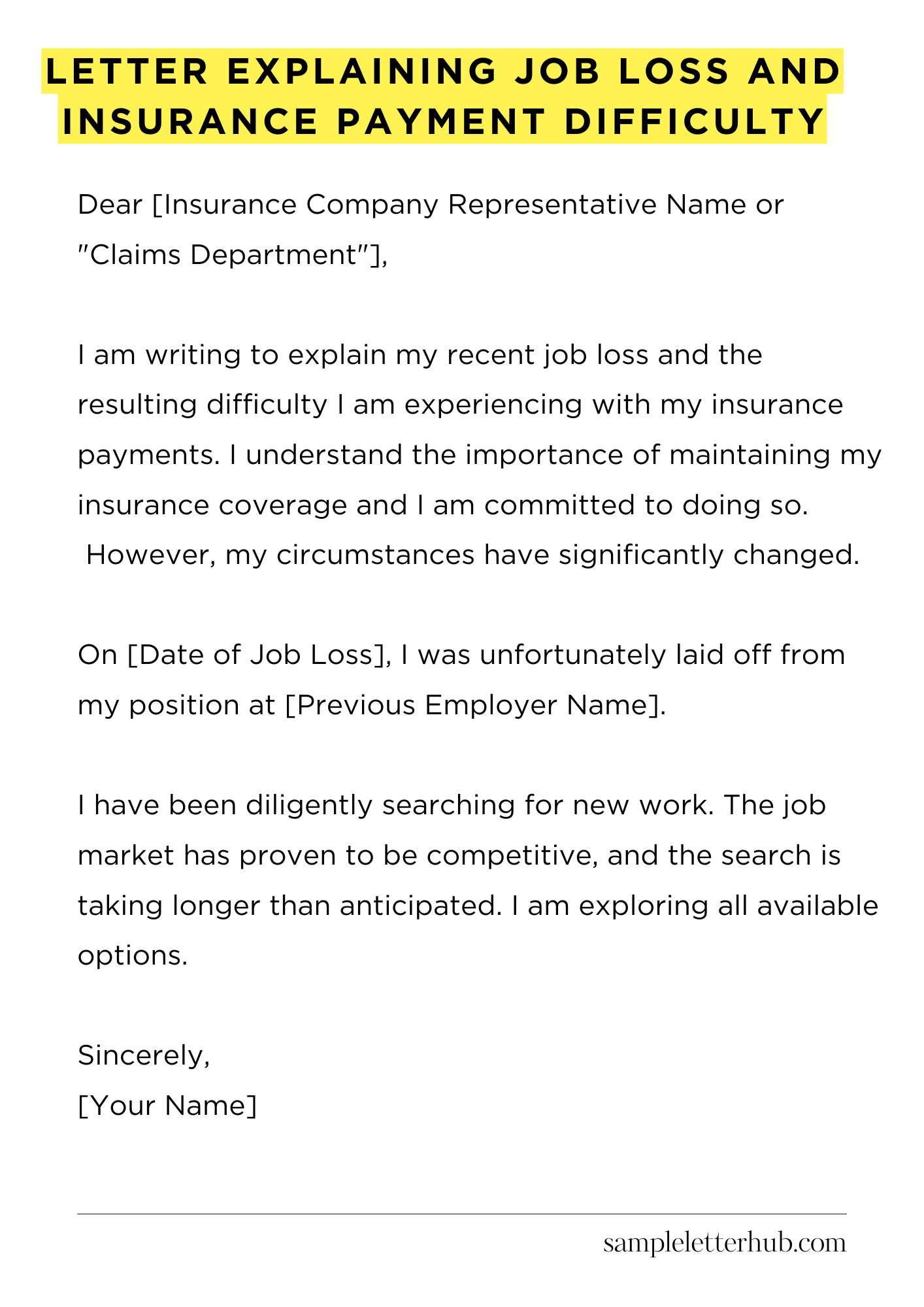
Dear [Insurance Company Representative Name or “Claims Department”],
I am writing to explain my recent job loss and the resulting difficulty I am experiencing with my insurance payments. I understand the importance of maintaining my insurance coverage and I am committed to doing so. However, my circumstances have significantly changed.
On [Date of Job Loss], I was unfortunately laid off from my position at [Previous Employer Name]. This has created a financial strain that is making it challenging to meet all of my monthly obligations, including my insurance premiums. It was a difficult situation, and I am actively seeking new employment.
I have been diligently searching for new work. The job market has proven to be competitive, and the search is taking longer than anticipated. I am exploring all available options.
Due to this unexpected loss of income, I am requesting your understanding and assistance regarding my insurance payments. I am currently behind on my payment for [Policy Type, e.g., health insurance, auto insurance, etc.]. I would like to explore options to maintain my coverage during this challenging period.
I would be grateful if you could provide information on any available programs or payment plans that might be suitable for my situation. Perhaps a temporary reduction in premiums or a grace period would be possible. I am particularly interested in understanding any hardship programs your company offers.
I am prepared to provide any documentation that might be needed to support my request. This could include proof of my job loss, documentation of my unemployment status, or any other relevant information. Please let me know what is required.
I value the protection my insurance provides and I am eager to resolve this matter as quickly as possible. I would appreciate it if you could contact me at your earliest convenience to discuss this further. You can reach me at the phone number listed above or via email.
Thank you very much for your time, consideration, and understanding.
Sincerely,
[Your Name]
How to Write Letter Explaining Job Loss and Insurance Payment Difficulty
Losing your job is a significant life upheaval, and when you couple that with the potential for disruptions to your insurance coverage, it can feel overwhelming. You’ll need to compose a letter to your insurance provider, articulating your situation.
This act of written communication can be a crucial step in maintaining your essential benefits. We’ll delve into the necessary components to help you navigate this delicate process effectively.
1. Commence with an Official Salutation
Begin with a formal salutation. Address your missive to the appropriate department or, if possible, a specific individual within the insurance company. Use titles like “Dear Claims Department” or “Dear Mr./Ms. [Last Name].”
This establishes a professional tone from the get-go. Precision here underscores your seriousness.
2. Explicitly State Your Predicament: Job Termination
The core of your letter should clearly and concisely declare your job loss. Provide the date of your termination and, if pertinent, the name of your former employer. Don’t mince words. Get directly to the point. Make your circumstances crystal clear. Be factual.
3. Describe Your Financial Impediments
Now, meticulously elucidate your current financial straits. Detail how the job loss has directly impacted your ability to meet your insurance premium payments.
Include any relevant information about severance pay, unemployment benefits, or other income streams. Provide tangible figures if possible. Specificity enhances credibility.
4. Request a Temporary Forbearance
Within this segment, propose solutions. Politely request a temporary forbearance on your premium payments. Explain what timeframe would be reasonable, given your expected financial situation.
This demonstrates initiative and proactive planning. Be realistic in your request. A well-reasoned proposal is more likely to garner favorable consideration.
5. Furnish Supportive Documentation
To bolster your claims, include supporting documentation. This could encompass a copy of your termination letter, unemployment benefits documentation, and any other evidence that validates your position. Include any related correspondence.
Attachments augment your credibility and reinforce your narrative. Always retain copies of everything you send.
6. Showcase Sincerity and Gratitude
Express genuine sincerity in your letter. Thank the insurance provider for considering your request and acknowledge their understanding of your difficult position. End with a polite closing, such as “Sincerely” or “Respectfully.”
Demonstrate appreciation for their assistance. This shows you’re not just complaining, but attempting to resolve a challenge.
7. Include Your Contact Information and a Definitive Closing
Always conclude your letter with your full name, address, phone number, and email address. Ensure these details are accurate and readily available for the recipient. Then, add a final, conclusive statement, like “I eagerly await your response.”
Proofread thoroughly before dispatching. Ensure your communication is free of errors. This leaves a lasting impression of meticulousness.
FAQs about Letter Explaining Job Loss and Insurance Payment Difficulty
What is the primary purpose of a letter explaining job loss and insurance payment difficulty?
The primary purpose of this letter is to formally notify insurance providers of a job loss, which often leads to a change in financial circumstances.
It aims to explain the reason behind the inability to make timely insurance payments and to potentially explore options for continued coverage or modified payment plans. This can help to prevent policy cancellation or other adverse actions.
What key information should be included in this type of letter?
The letter should include the policyholder’s full name, policy number, the date of job loss, the employer’s name, and a clear explanation of the situation.
It should state that the job loss is impacting the ability to pay premiums and, if possible, propose a solution like a temporary payment deferral, a change in coverage level to lower premiums, or a request for a payment plan. It’s also crucial to include contact information and the desired method of response from the insurer.
Can a letter regarding job loss and insurance payment difficulty affect my credit score?
While the letter itself won’t directly impact your credit score, the failure to pay insurance premiums can. Insurance companies might report non-payment to credit bureaus, especially if debt collection efforts are necessary.
Therefore, addressing the situation promptly and working with your insurer to find a solution is key to mitigate negative credit consequences.
What are some potential solutions an insurance company might offer in response to this letter?
Insurance companies may offer a range of solutions. These could include a temporary payment deferral, a payment plan to spread out the payments, a temporary reduction in coverage to lower premiums, a change to a less expensive policy, or a waiver of late fees. The specific options will depend on the insurance company’s policies and the type of insurance.
How should I follow up after sending this letter?
After sending the letter, follow up with your insurance company within a reasonable timeframe (e.g., within a week or two) to confirm they received it and to inquire about their response.
This could involve a phone call or an email. Keep a copy of the letter and any communication exchanged with the insurance company for your records. Document the date, time, and content of all communication.
Related:
Resignation letter due to rude boss
Resignation letter moving to another state
Resignation letter due to illness of family member
Resignation letter due to study