

Facing financial struggles? Need help managing your bills? A letter for reduced payment plan due to financial hardship can be a lifeline. Its purpose is to request a temporary or permanent adjustment to your payment schedule. You explain your situation and ask for a more manageable plan. This helps you avoid late fees and maintain good standing with your creditors.
Writing this letter can feel overwhelming. We understand. That’s why we’re here to help. We’ve compiled templates, examples, and samples of a letter for reduced payment plan due to financial hardship. These are ready-to-use documents. They provide a solid starting point for your own letter.
Need to draft a letter for reduced payment plan? Our provided samples will make it easier. We want to help you create a compelling and effective communication. Get ready to download and adjust. Good luck with writing your financial hardship letter!
[Your Name]
[Your Address]
[Your Phone Number]
[Your Email Address]
[Date]
[Creditor’s Name]
[Creditor’s Address]
Subject: Request for Reduced Payment Plan Due to Financial Hardship
Dear [Creditor’s Name],
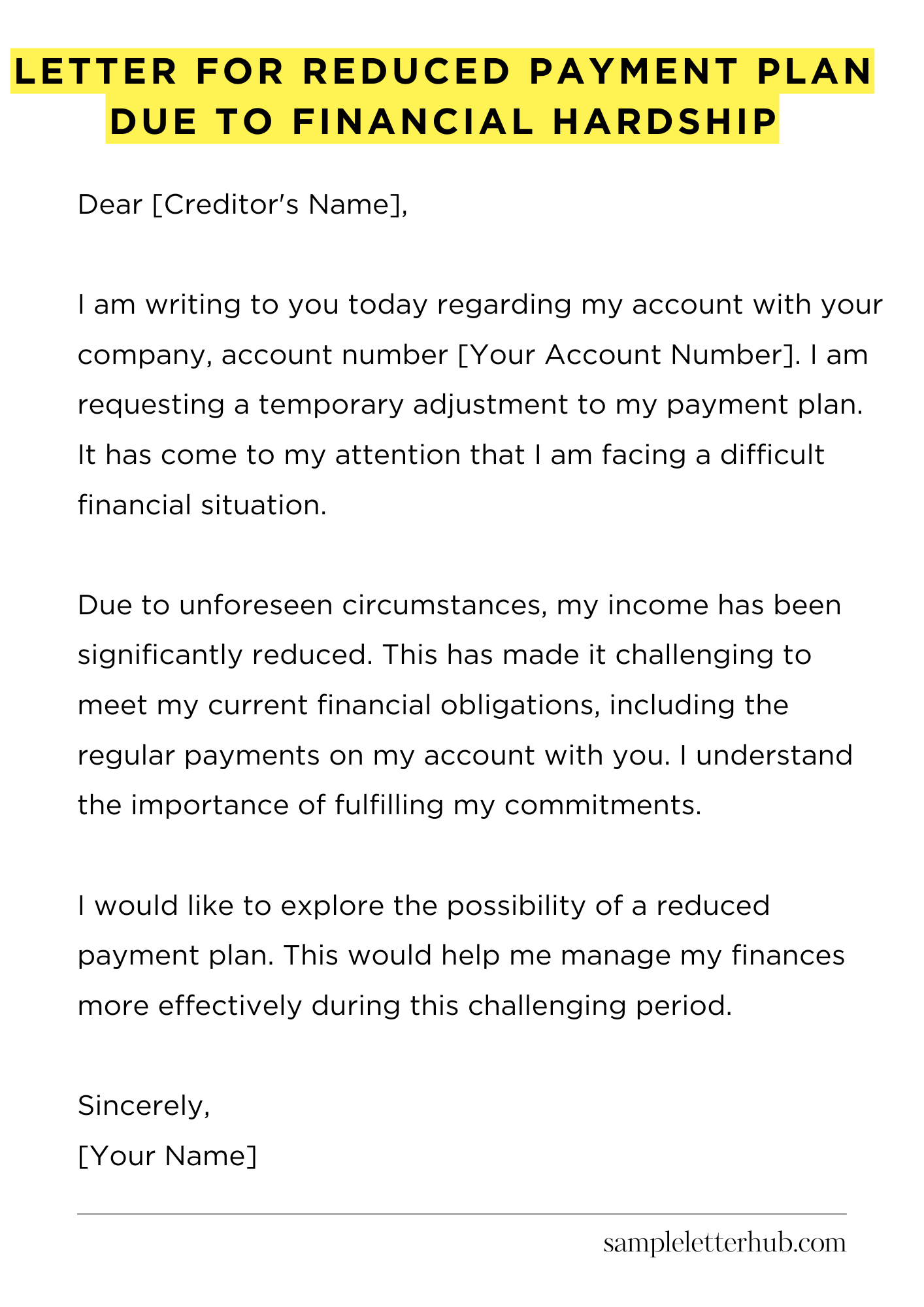
I am writing to you today regarding my account with your company, account number [Your Account Number]. I am requesting a temporary adjustment to my payment plan. It has come to my attention that I am facing a difficult financial situation.
Due to unforeseen circumstances, my income has been significantly reduced. This has made it challenging to meet my current financial obligations, including the regular payments on my account with you. I understand the importance of fulfilling my commitments.
I would like to explore the possibility of a reduced payment plan. This would help me manage my finances more effectively during this challenging period. I am committed to repaying my debt and believe that a modified payment plan would enable me to do so without further straining my limited resources.
I have carefully reviewed my budget and can realistically afford to pay [Proposed Monthly Payment Amount] per month.
I have attached [Optional: Include any supporting documents, e.g., recent pay stubs, bank statements, or a letter explaining your situation] to help you understand my current financial situation. I am open to discussing this matter further. I am also available to provide any additional information you may require.
I appreciate your understanding and willingness to work with me during this difficult time. I look forward to your positive response and a resolution that allows me to continue meeting my obligations while managing my financial challenges. Your cooperation is greatly appreciated. Thank you for your time and consideration of my request.
Sincerely,
[Your Name]
How to Write Letter for Reduced Payment Plan Due to Financial Hardship
Navigating financial adversity is a challenging experience. It requires resilience and strategic action. One crucial step in mitigating financial strain is communicating your situation effectively. This often involves crafting a well-structured letter, specifically to request a reduced payment plan.
1. Initiate: The Salutation and Recipient
Start your missive with a formal salutation. Employ “Dear [Creditor’s Name/Department],” or a similarly professional greeting. Ensure the recipient is accurately identified; research the appropriate individual or department. Inaccuracy can derail your efforts from the onset. Address them with the utmost courtesy and respect. This sets a crucial tone.
2. State Your Case: The Heart of the Matter
The core of your letter necessitates a clear and concise declaration of your financial hardship. Elaborate upon the specific circumstances precipitating your predicament. Be upfront about why you are unable to fulfill your existing payment obligations.
Provide a succinct overview of the factors contributing to your impecuniousness, such as job loss, unexpected medical expenses, or other unforeseen financial setbacks.
3. Provide Substantiation: Backing Your Claims
Integrate supporting documentation. This is a critical component to lend credence to your assertions. Include copies of pertinent documents that validate your claims.
These might include bank statements, medical bills, unemployment notices, or any relevant paperwork demonstrating your reduced income or increased expenses. This evidence provides empirical support for your request.
4. Propose a Solution: Laying Out Your Terms
This section is where you proactively suggest a resolution. Clearly articulate the type of payment plan you are seeking. Perhaps you are requesting a reduced monthly payment, a temporary suspension of payments, or an adjusted repayment schedule.
Specify the amount you can realistically afford to pay. The more concrete your proposal, the higher the likelihood of acceptance.
5. Demonstrate Commitment: Reaffirming Your Intent
Reiterate your commitment to honoring your debt. This builds trust and goodwill. Express your sincere intention to repay the debt as soon as your financial situation stabilizes. Reinforce your dedication to finding a viable solution with the creditor. This displays responsibility and a willingness to cooperate.
6. Concluding the Correspondence: The Parting Words
Conclude your letter with a professional and respectful closing, such as “Sincerely,” or “Respectfully.” Include your full name, address, phone number, and email address. Offer your availability for any further clarification or discussion. Include a polite acknowledgment of their time. Ensure all contact information is accurate and up-to-date.
7. Polishing and Dispatch: Ensuring a Polished Product
Before submitting, meticulously proofread your letter. Correct any grammatical errors or typos. Ensure clarity and coherence throughout the text.
Use a professional font and layout. Once you are confident in its presentation, consider sending it via certified mail with return receipt requested. This provides documentation of its delivery and receipt. Keep a copy of the letter for your records.
FAQs about Letter for Reduced Payment Plan Due to Financial Hardship
What is a letter for a reduced payment plan due to financial hardship?
A letter for a reduced payment plan due to financial hardship is a formal written request sent to a creditor (e.g., a credit card company, a mortgage lender, a utility company) by a debtor (the individual who owes money).
The purpose of the letter is to explain the debtor’s current financial situation, highlighting the reasons for their inability to make the full payments as initially agreed upon. It then proposes a modified payment plan that the debtor believes they can realistically afford.
The goal is to avoid default or other negative consequences associated with missing payments, such as late fees, damage to credit scores, or repossession.
What information should be included in a hardship letter?
A comprehensive hardship letter generally includes the following key information: identification of the account(s) in question (account numbers, creditor name), a clear explanation of the financial hardship (e.g., job loss, medical bills, unexpected repairs), supporting documentation, and contact information.
It’s important to be honest, transparent, and provide as much detail as possible to support the request. The letter should also maintain a respectful and professional tone.
What types of financial hardships typically qualify for a reduced payment plan?
A wide variety of financial hardships may qualify for a reduced payment plan. These include, but are not limited to: job loss or reduction in hours, unexpected medical expenses, serious illness, death of a family member, divorce or separation, natural disasters (e.g., fire, flood), and unexpected major home or vehicle repairs.
Creditors evaluate requests on a case-by-case basis. The more documentation provided to verify the hardship, the better the chances of acceptance.
How do I write a compelling hardship letter that increases the chances of approval?
To write a compelling letter, be clear, concise, and honest about your situation. Clearly identify the account and the creditor. Detail the specific financial hardship, providing dates and explanations. Include supporting documentation to back up your claims. Propose a realistic and sustainable payment plan, and be upfront about the reason for the hardship.
Maintain a professional tone and express your willingness to work with the creditor to resolve the issue. Consider having a second party read the letter to catch any errors and ensure it is clear and easy to understand.
What are the possible outcomes after sending a hardship letter?
After sending a hardship letter, the creditor will review the request. The possible outcomes include approval of the proposed payment plan, a counteroffer with different terms (e.g., a slightly higher payment or a different repayment period), a denial of the request, or a request for more information.
If approved, it’s critical to adhere to the agreed-upon payment schedule. If denied, the debtor may negotiate further, seek assistance from a credit counseling agency, or explore other options such as debt consolidation or bankruptcy. Be aware that the outcome depends on the creditor’s policies and the specific circumstances of the financial hardship.
Related:
Resignation letter due to rude boss
Resignation letter moving to another state
Resignation letter due to illness of family member
Resignation letter due to study