


Dealing with unexpected travel issues? Need to claim on your travel insurance? You might need a Travel Insurance Hardship Letter. This letter explains your difficult situation. Its purpose is to support your travel insurance claim. It helps insurers understand why you need to make the claim.
Writing this letter can feel tricky. Don’t worry, we’ve got you covered. This article offers travel insurance hardship letter templates. We’ll show you different sample letters. These examples will simplify your letter-writing process. Use them to write your own persuasive hardship letter for travel insurance.
We’ll break down various scenarios. We aim to help you claim successfully. Let’s get started and make claiming your travel insurance as painless as possible. Use these templates as your guide for a strong and compelling letter.
[Your Name/Your Company Name]
[Your Address]
[Your Phone Number]
[Your Email Address]
[Date]
[Insurance Company Name]
[Insurance Company Address]
Subject: Travel Insurance Hardship Claim – Policy Number [Your Policy Number]
Dear Sir/Madam,
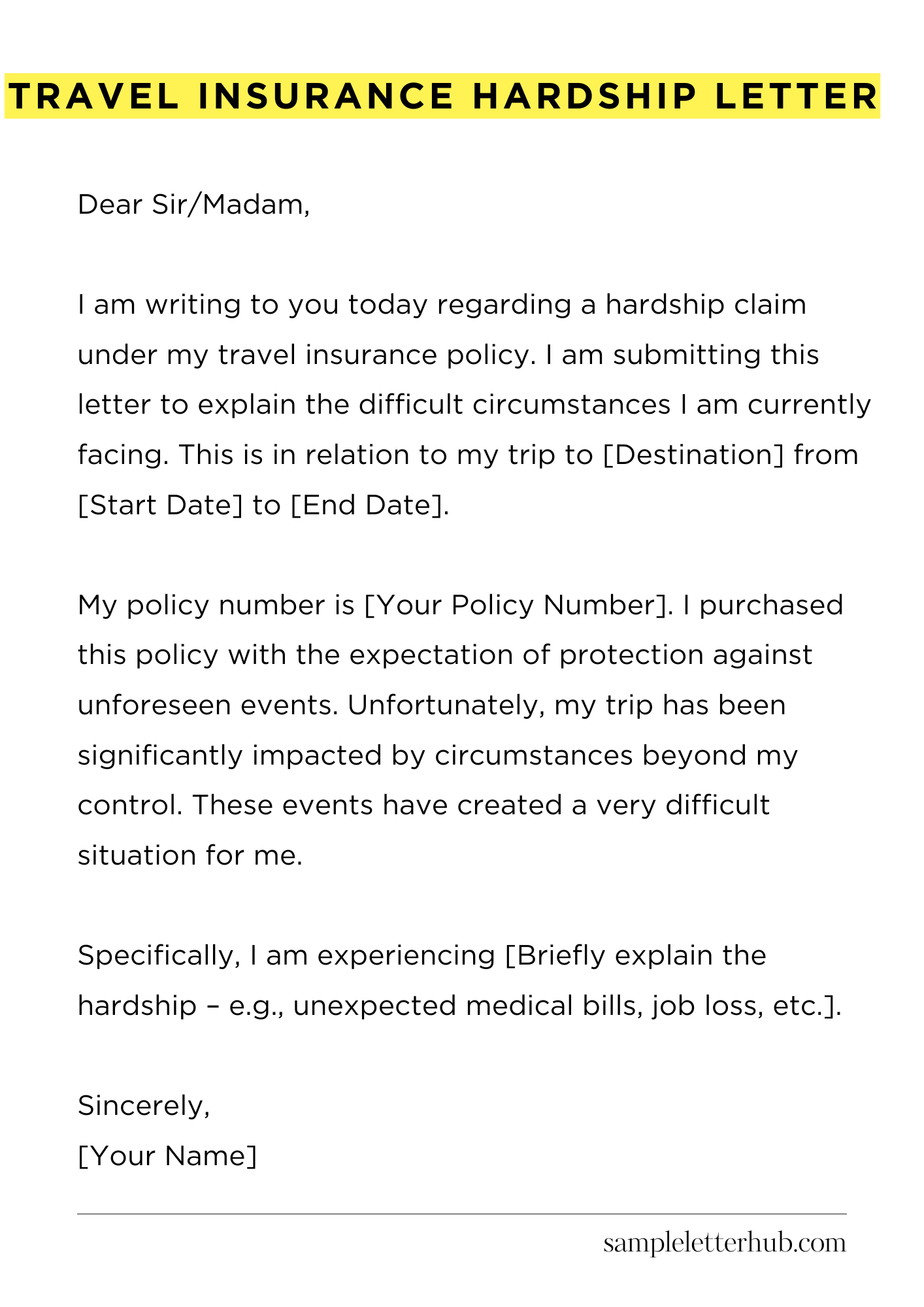
I am writing to you today regarding a hardship claim under my travel insurance policy. I am submitting this letter to explain the difficult circumstances I am currently facing. This is in relation to my trip to [Destination] from [Start Date] to [End Date].
My policy number is [Your Policy Number]. I purchased this policy with the expectation of protection against unforeseen events. Unfortunately, my trip has been significantly impacted by circumstances beyond my control. These events have created a very difficult situation for me.
Specifically, I am experiencing [Briefly explain the hardship – e.g., unexpected medical bills, job loss, etc.]. This has resulted in [Explain the impact of the hardship – e.g., inability to continue the trip, need for medical care, etc.]. The details are quite complicated. It’s truly been overwhelming.
Supporting documentation, including [List the documents you are including – e.g., medical bills, proof of job loss, etc.], is enclosed with this letter. These documents provide further evidence of my situation. I believe these demonstrate the extent of my financial and personal difficulties. They are essential to understanding my claim.
I respectfully request that you consider my claim based on these extenuating circumstances. I understand that the terms of the policy apply. I am hopeful that you will consider my situation sympathetically. I would appreciate it if you could review my claim quickly.
I am available to answer any questions you may have. You can reach me by phone at [Your Phone Number] or by email at [Your Email Address]. Please do not hesitate to contact me.
Thank you for your time, attention and consideration to my claim. I look forward to your response.
Sincerely,
[Your Name]
How to Write Travel Insurance Hardship Letter
Embarking on a journey, we anticipate unforgettable experiences. However, life, in its capricious nature, sometimes throws curveballs. Travel insurance, an essential safety net, aims to cushion these unforeseen circumstances.
When hardship strikes, crafting a compelling letter becomes crucial for claiming potential benefits. Here’s a comprehensive guide to navigating this process.
1. Initiate the Correspondence with Precision
Begin your missive by clearly stating its purpose. This should be explicitly mentioned right at the top. Reference your policy number, the specific event(s) leading to the claim, and the period to which the claim is applicable.
Clarity here establishes a solid foundation for your case. Ensure your recipient can effortlessly grasp the core issue. Keep it concise, but not laconic.
2. Delve into the Narrative: Detailing the Calamity
The core of your letter should revolve around the hardship. Provide an exhaustive account of what transpired. Explain the circumstances that led to your claim, offering a chronological, objective narrative.
Include dates, times, and locations – concrete details substantiate your claims. Employ strong, descriptive language to convey the gravity of the situation. Be truthful and avoid embellishments; stick to the verity of events.
3. Substantiating the Claim: Assembling Supporting Documentation
This is where the rubber meets the road. No claim is valid without supporting evidence. Include copies of every document pertinent to your claim. This may encompass medical reports, police reports (if applicable), flight cancellation notices, and any correspondence you’ve had with relevant authorities.
The more comprehensive your evidence, the stronger your case. It is akin to a judicial precedent that strengthens your stance.
4. Connect the Dots: Establishing Causation
Clearly articulate the causal relationship between the hardship and the travel disruption or loss. For instance, if you’re claiming for medical expenses, explicitly connect the illness or injury to the need for medical care.
If claiming for trip cancellation, demonstrate how the covered event directly prohibited your travel plans. Illustrate why your itinerary alteration or cancellation was unavoidable. Make the connection between the misfortune and its implications irrefutable.
5. Financial Ramifications: Quantifying the Losses
Meticulously enumerate all financial losses incurred as a direct result of the hardship. Provide itemized lists of expenses, including their individual costs. If possible, provide receipts and invoices for each cost.
Ensure that the total amount claimed aligns with your policy’s coverage limits. This is your chance to present the total monetary impact of the situation. Precise figures minimize ambiguity and enhance the credibility of your claim. Omissions in this section can hinder your prospects of recovery.
6. The Call to Action: Formulating a Precise Request
Politely, but firmly, state what you want. Specifically, what benefits are you seeking from the insurance company? Request a prompt and fair resolution of your claim. Outline any specific actions you require from the insurer.
Express your hope for a positive outcome and offer to provide any further information that may be needed to expedite the assessment. This section is key to translating your narrative into a quantifiable outcome.
7. Finalizing the Letter: Format and Salutations
Proofread the entire letter meticulously for grammar, spelling, and punctuation errors. A polished, professional presentation bolsters your credibility. Choose a formal salutation (e.g., “Dear Sir/Madam”). Use a clear font and format the letter in a professional style. Include your full name, address, contact information, and date.
Sign the letter manually if sending a physical copy. Sending the document electronically is permissible, however, it is prudent to check the requirements of the insurance provider. Ensure that you retain a copy of the letter and all supporting documentation for your records; it is the sine qua non of your record keeping.
FAQs about Travel Insurance Hardship Letter
What is a Travel Insurance Hardship Letter?
A travel insurance hardship letter, also known as a financial hardship letter, is a formal document you submit to your travel insurance provider. It explains why you are unable to pay for your travel insurance premium or are requesting assistance with a claim due to unforeseen financial difficulties.
This may involve providing documentation of your circumstances, such as proof of job loss, unexpected medical bills, or other significant financial setbacks impacting your ability to meet your obligations.
When Should I Submit a Travel Insurance Hardship Letter?
You should consider submitting a hardship letter in a few key situations. Firstly, if you are unable to afford your travel insurance premium payments, contact your insurer immediately to explore payment plan options or potential hardship considerations.
Secondly, if you are filing a claim related to travel disruptions (like a trip cancellation or delay) and are experiencing financial difficulties, a hardship letter can help explain your situation and potentially expedite the claim process or support your case for additional consideration.
Finally, if you are already experiencing financial hardship and have an emergency, a letter can be submitted to seek assistance with medical coverage or to seek options to recover losses.
What Information Should I Include in a Travel Insurance Hardship Letter?
Your letter should clearly state your policy details, including the policy number and the specific issue you are addressing (e.g., inability to pay premiums, claim denial).
You should then explain your financial hardship in detail, providing specific examples and dates. Include supporting documentation, such as medical bills, proof of unemployment, bank statements, or other relevant documents to substantiate your claims.
Be honest, concise, and professional in your writing, and clearly state what you are requesting from the insurer (e.g., a payment plan, reconsideration of a claim decision, or special consideration).
What Supporting Documents Do I Need to Include?
The required supporting documents will vary depending on the nature of your hardship. Common examples include: proof of job loss (termination letter, unemployment benefits documentation), medical bills and related expenses, bank statements, eviction notices, and other documentation of financial distress.
Always check your insurance policy and speak to your insurer to confirm exactly what they require. It’s important to provide copies rather than originals, and organize documents clearly for easy review.
What Happens After I Submit My Hardship Letter?
After submitting your letter, the insurance company will review your request and supporting documents. They will assess your situation and determine the appropriate course of action. This could involve offering a payment plan, reconsidering a claim denial, providing a partial settlement, or unfortunately, in some cases, denying your request.
Be prepared to wait for a response, as processing times can vary. Keep a copy of your letter and all supporting documentation for your records, and follow up with the insurer if you haven’t heard back within a reasonable timeframe.
Related:
Resignation letter due to rude boss
Resignation letter moving to another state
Resignation letter due to illness of family member
Resignation letter due to study