

A life insurance hardship letter is a formal request. It’s addressed to the life insurance company. The purpose is to explain financial difficulties. This can influence policy decisions. It aims to prevent policy lapses or access funds.
We understand life insurance can be complex. We’re here to simplify the process. This article provides life insurance hardship letter templates. We offer examples and samples. They cover various situations.
Our goal is to help you. These samples make letter writing easier. You will find different scenarios. This will assist you in creating the perfect hardship letter for your needs.
[Your Name/Your Company Name]
[Your Address]
[Your Phone Number]
[Your Email Address]
[Date]
[Insurance Company Name]
[Insurance Company Address]
Subject: Life Insurance Policy Hardship Request – Policy Number [Your Policy Number]
Dear Sir/Madam,
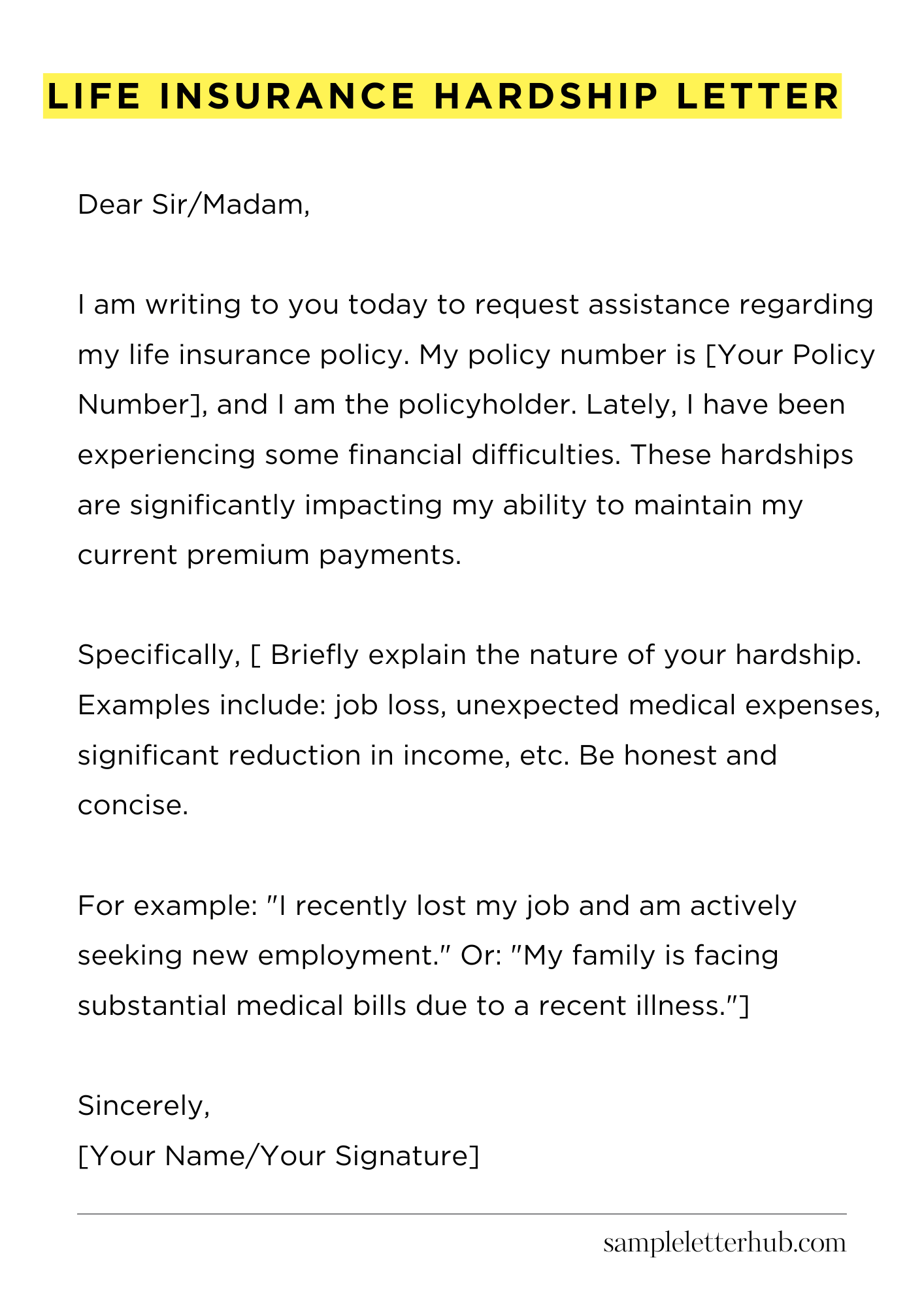
I am writing to you today to request assistance regarding my life insurance policy. My policy number is [Your Policy Number], and I am the policyholder. Lately, I have been experiencing some financial difficulties. These hardships are significantly impacting my ability to maintain my current premium payments.
Specifically, [ Briefly explain the nature of your hardship. Examples include: job loss, unexpected medical expenses, significant reduction in income, etc. Be honest and concise.
For example: “I recently lost my job and am actively seeking new employment.” Or: “My family is facing substantial medical bills due to a recent illness.”] This situation has created considerable strain. It is making it challenging to meet my financial obligations.
Because of this, I am concerned about the possibility of my policy lapsing. Losing my life insurance would be a great worry for me. It would leave my loved ones vulnerable during a difficult time.
I would be grateful if you would consider my situation. I am exploring all available options to manage my finances. Are there any provisions within my policy or any hardship programs that I might be eligible for?
Some options that might be helpful could include: a temporary reduction in premium payments, a payment plan, or a temporary suspension of my premiums.
I have attached supporting documentation to this letter. [List the documents you are including. Examples include: unemployment letter, medical bills, bank statements, etc.] These documents provide further context to my situation. I am happy to provide any other information you may require.
Thank you for your time, consideration, and understanding during this challenging period. I look forward to hearing from you soon regarding this matter and hope to find a solution.
Sincerely,
[Your Name/Your Signature]
How to Write Life Insurance Hardship Letter
Navigating the terrain of life insurance claims, particularly when faced with financial duress, necessitates a carefully constructed hardship letter. This document serves as your articulate plea, designed to convey the exigency of your circumstances to the insurance provider.
Mastering the art of composing such a letter can significantly impact the outcome of your claim. Let’s delve into the essential components.
1. Commence with an Impeccable Salutation
Your missive should begin with a professional and respectful greeting. Employ the formal salutation “Dear [Insurance Company Name],” or if you have a specific contact, “Dear Mr./Ms./Mx. [Last Name]”. Avoid casual salutations. It sets the tone for the entire communication and projects professionalism.
2. Clearly Articulate Your Identity and the Policy Details
Immediately identify yourself. Be meticulous in providing your full name, address, contact information, and the policy number associated with the life insurance claim. This establishes a baseline for the company to cross-reference and instantly understand your connection to the claim.
3. Detail the Precipitating Circumstances and Hardship
This is the core of your hardship letter. Articulate the specific circumstances that have befallen you. Explain the nature of your financial difficulties with candor and lucidity. Mention any unexpected medical expenses, loss of employment, or other unforeseen expenditures. Be succinct, yet comprehensive; every detail counts.
4. Substantiate Your Claims with Supporting Documentation
A well-crafted letter is rendered impotent without accompanying documentation. Attach copies, not originals, of all supporting evidence. This might include medical bills, bank statements, proof of unemployment, eviction notices, or any documentation that serves as corroborative proof.
Organize the documents methodically and clearly label each item for ease of review by the insurance company. This validates your claims beyond a shadow of a doubt.
5. Present a Compelling Rationale for Claim Expediency
Articulate the urgency of your situation and the implications of delayed assistance. Explain precisely how the life insurance payout would alleviate your hardship.
Provide a clear understanding of what you are hoping to achieve with the funds, whether it’s paying for crucial expenses or preventing further financial deterioration. This helps the insurance company understand the gravity of the matter.
6. Conclude with a Professional and Hopeful Closing
End your letter with a professional closing, such as “Sincerely,” or “Respectfully,” followed by your full name and signature. Reiterate your contact information, just in case they need to reach you.
If possible, state your hope for a positive outcome and offer to provide further information if necessary. Keep the tone both assertive and gracious.
7. Rigorous Review and Proofreading are Paramount
Before dispatching your letter, thoroughly review it for any grammatical errors, spelling mistakes, or factual inaccuracies. Enlist a second pair of eyes to provide objective feedback.
Ensuring your letter is impeccably written enhances its credibility and demonstrates your commitment to presenting a compelling case. A minor oversight can significantly weaken your chances of success.
FAQs about Life Insurance Hardship Letter
What is a life insurance hardship letter, and when is it necessary?
A life insurance hardship letter is a formal document submitted to an insurance provider when the policyholder is experiencing significant financial difficulties that impact their ability to pay premiums.
It’s necessary when you’re struggling to keep up with payments due to job loss, illness, unexpected expenses, or other unforeseen circumstances that create financial strain. The goal is often to explore options like temporary premium suspension, a reduced payment plan, or other forms of assistance to prevent policy lapse.
What information should be included in a life insurance hardship letter?
A comprehensive hardship letter should clearly state your policy number, the reason for your financial hardship (supported by documentation if possible), and the specific assistance you’re requesting from the insurance company.
This can include a temporary reduction in premiums, a payment plan, or other solutions. It’s essential to provide accurate and detailed information about your financial situation, including income, expenses, and any supporting documentation that verifies the situation.
What kind of supporting documentation is typically required with a hardship letter?
Supporting documentation varies depending on the reason for the hardship. Examples include: a letter of termination from your employer (for job loss), medical bills (for illness), bank statements, proof of government assistance (if applicable), and any other documents that support your claim.
The insurance company will need proof to verify your financial need. Submitting detailed evidence increases the chance of acceptance of your hardship letter.
What are the possible outcomes after submitting a life insurance hardship letter?
After submitting a hardship letter, the insurance company will review your request and supporting documentation. Possible outcomes include: approval of the requested assistance (premium reduction, payment plan, or suspension), denial of the request (with an explanation), or a counteroffer with an alternative solution.
The insurer might also request further information. The outcome depends on the insurance company’s policies and the specific circumstances of your case.
How does a life insurance hardship letter affect my policy?
The impact on your policy depends on the outcome of your hardship letter. If approved for assistance, your policy may remain in force with adjusted terms.
If a temporary premium suspension is granted, the policy might remain active for a limited time, but you’ll likely need to catch up on the missed premiums later. If your request is denied and you can’t make payments, the policy could lapse, meaning the coverage ends, and you may lose the benefits. It’s crucial to understand the implications of any agreement before accepting it.
Related:
Resignation letter due to rude boss
Resignation letter moving to another state
Resignation letter due to illness of family member
Resignation letter due to study