

Dealing with tough times? You might need a “Letter Requesting Temporary Policy Adjustment Due to Hardship.” This letter asks a company or organization for a break. It seeks temporary relief from a policy. The goal? To ease financial or personal burdens.
Struggling to write your own letter? No worries. We’ve got you covered. We’re sharing templates! You’ll find examples and samples. Use them to craft your own perfect “Letter Requesting Temporary Policy Adjustment Due to Hardship.”
Need help with a financial hardship letter? Or a hardship letter sample? We’ll make it simple. Consider these hardship letter examples your new best friend. Writing is now easy.
[Your Name]
[Your Address]
[Your Phone Number]
[Your Email Address]
[Date]
[Recipient’s Name]
[Recipient’s Title]
[Company/Organization Name]
[Company/Organization Address]
Dear [Recipient’s Name],
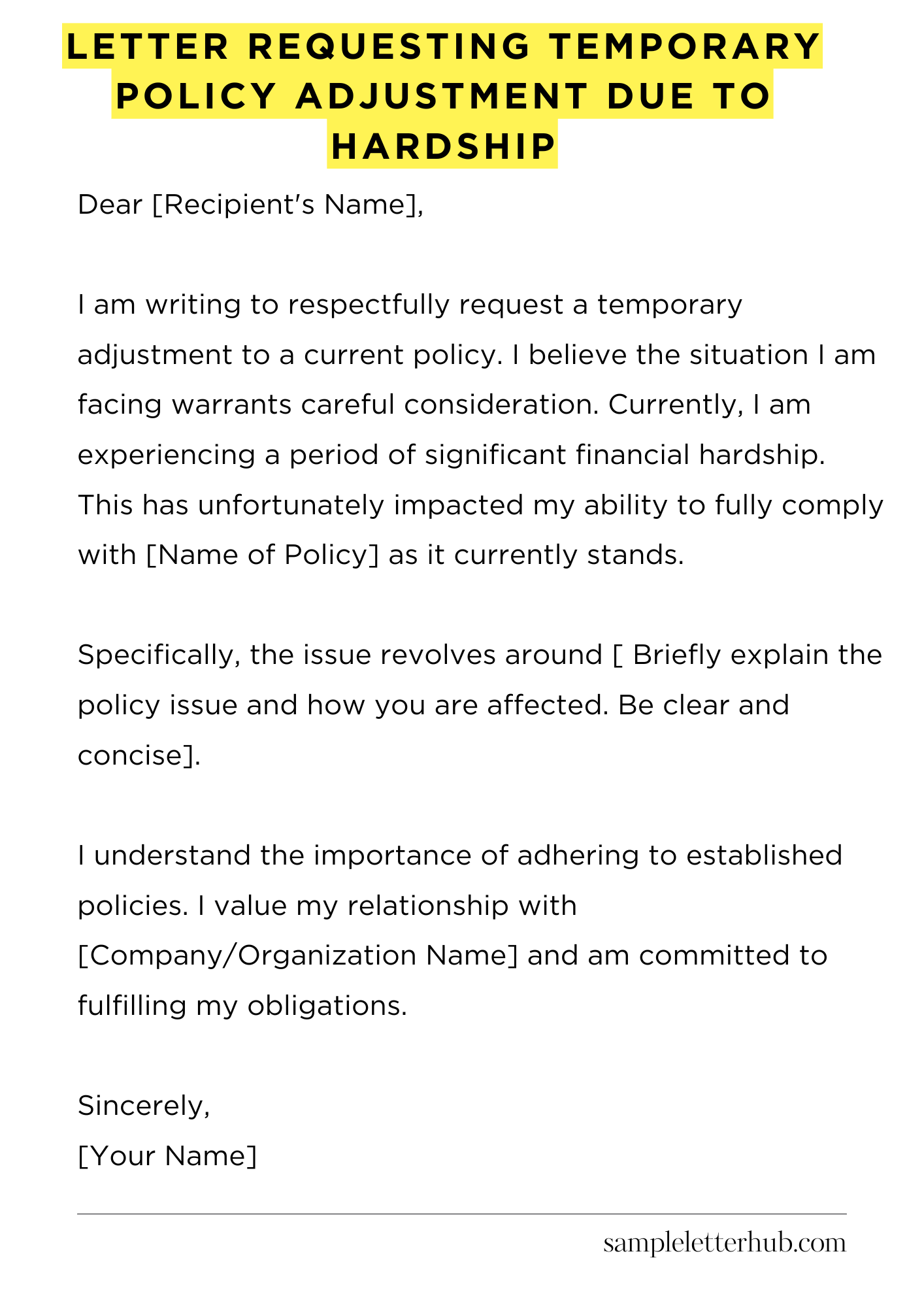
I am writing to respectfully request a temporary adjustment to a current policy. I believe the situation I am facing warrants careful consideration. Currently, I am experiencing a period of significant financial hardship. This has unfortunately impacted my ability to fully comply with [Name of Policy] as it currently stands.
Specifically, the issue revolves around [ Briefly explain the policy issue and how you are affected. Be clear and concise]. The direct consequence of this has been [Explain the negative impact on you]. This situation is placing a considerable strain on my personal finances.
I understand the importance of adhering to established policies. I value my relationship with [Company/Organization Name] and am committed to fulfilling my obligations. My desire is to find a temporary solution to alleviate this difficulty.
Therefore, I propose [Suggest a specific, reasonable adjustment to the policy that would help you]. This adjustment would allow me to overcome this challenge.
I am confident that this is a short-term issue. I anticipate that my situation will improve within [Timeframe]. I am readily available to provide any supporting documentation that might be necessary. I can also readily answer any questions you might have.
Thank you very much for your time and understanding. I look forward to hearing from you soon regarding this request. I am hoping for a favorable response.
Sincerely,
[Your Name]
How to Write Letter Requesting Temporary Policy Adjustment Due to Hardship
Life throws curveballs. Sometimes, these curveballs land us in situations where adhering to existing policies becomes unduly burdensome. If you find yourself in such straits, and a temporary policy adjustment could provide much-needed respite, a well-crafted letter is your primary instrument.
1. Initiate: The Salutation and Recipient
Begin with a professional salutation. Address the letter to the specific person or department responsible for policy adjustments. If you’re unsure of the name, research it.
Employing a generic “To Whom It May Concern” is permissible but demonstrates a lack of initiative. Ascertain the recipient’s title and use it with precision: “Dear Mr./Ms. [Surname],”
2. The Compelling Introductory Paragraph
The opening paragraph is crucial; it’s your first chance to seize the reader’s attention. Succinctly state your purpose: to request a temporary policy adjustment. Briefly identify the policy in question and the specific hardship you’re facing.
This section should be brief but impactful. For example: “I am writing to formally request a temporary adjustment to policy X, specifically regarding [mention specific clause/aspect], due to the unexpected and significant financial hardship I am currently experiencing.”
3. Delineate the Circumstances: The Body of the Letter
Here, you meticulously elaborate on your hardship. Provide a clear, detailed, and factual account of your situation. Avoid hyperbole and unnecessary emotional language. Instead, focus on providing evidence. Explain the impact of the policy on your current situation. Include dates, specific examples, and quantifiable data whenever possible.
This section is where you demonstrate the *nexus* between the policy and your hardship. For instance, if you are struggling with medical bills, include dates, amounts, and medical provider information.
4. Assemble the Supporting Documentation
Corroboration is key. Attach relevant supporting documentation. This might encompass medical bills, bank statements, proof of unemployment, or any other documents that substantiate your claims.
Organize your attachments, and reference them within the body of your letter. This reinforces the credibility of your appeal and presents irrefutable evidence. Number or clearly label each document and mention it, for instance, in parentheses “(See Attachment 1: Medical Bills)”. Make it easy for the recipient to evaluate your case.
5. Articulating the Specific Request
Be crystal clear about the specific adjustment you are seeking. Don’t leave room for ambiguity. State precisely what you want, when you want it (specify the timeframe for the adjustment), and the rationale behind your request. Outline how the temporary adjustment would alleviate your hardship. Be realistic in your request.
A well-defined request shows you’ve thought this through. Example: “I respectfully request a temporary waiver of late fees associated with payment obligations, for a period of three months, beginning [Date], to allow me the time to regain financial stability.”
6. The Conclusion: Reiteration and Gratitude
Summarize your request briefly in a concluding paragraph. Express your gratitude for their time, attention, and consideration. Reiterate your willingness to provide any further information that might be needed.
This is your final opportunity to leave a positive impression. End with a polite, professional closing: “Sincerely,” “Respectfully,” or “Yours faithfully,” followed by your full name and contact information.
7. Polishing and Perfection: Proofreading and Editing
Before dispatching your letter, meticulously proofread it for any grammatical errors, spelling mistakes, or stylistic inconsistencies. Ensure that the tone is professional, respectful, and factual.
A well-written, error-free letter will significantly increase your chances of a favorable outcome. Read the letter aloud to catch any awkward phrasing. If possible, have someone else review it as a fresh pair of eyes can often catch errors you might miss. Finally, check your formatting to ensure all documents are complete.
FAQs about Letter Requesting Temporary Policy Adjustment Due to Hardship
What is a letter requesting a temporary policy adjustment due to hardship?
A letter requesting a temporary policy adjustment due to hardship is a formal written document submitted to an organization (e.g., a lender, utility company, insurance provider) to ask for temporary modifications to a policy or agreement due to unforeseen circumstances that have caused financial or personal hardship.
This typically involves requesting a temporary change to payment schedules, deadlines, or other policy terms.
What kind of information should be included in the letter?
The letter should clearly state the reason for the hardship and how it is impacting your ability to meet the original policy terms. It should provide specific details about the circumstances causing the hardship (e.g., job loss, medical emergency, natural disaster). Include supporting documentation like medical bills, unemployment notices, or other relevant proofs.
Be specific about the type of adjustment requested (e.g., a temporary payment reduction, a payment moratorium, or extension of a deadline) and the desired duration of the adjustment.
What types of hardships typically warrant consideration for a policy adjustment?
Common examples include loss of employment, significant medical expenses, death of a primary wage earner, natural disasters (e.g., hurricanes, floods, wildfires), or other unforeseen events that lead to a sudden and significant reduction in income or increase in expenses, making it difficult to adhere to the existing policy.
What supporting documentation should I include with my letter?
The type of documentation needed will vary depending on the hardship. However, examples include recent bank statements, pay stubs, medical bills, insurance claims, documentation of job loss or reduced work hours, death certificates (if applicable), and any other supporting documents that can substantiate the claim of hardship and the need for a temporary adjustment.
What is the typical outcome after submitting a letter requesting a temporary policy adjustment?
The outcome varies depending on the organization’s policies, the specifics of the situation, and the documentation provided. The organization will review the request and supporting documentation and may approve the requested adjustment, offer a modified adjustment, or deny the request.
You should receive a written response outlining the decision and any agreed-upon terms if the adjustment is approved. It’s important to carefully review any approved adjustments to ensure you understand the new terms and the duration of the adjustment.
Related:
Resignation letter due to rude boss
Resignation letter moving to another state
Resignation letter due to illness of family member
Resignation letter due to study