

Dealing with high insurance premiums can be tough. Sometimes, unexpected financial hardship hits. A hardship letter for insurance premium helps. Its purpose? To explain your situation to your insurance company. You are asking for help. You might need a payment plan or a temporary premium reduction.
Feeling overwhelmed? Don’t worry. This article is your guide. We have your back. We’re offering various hardship letter for insurance premium templates. These are samples to get you started. You can easily adapt them. Write your own hardship letter fast.
Need to draft your hardship letter quickly? Our examples cover different scenarios. Whether it is job loss, medical bills, or other challenges, our samples help. Craft a clear and compelling letter. Communicate your needs to your insurance provider effectively. Get the help you deserve.
[Your Name]
[Your Address]
[Your Phone Number]
[Your Email Address]
[Date]
[Insurance Company Name]
[Insurance Company Address]
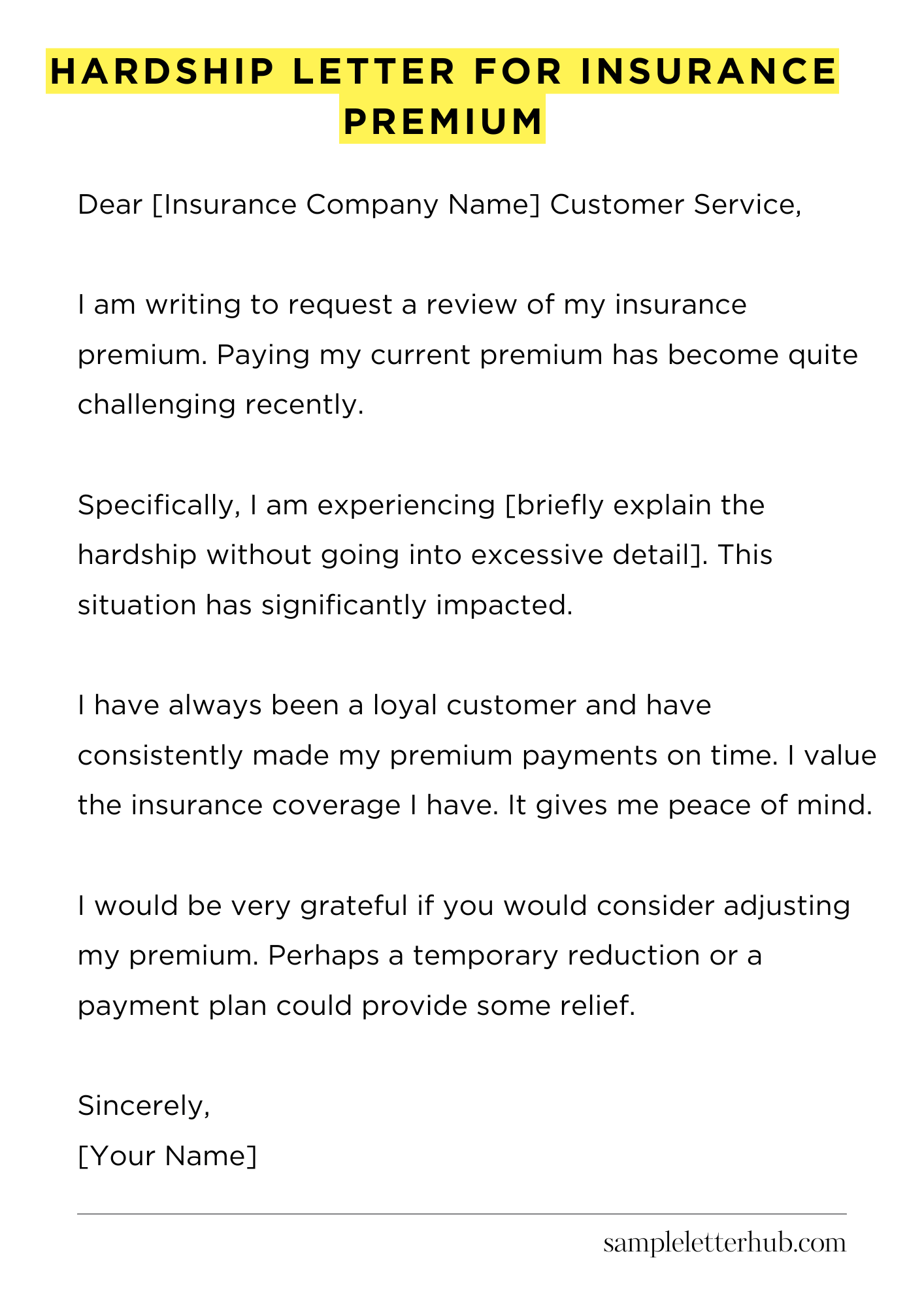
Dear [Insurance Company Name] Customer Service,
I am writing to request a review of my insurance premium. Paying my current premium has become quite challenging recently. I am facing some difficult financial circumstances.
Specifically, I am experiencing [briefly explain the hardship without going into excessive detail]. This situation has significantly impacted my ability to manage my expenses. My income has decreased and other unexpected costs have come up.
I have always been a loyal customer and have consistently made my premium payments on time. I value the insurance coverage I have. It gives me peace of mind.
I would be very grateful if you would consider adjusting my premium. Perhaps a temporary reduction or a payment plan could provide some relief during this difficult period. These options would certainly make things easier for me right now.
I have attached supporting documentation, such as [list any supporting documents, e.g., bank statements, proof of unemployment, etc.]. This information demonstrates the details of my financial hardship. The goal is to show the need for help.
I am eager to resolve this matter quickly. I look forward to hearing from you soon regarding this request. Thank you for your time and consideration. I truly appreciate your understanding.
Sincerely,
[Your Name]
How to Write Hardship Letter for Insurance Premium
Navigating financial straits is, unfortunately, a universal experience. When circumstances unexpectedly impact your ability to meet financial obligations, especially insurance premiums, understanding how to articulate your situation effectively becomes paramount. A well-crafted hardship letter can potentially offer reprieve. Here’s a pragmatic guide on constructing a compelling one:
1. Initiate with a Formal Salutation
Begin your missive with a professional salutation. Address the insurance provider directly. Use “To Whom It May Concern” if a specific name is unavailable. Adherence to formality demonstrates respect for the recipient and the gravity of your request. This immediately sets a tone of professionalism that will be maintained throughout the letter.
2. Explicitly State Your Purpose
The commencement of your letter necessitates a clear declaration of intent. State upfront that you are composing the missive to petition for relief regarding your insurance premium due to documented financial hardship. This directness ensures that the recipient immediately grasps the essence of your communication.
3. Detail Your Financial Predicament
This section is the crux of your letter. It’s where you elucidate the reasons behind your financial predicament. Provide a chronological narrative, detailing the onset of the hardship and the specific events that precipitated it. Substantiate your claims with concrete examples.
For instance, if you experienced job displacement, mention the date of termination and your efforts to secure alternative employment. If you are experiencing illness, include the type of the disease or injury along with the medical expense.
4. Include Supporting Documentation
The potency of your letter hinges on the inclusion of supporting documentation. Gather all relevant documentation to validate your claims.
Examples include: Termination letters, medical bills, bank statements demonstrating reduced income, benefit statements, and proof of public assistance eligibility. These artifacts serve as corroborative evidence, fortifying your petition.
5. Specify the Requested Relief
Clearly articulate the relief you are seeking. Are you requesting a temporary reduction in premiums, a payment plan, or a complete waiver? Be precise in your requests.
This specificity streamlines the review process and enhances the likelihood of a favorable response. A vague request can be easily dismissed.
6. Express Gratitude and Conclusion
Conclude your letter with a gesture of gratitude. Thank the recipient for their time and consideration. Reiterate your contact information, including your full name, address, phone number, and policy number. This information helps them to contact you, for further assessment. End with a professional closing, such as “Sincerely” or “Respectfully.”
7. Proofread and Iterate
Before dispatching your letter, meticulously proofread it for any grammatical errors or typos. Ensure the letter is logically structured, coherent, and free of any ambiguities.
Consider having a trusted friend or family member review the letter for clarity. Revision is an iterative process; refine your message until it effectively conveys your situation and maximizes the prospect of obtaining the desired outcome.
FAQs about Hardship Letter for Insurance Premium
What is a hardship letter for insurance premium, and why is it needed?
A hardship letter is a formal written request submitted to an insurance company explaining the financial difficulties a policyholder is facing that prevent them from paying their insurance premium. It serves as a plea for assistance, potentially leading to options like a payment plan, temporary premium reduction, or waiver of premiums.
It’s necessary when unforeseen circumstances, such as job loss, medical emergencies, or natural disasters, impact the policyholder’s ability to fulfill their financial obligations.
What specific information should be included in a hardship letter?
A comprehensive hardship letter should include: the policyholder’s full name, policy number, and contact information. It must clearly state the specific nature of the hardship being experienced.
This is accompanied by dates, detailed explanations of how the hardship has impacted finances, supporting documentation (e.g., medical bills, unemployment notices), a clear request for assistance (e.g., payment plan, premium reduction), and a sincere expression of the desire to maintain the insurance coverage.
What types of hardships typically qualify for consideration by insurance companies?
Insurance companies typically consider a range of hardships. These often include job loss or reduction in income, significant medical expenses not covered by insurance, the death of a primary income earner, natural disasters (e.g., fire, flood), and unexpected major repairs to a home.
What are the possible outcomes after submitting a hardship letter?
The outcomes vary depending on the insurance company’s policies and the specific circumstances. Possible outcomes include: approval of a payment plan, a temporary reduction in premiums, a temporary waiver of premiums, referral to a social service agency, or, in some cases, denial of the request.
The insurance company will assess the information, review the supporting documentation, and communicate its decision to the policyholder.
How can I increase my chances of having my hardship letter approved?
To increase the likelihood of approval, it’s essential to: provide a clear and concise explanation of the hardship, include all relevant and verifiable supporting documentation (e.g., bank statements, bills, layoff notices).
Related:
Resignation letter due to rude boss
Resignation letter moving to another state
Resignation letter due to illness of family member
Resignation letter due to study