

Dealing with a missing piece of evidence? Don’t worry, it happens! An explanation letter for missing evidence in a claim is your chance to clarify why specific documentation is absent. Its purpose is simple: to explain the situation clearly to the recipient, ensuring they understand the context surrounding the missing proof. This helps to maintain your claim’s credibility.
Crafting the perfect explanation letter can be tricky. That’s why we’re here to help you navigate this. We’ll be sharing a collection of handy templates, examples, and samples of the all-important explanation letter for missing evidence.
Use our provided samples as a springboard. We’ve got you covered. Consider these letters your secret weapon. Each one is designed to make writing your own missing evidence letter easier than ever. Get ready to express yourself!
[Your Name/Law Firm Letterhead]
[Your Address]
[Your Phone Number]
[Your Email Address]
[Date]
[Recipient Name/Insurance Company]
[Recipient Address]
Subject: Explanation Regarding Missing Evidence in Claim – [Claim Number]
Dear [Recipient Name],
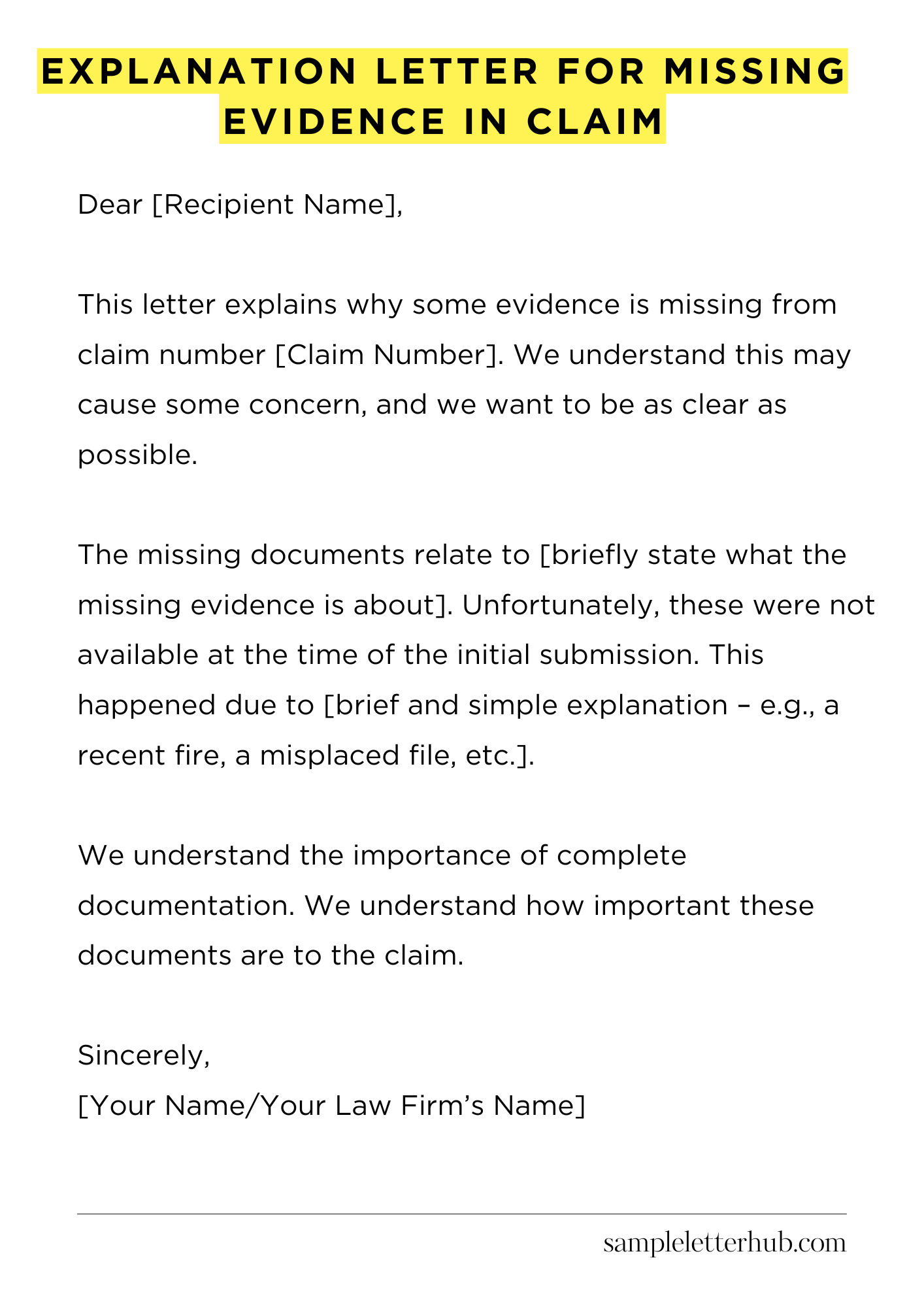
This letter explains why some evidence is missing from claim number [Claim Number]. We understand this may cause some concern, and we want to be as clear as possible.
The missing documents relate to [briefly state what the missing evidence is about]. Unfortunately, these were not available at the time of the initial submission. This happened due to [brief and simple explanation – e.g., a recent fire, a misplaced file, etc.].
We understand the importance of complete documentation. We understand how important these documents are to the claim.
Since we realized the original documents were unavailable, we have taken steps to rectify the situation. We have already [state what you have done – e.g., contacted the relevant parties, requested replacement documents, etc.]. We are working diligently to gather the necessary information.
We anticipate having the missing evidence within [state timeframe – e.g., the next week, approximately ten days, etc.]. We will forward it to you immediately upon receipt. We are doing everything possible to prevent further delays.
We apologize for any inconvenience this may cause. We are committed to a quick resolution of this claim. We appreciate your patience and understanding in this matter.
Please do not hesitate to contact us if you have any questions or require further clarification. We are here to help.
Sincerely,
[Your Name/Your Law Firm’s Name]
How to Write Explanation Letter for Missing Evidence in Claim
Submitting a claim and realizing you’re missing crucial supporting evidence can be a nerve-wracking experience. Don’t despair! A well-crafted explanation letter can often bridge the evidentiary gap and bolster your claim’s prospects. This guide provides a structured approach to composing a compelling letter that addresses missing documentation and mitigates potential issues.
1. Begin with a Formal Salutation
Your missive should commence with a proper salutation. Address the recipient, typically the claims adjuster or the entity processing your claim, using their full name and title if known.
A generic greeting, such as “To Whom It May Concern,” while acceptable, lacks a personalized touch. Aim for a specific, professional greeting. For instance, “Dear Ms. Eleanor Vance, Claims Adjuster,” demonstrates respect and attention to detail. This initial impression sets the tone for the entire correspondence.
2. Clearly State the Purpose and Reference the Claim
Immediately declare the intent of your letter in the opening paragraph. Be unequivocally clear: you are writing to address missing evidence related to a specific claim. Include the claim number, date of submission, and any other identifying information. This facilitates swift identification and processing of your letter.
Avoid ambiguity; transparency is key. For example, “This letter is in reference to claim number 1234567, submitted on October 26, 2023, regarding [briefly state the claim’s subject matter], and is intended to explain the absence of the following documentation…”
3. Identify the Missing Evidence and Offer a Detailed Explanation
This is the crux of your letter. Meticulously identify each piece of missing evidence. Then, provide a comprehensive explanation for its absence. Be candid, truthful, and avoid evasiveness.
If the document was lost, explain how and when. If the document is still in process, describe the steps you’ve taken to obtain it. If the document never existed, provide a reasoned justification. Offer alternate information to compensate for its deficiency. This section demands meticulous attention and clarity.
4. Offer Supporting Documentation (If Possible)
While the original evidence may be missing, can you provide substitute documentation? This is where your preparedness shines. Do you have secondary evidence, such as photographs, witness statements, or corroborating documentation?
Attach copies of these materials to bolster your explanation. If you have electronic records, be sure to include them. This proactive approach underscores your commitment to substantiate your claim.
5. Acknowledge and Apologize (If Necessary)
If the missing evidence is due to your oversight, acknowledge it. A brief, sincere apology can be beneficial. It demonstrates accountability and professionalism. However, avoid excessive self-blame, as it could undermine the perceived strength of your claim.
A simple, “I apologize for any inconvenience the absence of this document may cause” is often sufficient. Remember to stay focused on the resolution.
6. State Your Expectations and Request Action
Clearly articulate your expectations. Specifically state what action you’d like the recipient to take regarding the missing evidence. Are you requesting a waiver?
Are you awaiting a decision based on the information provided? Be direct and explicit in your requests. This ensures there are no misunderstandings. For instance, “I trust that this explanation and the attached supporting documentation are sufficient to facilitate the processing of my claim.”
7. Conclude with a Professional Closing
Conclude your letter with a professional closing. Use a formal sign-off, such as “Sincerely,” or “Respectfully.” Provide your full name, contact information (phone number, email address), and date.
If applicable, note any attached documents. Proofread the entire letter meticulously before submitting it. A well-presented letter leaves a favorable impression and significantly improves the likelihood of a positive outcome. Remember, precision is paramount; it should convey your commitment to resolving the issue. Good luck!
FAQs about Explanation Letter for Missing Evidence in Claim
What is an explanation letter for missing evidence?
An explanation letter for missing evidence is a formal document submitted to an insurance company, court, or other relevant party. It provides a detailed explanation as to why supporting documentation or evidence required to substantiate a claim is unavailable. The letter aims to offer context, reasons for the absence, and potentially alternative evidence to support the claim’s validity.
What information should be included in an explanation letter?
A well-crafted explanation letter typically includes the claimant’s information (name, address, claim number, etc.), a clear statement identifying the missing evidence and its importance, a comprehensive explanation for its absence (e.g., loss, damage, unavailability), the steps taken to try and retrieve the missing evidence.
What are the common reasons for missing evidence?
Common reasons for missing evidence include loss or damage (e.g., fire, theft, natural disasters), the original document’s unavailability (e.g., medical records held by a closed clinic), destruction (e.g., documents discarded), logistical difficulties, and inability to obtain the documentation, among others. The specific reason must be clearly stated and explained in detail within the letter.
How does the explanation letter impact the claim outcome?
The impact of the explanation letter depends on the specific claim and the context of the missing evidence. A well-written and convincing letter can significantly improve the chances of a favorable outcome.
It provides an opportunity to explain the situation to the adjudicator and to clarify the circumstances that have led to the lack of evidence. However, its effectiveness relies on the credibility of the explanation and the availability of alternative supporting documentation. The final outcome rests with the reviewer’s decision.
When should an explanation letter be submitted?
An explanation letter should be submitted as soon as possible after the missing evidence is identified. It’s often best to provide the letter as part of the initial claim filing, or immediately after the entity requests the missing documentation.
Prompt submission increases the likelihood of a positive outcome by proactively addressing the issue before the claim is rejected or delayed. Waiting too long may result in negative assumptions.
Related:
Resignation letter due to rude boss
Resignation letter moving to another state
Resignation letter due to illness of family member
Resignation letter due to study