

A Letter Explaining Correction of Claim Details clarifies errors in insurance claims. It’s a formal document. Its purpose is to fix mistakes. These mistakes could be in medical bills or car accident reports. The letter ensures accurate processing of the claim.
Dealing with claim errors can be confusing. We understand. That’s why we’re here to help you draft your own Letter Explaining Correction of Claim Details. This article provides easy-to-use templates. Find sample letters for various situations.
We will provide different letter formats. You can easily modify them. They will address common claim issues. Save time and reduce stress with our simple guide. Use our claim correction letter samples to get the job done.
[Your Name/Company Name]
[Your Address]
[Your City, Postal Code]
[Your Email]
[Your Phone Number]
[Date]
[Recipient’s Name/Company Name]
[Recipient’s Address]
[Recipient’s City, Postal Code]
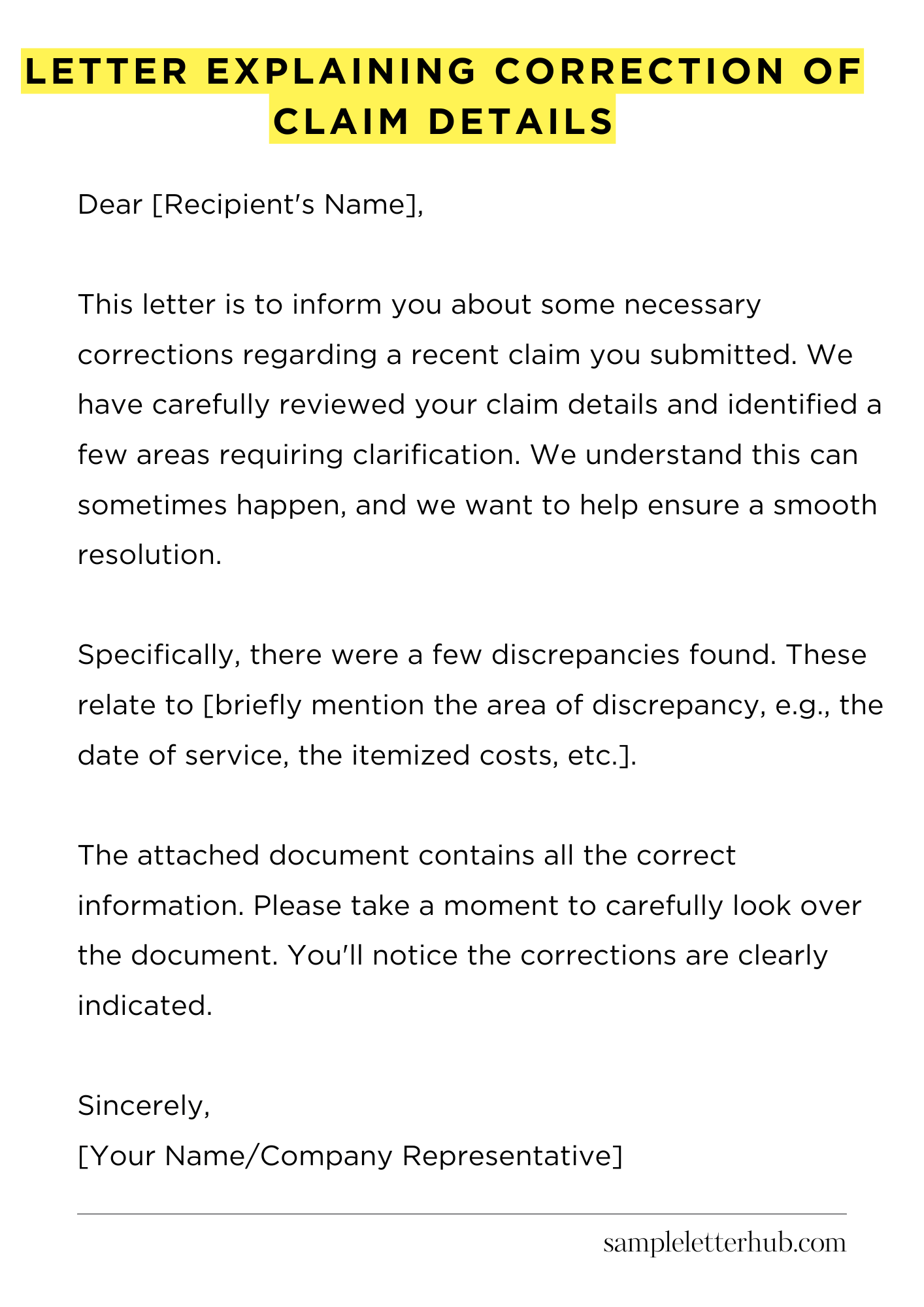
Dear [Recipient’s Name],
This letter is to inform you about some necessary corrections regarding a recent claim you submitted. We have carefully reviewed your claim details and identified a few areas requiring clarification. We understand this can sometimes happen, and we want to help ensure a smooth resolution.
Specifically, there were a few discrepancies found. These relate to [briefly mention the area of discrepancy, e.g., the date of service, the itemized costs, etc.]. Providing accurate information is very important in processing claims correctly. Therefore, we would appreciate it if you could review the attached documentation.
The attached document contains all the correct information. Please take a moment to carefully look over the document. You’ll notice the corrections are clearly indicated.
We kindly request you to confirm the corrections. Please sign and return the corrected document to us at your earliest convenience. This will help us expedite the claim’s processing.
You can return the signed form by email or by postal service. You can also contact us if you have any questions or require further assistance. We are happy to help you understand the changes in more detail. Our customer service team is available at [phone number] or [email address].
We appreciate your cooperation in this matter. Thank you for your understanding.
Sincerely,
[Your Name/Company Representative]
How to Write Letter Explaining Correction of Claim Details
1. Initiate with Precision: The Salutation and Context
Begin your missive with a formal salutation. Employ “Dear [Recipient Name],” or if the name is unknown, “To Whom It May Concern.” Subsequently, succinctly articulate the purpose of your letter.
This initial paragraph sets the tone. Clearly state that you are penning this communication to rectify previously submitted claim details. Provide the claim number and date of submission. This initial contextualization is paramount to ensure clarity and immediate understanding.
2. Pinpointing the Aberration: Identifying the Error
Proceed to pinpoint the specific erroneous information. Be explicit. Avoid ambiguity. The goal is to leave no room for misinterpretation. Articulate exactly what was initially provided incorrectly.
For instance, did you misstate the date of service? Or was the diagnostic code inaccurately reported? Use meticulous language. Consider this the core of your explanatory endeavor. Clarity here directly correlates with a streamlined correction process.
3. Substantiating the Rectification: Justification and Supporting Evidence
Now, provide the factual, corrected information. Present the accurate details. Crucially, offer a concise justification for the correction. Why was the initial data erroneous? Was it a typographical error?
Did you access the wrong records initially? Consider what caused the mistake to happen and explain it. If pertinent, enclose supporting documentation. Attach any necessary evidence, such as corrected invoices, medical reports, or any materials that corroborate the revisions.
4. Delving into the Nomenclature: The Terminology and Codes
This is where you might need to use specific terminology. If your claim involves medical billing, insurance, or other specialized fields, incorporate the correct codes or terminologies.
For instance, if you’re dealing with a CPT code, ensure that the revised code is accurately referenced. Verify all nomenclature. This section demonstrates that the individual understands the subject matter. Such detail adds credibility to your explanation.
5. Mitigating the Ramifications: Acknowledging the Impact
Thoughtfully acknowledge any potential repercussions caused by the initial incorrect information. Recognize that the erroneous data may have caused delays in processing, or in some cases, other issues.
If applicable, apologize for any inconvenience or frustration your error may have caused. Express your commitment to accuracy and prevent future discrepancies. It reflects accountability and professionalism.
6. The Concluding Admonition: Request and Assurance
Conclude the letter by explicitly requesting the recipient to amend the claim details based on the provided corrections. Kindly request confirmation that the necessary adjustments have been processed.
Offer to furnish any further information or documentation they may require. Reiterate your commitment to precision and accuracy. Include your contact information for any follow-up inquiries. This shows you are ready to help at any time.
7. The Parting Salvo: Closing and Signatory
Close your letter with a professional and appropriate sign-off, such as “Sincerely,” or “Respectfully,”. Sign the letter manually, and type your full name beneath the signature.
If possible, include your title and contact information (phone number, email address) for ease of follow-up. Ensure that the letter is proofread meticulously before dispatching it. This final verification will further enhance the impression of your professionalism and meticulousness.
FAQs about Letter Explaining Correction of Claim Details
What is the purpose of a letter explaining the correction of claim details?
The primary purpose of a letter explaining the correction of claim details is to inform the recipient, typically an insurance provider or another relevant party, about modifications made to a previously submitted claim.
This letter clarifies any errors or omissions, ensuring accuracy in processing and preventing potential delays or denials. It serves as an official communication channel to rectify information and maintain transparency throughout the claims process.
What specific information should be included in a letter explaining the correction of claim details?
A comprehensive letter should include the original claim details (e.g., claim number, date of submission, and the nature of the claim), the specific details being corrected, and the corrected information.
The letter should clearly state why the corrections are necessary. It’s also beneficial to provide supporting documentation if available (e.g., updated invoices, medical records, or any other relevant evidence) to validate the changes.
Who typically sends a letter explaining the correction of claim details?
The individual or entity who originally filed the claim usually sends this type of letter. This could be the policyholder, a healthcare provider, or another party involved in the claim.
The sender is responsible for ensuring the accuracy of the corrected information and providing any necessary documentation to support the changes made.
How does the correction of claim details impact the claims process?
Correcting claim details can significantly impact the claims process. Accurate information helps ensure that the claim is processed efficiently and accurately. It can prevent delays caused by inaccurate data, and it increases the likelihood of a successful claim outcome. Conversely, a failure to correct errors can lead to claim denials or underpayments.
What are the potential consequences of not correcting inaccurate claim details?
Failing to correct inaccurate claim details can result in a range of negative consequences. The claim may be denied, leading to financial loss for the claimant.
It can also cause delays in payment processing, which can be frustrating and may necessitate additional follow-up. In some situations, providing false or misleading information could result in more serious issues, such as investigations or accusations of fraud.
Related:
Resignation letter due to rude boss
Resignation letter moving to another state
Resignation letter due to illness of family member
Resignation letter due to study