

Ever had a claim denied or delayed? It’s frustrating. Sometimes, insurance companies need more information. An explanation letter for claim inconsistencies is the answer. This letter clarifies any discrepancies or missing details. Its purpose is to get your claim approved quickly and accurately.
Dealing with confusing claim denials can be tough. We’re here to help you. We understand the struggle. That is why we are providing you with simple sample explanation letters! You can use our templates. We have many examples too.
Crafting these letters doesn’t have to be hard. Our simple explanation letter examples will guide you. We’ll show you how to write any explanation letter for claim discrepancies. You can get your insurance claims approved. Make it easy with our simple, ready-to-use samples.
[Your Name/Company Name]
[Your Address]
[Your City, Postal Code]
[Your Email Address]
[Your Phone Number]
[Date]
[Recipient Name/Company Name]
[Recipient Address]
[Recipient City, Postal Code]
Subject: Explanation Regarding Claim Inconsistencies
Dear [Recipient Name],
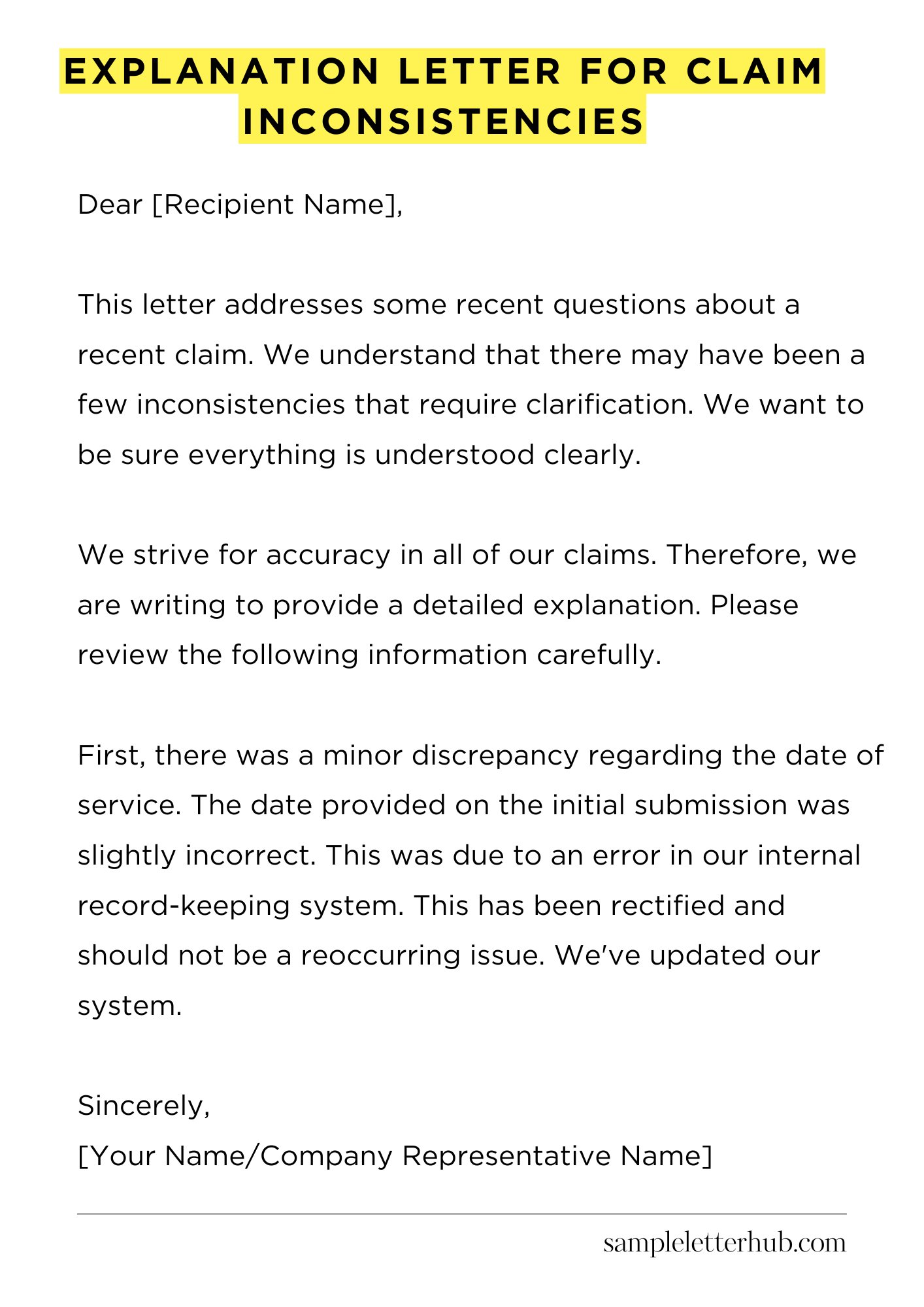
This letter addresses some recent questions about a recent claim. We understand that there may have been a few inconsistencies that require clarification. We want to be sure everything is understood clearly.
We strive for accuracy in all of our claims. Therefore, we are writing to provide a detailed explanation. Please review the following information carefully.
First, there was a minor discrepancy regarding the date of service. The date provided on the initial submission was slightly incorrect. This was due to an error in our internal record-keeping system. This has been rectified and should not be a reoccurring issue. We’ve updated our system.
Second, the cost of one particular item appears different from the agreed-upon price. The reason for this is, there was a promotion or discount which we failed to apply. We are addressing that issue immediately. The correct price has now been applied to this claim.
Finally, we noticed a minor difference between the listed quantity and the actual amount received. This stemmed from a miscount during the inventory process. We are implementing new procedures to avoid this in the future, including double-checking all shipments. This will ensure greater accuracy.
We sincerely apologize for any inconvenience these inconsistencies may have caused. We are committed to providing the most accurate information possible. We value your business and are dedicated to maintaining a high level of transparency.
We have attached a revised claim form reflecting these corrections. Please examine it carefully at your earliest convenience.
If you have any further questions or require additional information, please do not hesitate to contact us directly. We are always here to help.
Thank you for your understanding and cooperation.
Sincerely,
[Your Name/Company Representative Name]
How to Write Explanation Letter for Claim Inconsistencies
Understanding the Labyrinth of Claim Inconsistencies
Navigating the terrain of claim inconsistencies can feel like venturing into a convoluted labyrinth. These discrepancies, however minute, often necessitate clarification. First and foremost, you should discern the exact nature of the inconsistencies. Are they numerical anomalies, procedural deviations, or factual inaccuracies?
A meticulous evaluation is critical before even considering crafting your explanation letter. You must identify the root cause to provide an effective response.
Preliminary Reconnaissance: Gathering Pertinent Information
Before putting pen to paper (or fingers to keyboard), assemble all relevant documentation. This includes the original claim, all supporting evidence, and any communication you’ve had concerning the claim.
Thoroughness is paramount; leave no stone unturned. Assemble all the documentation you have, and review all the details with utmost care. You may need to revisit past interactions, like emails, to uncover all the important details.
Crafting the Compelling Aperture: Your Opening Statement
Your introductory paragraph is your pitch, your chance to seize the attention of the reader. It should be concise, professional, and explicitly state the purpose of the letter.
Clearly identify the claim in question, referencing its claim number or other unique identifier. A direct, clear, and unambiguous opening establishes credibility from the very beginning. State your intention and offer clarity on what you want to achieve.
Delving into the Depths: The Body of Your Explanation
The body of your explanation letter is where you unravel the complexities of the claim inconsistencies. Break down the issues point by point, addressing each discrepancy individually.
Provide clear, logical, and evidence-backed explanations. Offer specific supporting details to fortify your explanations. Use a numbered or bulleted format to enhance readability and organization. Keep each point separate, making it easier for the reader to grasp your perspective.
Evidence: The Cornerstone of Your Argument
Your explanations, no matter how eloquent, are only as strong as the evidence supporting them. Always cite specific documents, dates, and figures. If applicable, incorporate copies of supporting documentation, perhaps as attachments.
Each piece of evidence you use should clearly align with the points you’re making. The goal is to provide the recipient with the resources needed to confirm the facts and settle the discrepancy in your favor.
The Concluding Couplet: Summarizing and Seeking Resolution
Your conclusion should reiterate the main points of your explanation. Summarize your justification for the claims and gently restate your request for resolution. Express your willingness to provide further clarification.
Finally, include your contact information for any follow-up inquiries. A well-crafted conclusion should leave the reader confident and satisfied that your position is the correct one.
The Post-Submission Checklist: Ensuring Perfection
Before dispatching your letter, subject it to a rigorous review. Proofread meticulously for grammatical errors and typos. Ensure all attachments are included and properly labeled.
Check the formatting to confirm it appears professional. Have a second pair of eyes review the letter for clarity and accuracy. Make certain that it provides the information required to bring the matter to a favorable close.
FAQs about Explanation Letter for Claim Inconsistencies
What is an Explanation Letter for Claim Inconsistencies?
An Explanation Letter for Claim Inconsistencies is a formal document requested by an insurance company or other organization when there are discrepancies, missing information, or potential fraud concerns related to an insurance claim or financial transaction.
It provides a detailed account from the claimant, clarifying the inconsistencies and offering supporting evidence to justify the claim’s validity.
What Information Should Be Included in an Explanation Letter?
A comprehensive explanation letter must include the following information:
- Claimant’s Information: Full name, address, policy/account number, and contact information.
- Incident Details: Date, time, and location of the incident or event leading to the claim.
- Detailed Explanation: A clear and concise account of the inconsistencies identified, along with a thorough explanation addressing each point.
- Supporting Documentation: Copies of any evidence that support the explanation, such as photographs, medical records, receipts, police reports, or witness statements.
- Acknowledgment: A statement acknowledging the importance of honesty and accuracy in the claim process and affirming the truthfulness of the information provided.
- Signature: The claimant’s signature and the date of the letter.
Why is an Explanation Letter Necessary?
An explanation letter is necessary for the following reasons:
- Clarification: To resolve any ambiguity or confusion surrounding the claim.
- Validation: To provide evidence supporting the accuracy and legitimacy of the claim.
- Compliance: To meet the requirements of the insurance policy or related agreements.
- Investigation: To aid the insurer or organization in their investigation of the claim.
- Prevention of Fraud: To demonstrate good faith and transparency, helping to prevent insurance fraud.
What Happens If the Explanation Letter is Insufficient or Not Provided?
If the explanation letter is insufficient or not provided, the consequences may include:
- Claim Denial: The insurance company or organization may deny the claim due to the inability to verify the information.
- Delay in Processing: The processing of the claim may be significantly delayed while waiting for the requested information.
- Further Investigation: The company may initiate a more in-depth investigation, which could involve additional documentation requests, interviews, or inspections.
- Potential Legal Action: In cases of suspected fraud or misrepresentation, the company may pursue legal action against the claimant.
How Can I Ensure My Explanation Letter is Effective?
To ensure your explanation letter is effective, follow these tips:
- Be Honest and Accurate: Provide truthful and precise information.
- Be Clear and Concise: Use simple, easy-to-understand language.
- Be Specific: Address each inconsistency directly and thoroughly.
- Organize Logically: Present the information in a clear and structured manner.
- Include Supporting Documentation: Provide all relevant evidence to support your claims.
- Review Carefully: Proofread the letter for any errors before submitting it.
- Keep a Copy: Retain a copy of the letter and all supporting documents for your records.
Related:
Resignation letter due to rude boss
Resignation letter moving to another state
Resignation letter due to illness of family member
Resignation letter due to study