

Sometimes, banks or financial institutions might suspect fraud. They might freeze your account. You’ll need to explain yourself. This is where a “Letter Explaining Previous Fraud Suspicion (Clarification)” comes in. The letter clarifies the situation. Its purpose is to resolve any doubts.
Writing this type of letter can feel tricky. Don’t worry, we’re here to help. We’ve gathered helpful templates, examples, and samples. Use these clarification letter samples. They cover different scenarios. These are fraud explanation letter samples. Our samples make it simple to draft your own.
Need to write an effective letter explaining fraud suspicion? Our provided letter samples are ready. They are easy to adapt. You can customize them for your situation. Get started today and clear things up about your bank account with our examples.
[Your Name/Company Name (if applicable)]
[Your Address]
[Your Phone Number]
[Your Email Address]
[Date]
[Recipient Name/Company Name]
[Recipient Address]
Dear [Recipient Name],
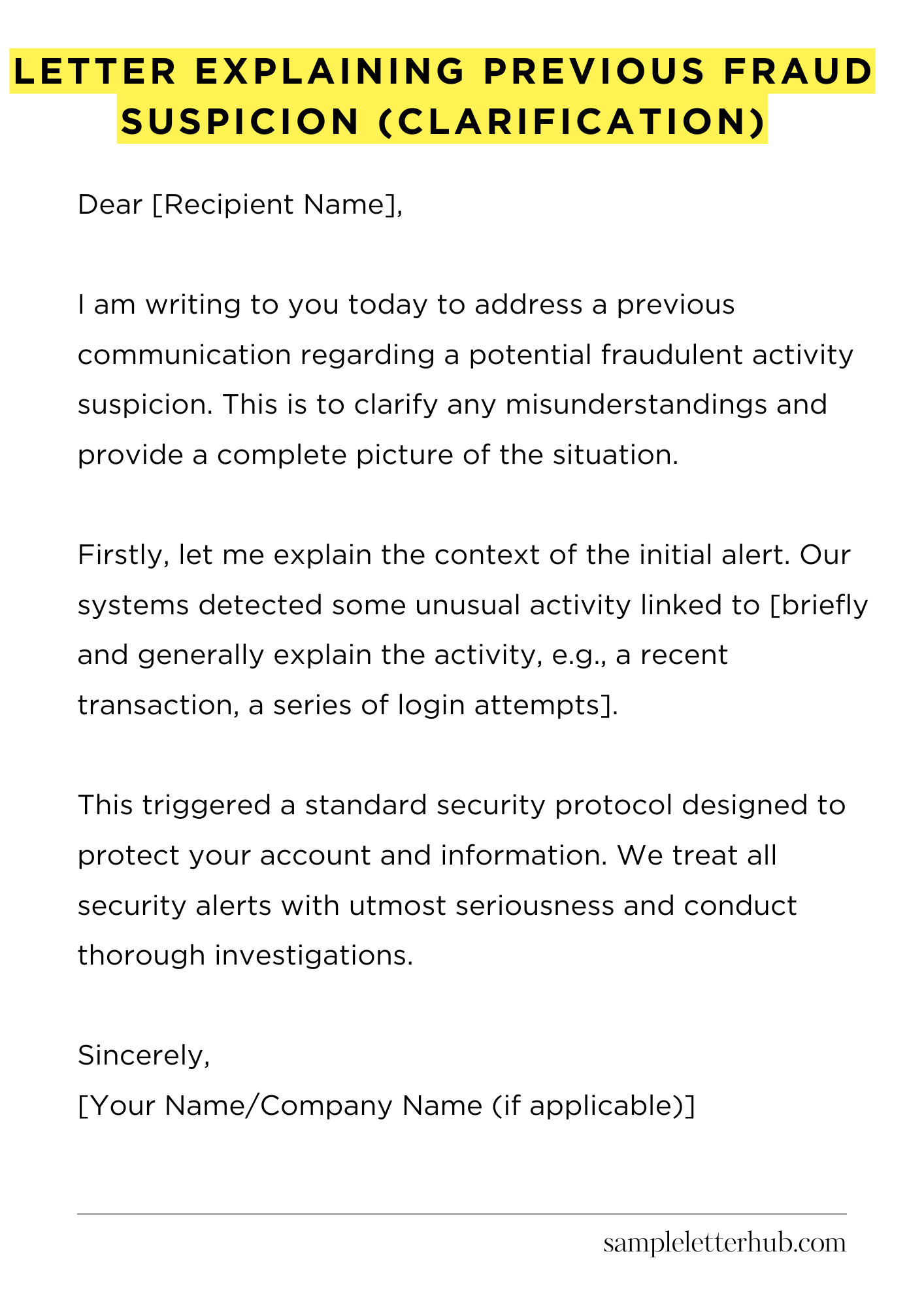
I am writing to you today to address a previous communication regarding a potential fraudulent activity suspicion. This is to clarify any misunderstandings and provide a complete picture of the situation. We understand that this may have caused some concern, and we sincerely apologize for any inconvenience or anxiety it may have caused.
Firstly, let me explain the context of the initial alert. Our systems detected some unusual activity linked to [briefly and generally explain the activity, e.g., a recent transaction, a series of login attempts].
This triggered a standard security protocol designed to protect your account and information. We treat all security alerts with utmost seriousness and conduct thorough investigations.
We would like to assure you that after a comprehensive review, we have concluded that the flagged activity was, in fact, not fraudulent. We found that the [explain the real cause, e.g., transaction was authorized, login was from a different but authorized device]. This information is now fully integrated into our internal records.
We have now taken additional measures to prevent similar misinterpretations in the future. These measures include [mention any specific improvements, e.g., refining our detection algorithms, updating our customer communication protocols]. This will reduce the chances of unnecessary alarms. We remain committed to protecting your security.
We value your trust and are dedicated to maintaining the highest standards of security. We appreciate your patience and understanding in this matter. Furthermore, we appreciate your cooperation in helping us protect your information.
If you have any further questions or concerns, please do not hesitate to contact us directly. We are always available to help.
Sincerely,
[Your Name/Company Name (if applicable)]
How to Write Letter Explaining Previous Fraud Suspicion (Clarification)
1. Initiate with Candor: The Opening Salvo
The commencement of your missive is paramount; it sets the tone. Begin with a clear and concise declaration of your intention. Acknowledge the antecedent fraud suspicion explicitly.
Frame it as an attempt at clarification. Ensure the tone is non-accusatory, yet resolute in its purpose. State your willingness to proffer comprehensive elucidation regarding the matter at hand. This should be direct and forthright; subterfuge is not your ally.
2. The Genesis of the Incident: Laying the Groundwork
Delineate the circumstances that instigated the initial suspicion. Provide a chronology of events leading up to the scrutiny. Be meticulous in detailing dates, times, and involved parties.
Recall any relevant documentation, such as account statements or transaction records. Explain any irregularities or discrepancies that triggered the concern. This is about providing context. Avoid ambiguity; every piece of information matters. Paint a comprehensive picture, allowing your reader to gain a complete understanding of events.
3. Deconstruction of the Suspicion: Examining the Allegations
Carefully dissect each point of the fraud suspicion. Address each specific concern raised, item by item. Offer a compelling counter-narrative, armed with empirical evidence. Provide verifiable data, support your statements with supporting documentation, and provide logical explanations.
If a misunderstanding occurred, clarify its origins and how it was resolved. Employ irrefutable logic to refute any unfounded claims. Think of it as a legal argument; your goal is to dismantle the opposing perspective and replace it with your own version of events.
4. Documentation & Data: The Arsenal of Proof
Assemble all relevant documentation. Include copies of pertinent financial records, communications, and any other materials that substantiate your claims. Organize these exhibits systematically, referencing them directly in your explanation.
Ensure all information is accurate, easily readable, and properly cited. Any omissions will undermine your credibility. The absence of crucial data will weaken your stance. The aim is to create an undeniable body of evidence.
5. Mitigating Circumstances & Countervailing Factors
Should extenuating circumstances have contributed to the situation, address them. This might include system errors, human oversight, or any environmental factors. Be transparent about your limitations.
Acknowledge your vulnerabilities and offer resolutions, showing your readiness to learn from past instances. Substantiate all counterpoints using credible sources and data. Acknowledge any mistakes; it shows integrity. Demonstrate your commitment to prevent future recurrences.
6. The Plea for Resolution: Seeking a Favorable Outcome
Clearly state the desired outcome. Whether it’s the exoneration of your name, a reversal of punitive measures, or simply the restoration of trust, articulate your aims directly. Reiterate your commitment to transparency and cooperation. Offer a plan of action for resolving any remaining concerns.
Express your gratitude for their time and consideration, and demonstrate your anticipation of a favorable resolution. This demonstrates your intent to move forward positively.
7. The Concluding Adieu: Finalizing the Correspondence
Conclude the letter with a professional and reassuring sign-off. Repeat your contact information for any follow-up inquiries. Express your willingness to collaborate further in resolving the matter.
Reiterate your dedication to maintaining integrity. Proofread your letter meticulously before submission to identify and rectify errors. Make sure your message has a positive finish.
FAQs about Letter Explaining Previous Fraud Suspicion (Clarification)
What is the purpose of a letter clarifying a previous fraud suspicion?
The primary purpose of a letter clarifying a previous fraud suspicion is to formally address and resolve concerns related to past financial or transactional irregularities.
It aims to provide context, evidence, and explanations to dispel any misunderstandings or inaccuracies that led to the initial suspicion. The letter seeks to restore trust and demonstrate the individual’s or entity’s commitment to transparency and ethical financial practices.
What information should be included in a letter explaining a previous fraud suspicion?
A comprehensive letter should include: a clear and concise explanation of the initial suspicion, a detailed account of the events that led to the suspicion, any relevant supporting documentation, a thorough explanation addressing the concerns and providing clarity, corrective actions taken to prevent future issues, and contact information for further inquiries.
What are the potential consequences of not responding to a fraud suspicion or providing an insufficient explanation?
Failure to respond or providing an insufficient explanation can have significant repercussions. These may include reputational damage, the loss of business or professional opportunities, legal action, financial penalties, and further investigations by regulatory bodies. It’s crucial to address the suspicion promptly and thoroughly to mitigate these risks.
Who typically requests or receives a letter clarifying a fraud suspicion?
Letters clarifying fraud suspicions are often requested by financial institutions, regulatory bodies (e.g., the SEC, FCA), employers, business partners, or other stakeholders who have a vested interest in the financial integrity of an individual or entity. The recipient is usually the one who raised the initial suspicion.
How can one ensure the letter effectively clarifies the situation and restores trust?
To maximize effectiveness, the letter should be well-written, factual, and supported by concrete evidence. It should be transparent about the situation, acknowledging any mistakes made (if applicable) and demonstrating a genuine commitment to addressing and rectifying the issues.
The letter should clearly and logically explain the facts, proactively anticipate potential concerns, and provide a clear path forward. Seeking legal and financial advice can also ensure thoroughness.
Related:
Resignation letter due to rude boss
Resignation letter moving to another state
Resignation letter due to illness of family member
Resignation letter due to study