


Dealing with insurance claims can be tricky. Sometimes, insurance companies need more information. A Letter of Explanation for Previous Insurance Claims helps. It clarifies the details of past claims. This letter provides context. It helps the insurer understand the situation better.
Need to write your own letter? We got you. This article is your guide. We’ll share letter of explanation templates. You’ll find examples here. These sample letters will make it easy. Crafting your letter will be a breeze.
Whether it’s for health insurance or car insurance, we have you covered. We’ve got templates. We will assist you with helpful advice. Say goodbye to insurance claim worries. You can explain your insurance claim with ease.
[Your Name/Insurance Policy Holder Name]
[Your Address]
[Your Phone Number]
[Your Email Address]
[Date]
[Insurance Company Name]
[Insurance Company Address]
Dear [Insurance Adjuster Name, or “Claims Department”],
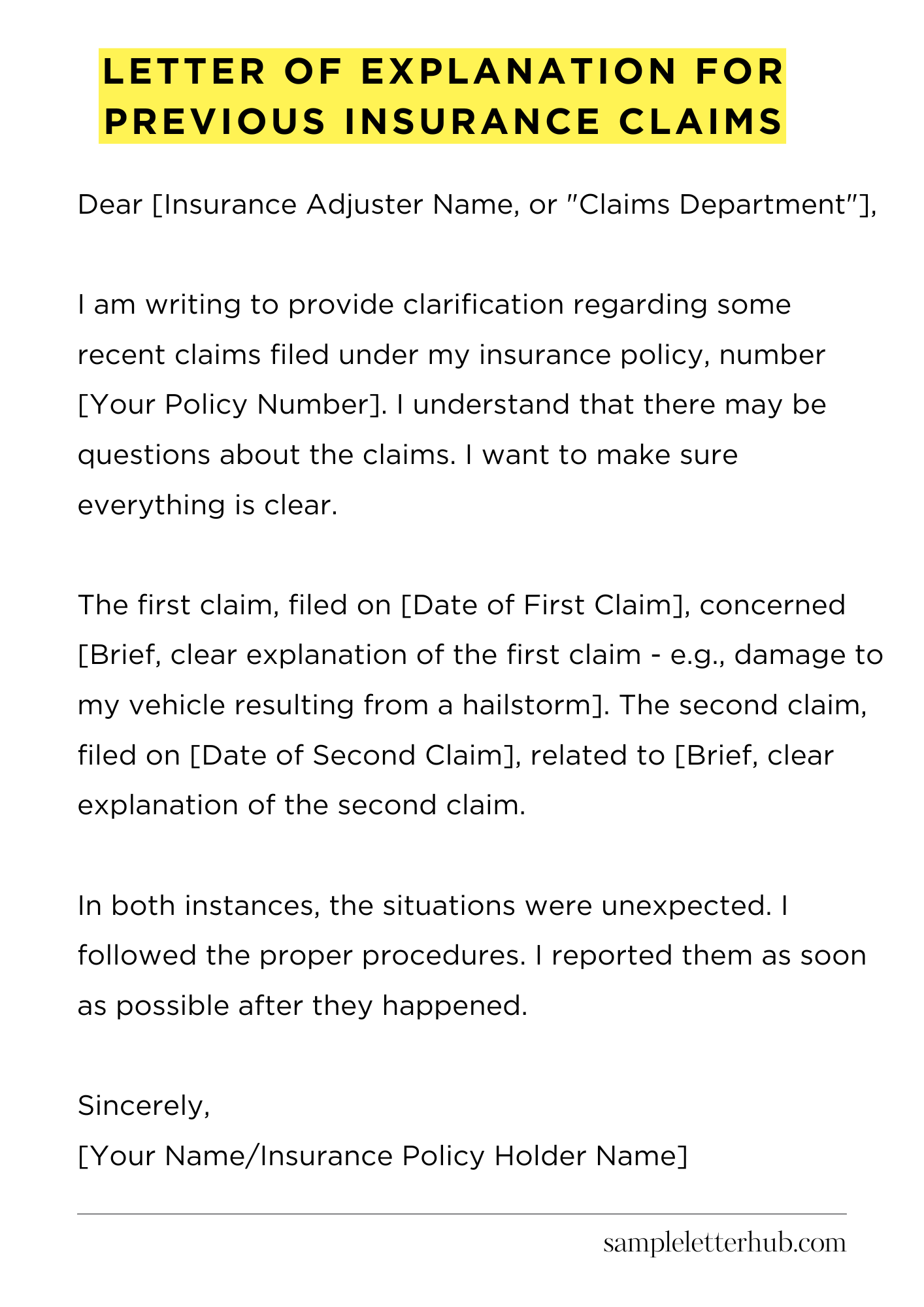
I am writing to provide clarification regarding some recent claims filed under my insurance policy, number [Your Policy Number]. I understand that there may be questions about the claims. I want to make sure everything is clear.
The first claim, filed on [Date of First Claim], concerned [Brief, clear explanation of the first claim – e.g., damage to my vehicle resulting from a hailstorm]. The second claim, filed on [Date of Second Claim], related to [Brief, clear explanation of the second claim – e.g., a medical expense related to a fall]. These were two separate events.
In both instances, the situations were unexpected. I followed the proper procedures. I reported them as soon as possible after they happened.
Regarding the first claim, the hailstorm caused significant dents. I took the vehicle to a reputable repair shop. They provided a detailed estimate.
For the second claim, I sought medical attention immediately. The doctor diagnosed a sprain. I have attached copies of all relevant documentation, including repair estimates and medical bills. The documentation is easy to read.
I trust that this explanation, along with the attached documentation, will help clarify any concerns you may have. I want to maintain a good relationship with you.
Please do not hesitate to contact me if you require any further information or clarification. I am available at the contact information provided above. I look forward to your prompt response and the continued coverage under my policy.
Sincerely,
[Your Name/Insurance Policy Holder Name]
How to Write Letter of Explanation for Previous Insurance Claims
Navigating the labyrinthine world of insurance claims can sometimes feel like traversing a treacherous jungle. An essential tool in this expedition is the letter of explanation, a vital document that clarifies the circumstances surrounding a previous claim.
Understanding how to construct a compelling letter can significantly impact the outcome, potentially influencing claim decisions in your favor. Let’s delve into the intricacies of crafting a persuasive and effective letter.
1. Initiate with Precision: The Salutation and Recipient
Begin your epistle with an appropriate salutation. It’s imperative that you address the correct recipient. If you are unsure, investigate the claim documentation. Use “Dear Mr./Ms./Mx. [Last Name]” if possible. Avoid generic salutations like “To Whom It May Concern,” unless absolutely necessary. This establishes a professional rapport immediately.
2. The Subject Line: Conciseness is Key
Your subject line should be clear and immediately informative. Think of it as the headline for your claim’s narrative. Employ phrases like “Explanation Regarding Claim Number [Claim Number]” or “Clarification for Insurance Claim – Policy Number [Policy Number]” This helps the insurance adjuster quickly grasp the letter’s purpose, streamlining the review process.
3. Contextualize the Situation: Provide the Background
The core of your letter rests on providing a clear and comprehensive explanation of the claim’s genesis. Start with the “what,” “when,” and “where.” State the nature of the incident that led to the claim. Include pertinent dates, times, and locations. Be succinct; avoid superfluous details that obfuscate the essential narrative.
4. Explain the Circumstances: Detail the Rationale
This section is where you elucidate the “why” and “how.” Detail the sequence of events that transpired. Articulate your reasoning behind the claim. If there were extenuating circumstances, address them here. Focus on facts. Avoid conjecture or emotional language. Demonstrate objectivity; this fosters trust with the reader.
5. Supporting Documentation: The Augmenting Element
A letter of explanation often gains significant credibility when it includes supporting documentation. Mention any documents, such as police reports, medical records, photographs, or witness statements, that corroborate your explanation. List them clearly and concisely. Reference them directly in your explanation.
6. The Conclusion: Summary and Assurance
Conclude your missive with a brief summary of the key points. Reiterate the claim’s rationale. Politely request the adjuster to review your explanation and supporting documents. Express your willingness to provide further clarification.
Thank the recipient for their time and consideration. You can end with a professional closing, such as “Sincerely” or “Respectfully”.
7. Polishing and Submission: Before the Send
Before dispatching your letter, meticulously proofread it for any grammatical errors or typographical mistakes. It is prudent to have a second pair of eyes review it as well. Ensure the document is well-formatted and easy to read.
Make copies of the letter and all supporting documentation for your records. Consider sending the letter via certified mail with return receipt requested. This provides proof of delivery and receipt, which may be crucial down the line. Finally, retain copies of all correspondence.
FAQs about Letter of Explanation for Previous Insurance Claims
What is a Letter of Explanation for Previous Insurance Claims?
A Letter of Explanation (LOE) for previous insurance claims is a written document that provides context and details regarding past insurance claims. It’s often requested by insurance companies when you apply for a new policy.
The purpose is to help the insurer understand the circumstances surrounding prior claims, assessing risk, and determining premiums.
When is a Letter of Explanation Required?
An LOE is typically required when you have had previous insurance claims, especially those involving significant payouts or multiple incidents. Insurance companies may request it when assessing new policy applications, particularly for auto, home, or health insurance.
The need for an LOE often depends on the type of claim, the frequency of claims, and the specific underwriting guidelines of the insurance provider.
What Information Should be Included in a Letter of Explanation?
A comprehensive LOE should include: The date of the claim, the type of incident (e.g., car accident, medical procedure), a clear description of the events leading to the claim.
How Should I Write a Letter of Explanation?
The LOE should be written in a clear, concise, and professional manner. Start with your name, address, and contact information. Then, state the policy number and the specific claim(s) you are addressing.
Briefly describe the incident, explain the circumstances, and provide supporting documentation if needed. End with a statement acknowledging that all information provided is accurate. Proofread carefully before submitting.
Can a Letter of Explanation Affect My Insurance Rates?
Yes, a Letter of Explanation can influence your insurance rates. The information provided helps the insurer assess the level of risk you present.
A well-written, honest LOE can mitigate the negative impact of previous claims. For example, if you can demonstrate that a past claim was an isolated incident or that you’ve taken steps to reduce future risk, it could lead to more favorable terms.
Related:
Resignation letter due to rude boss
Resignation letter moving to another state
Resignation letter due to illness of family member
Resignation letter due to study