

Need to write a late premium payment explanation letter? This letter explains why you missed your payment. Its main purpose is to prevent policy cancellation. You want to keep your insurance active. This is crucial for insurance coverage.
We’re here to help! We’ll give you templates and samples of late payment explanation letters. These will make writing your own letter easy. Crafting the perfect explanation letter has never been simpler.
Consider us your letter-writing allies. We have various examples to cover different situations. Find the right format. Explanation letters are now within your reach. Just customize the templates. You can create a compelling late premium payment letter in minutes.
[Your Name/Insurance Company Name]
[Your Address]
[Your City, Postal Code]
[Date]
[Recipient Name/Insurance Company Name]
[Recipient Address]
[Recipient City, Postal Code]
Dear [Recipient Name],
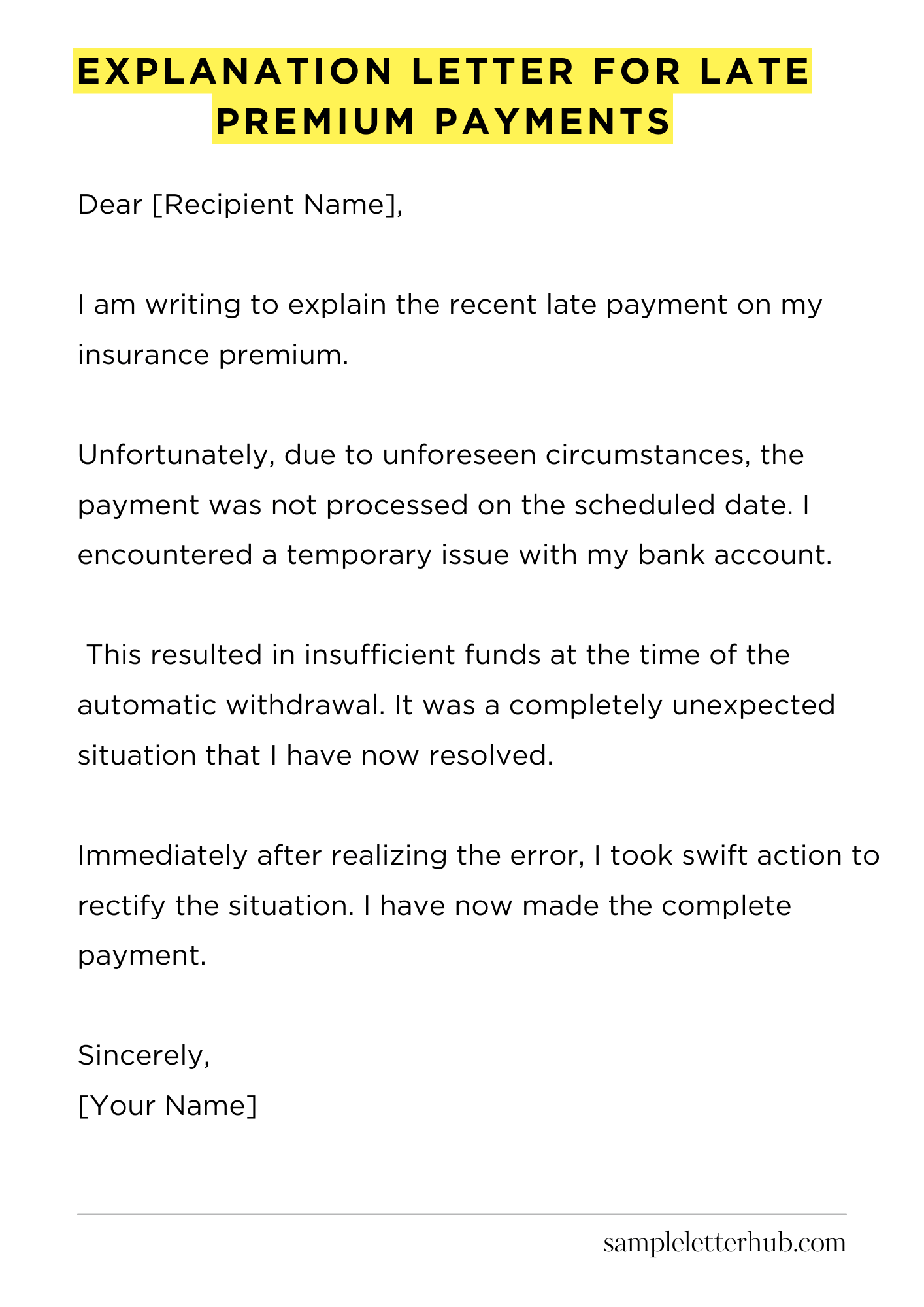
I am writing to explain the recent late payment on my insurance premium. This is something that I take very seriously, and I understand the importance of making payments on time to keep my coverage active. I sincerely apologize for the delay.
Unfortunately, due to unforeseen circumstances, the payment was not processed on the scheduled date. I encountered a temporary issue with my bank account. This resulted in insufficient funds at the time of the automatic withdrawal. It was a completely unexpected situation that I have now resolved.
Immediately after realizing the error, I took swift action to rectify the situation. I have now made the complete payment. I paid the full premium, including any late fees, on [Date of Payment]. You can see this payment reflected in your records.
I value my insurance policy and the protection it provides. I understand that maintaining a good payment history is essential for keeping my coverage secure. I will be sure to avoid this from happening again.
I want to assure you that this was an isolated incident. I am committed to making future payments on time. I have already implemented measures to prevent any further delays.
Thank you for your understanding in this matter. I appreciate your attention to this issue. Please let me know if you require any further information.
Sincerely,
[Your Name]
How to Write Explanation Letter for Late Premium Payments
Life can be a tempestuous journey, and sometimes, even the most meticulous among us find themselves adrift in a sea of forgotten deadlines. This article will help you navigate the tricky waters of writing an explanation letter for late premium payments. It is a necessary correspondence that, when done right, can prevent dire consequences with your insurance provider.
1. Commence with a Cogent Salutation
Your missive should begin with a professional salutation. Address the recipient, usually the insurance company or a specific individual within, with respect.
Avoid informal greetings like “Hey!” or “Hi there.” Instead, opt for “Dear Mr./Ms./Mx. [Last Name]” or a more formal “To Whom It May Concern,” depending on your familiarity. This sets a tone of professionalism from the outset.
2. Explicitly State Your Purpose
Be crystal clear about why you are writing. Immediately, in your opening paragraph, state that the letter serves to explain your late premium payment. This eliminates any ambiguity and swiftly directs the reader’s focus to the crux of the matter.
For instance, you could begin with: “I am writing to explain the late payment for my insurance policy…” Don’t beat around the bush; be direct.
3. Present a Concise Account of the Circumstances
This is where you elucidate the reasons behind your tardiness. Be honest and factual. Acknowledge the payment due date and the date of your belated payment. Provide a brief, but thorough, explanation of what caused the delay.
Whether it was a missed payment notification, a temporary financial setback, or an administrative error, outline the events in a logical sequence. The more candid you are, the better.
4. Offer Proactive Remedies and Assurances
Show the recipient that you have taken, or will take, proactive steps to prevent recurrence. This demonstrates your commitment to rectifying the situation and maintaining good standing with the insurer.
If you’ve updated your payment method, set up automatic payments, or implemented a reminder system, mention it. Further, add that such situations will not arise in the future. For example, “I have now enrolled in automatic payments to prevent future occurrences.”
5. Exhibit Gratitude and Express a Desire for Continued Coverage
Acknowledge that your error may have caused inconvenience. Express your gratitude for their understanding and cooperation in the matter. Reiterate your intention to maintain your coverage. This reinforces your value as a customer. Words like “Thank you for your understanding,” and “I value my coverage” are excellent additions.
6. Furnish Contact Details and Policy Information
To facilitate a swift response, include your contact information: your full name, address, phone number, and email address. Always include your policy number to allow the recipient to quickly locate your account. Ensure all information is easily accessible, to the person reading. This streamlines the process and ensures a seamless resolution.
7. Conclude with a Professional Closing and Signature
Conclude your letter with a professional closing, such as “Sincerely,” “Respectfully,” or “Yours faithfully.” Sign your name above your printed name. If sending a digital version, consider adding a digital signature.
This final step solidifies your commitment to the information provided and gives it the professional touch it deserves. Proofread carefully before dispatching it to ensure it is immaculate.
FAQs about Explanation Letter for Late Premium Payments
What is an Explanation Letter for Late Premium Payments, and Why is it Necessary?
An Explanation Letter for Late Premium Payments is a written document submitted to an insurance provider to explain the reasons behind a late payment on an insurance premium. It’s often required when a payment is received after the grace period has ended.
This letter is crucial as it helps maintain your insurance coverage and prevents policy cancellation. It provides context to the late payment, potentially influencing the insurer’s decision to reinstate your policy or avoid penalties.
What Information Should be Included in an Explanation Letter?
A comprehensive Explanation Letter should include the policyholder’s full name, policy number, and the date the late payment was made. It’s vital to clearly state the reason for the late payment, providing specific details rather than vague statements.
Supporting documentation, such as medical bills, bank statements, or proof of a job loss, should be included to substantiate your explanation. Finally, express your commitment to maintaining the policy and making future payments on time.
What Are Acceptable Reasons for Late Premium Payments?
Acceptable reasons typically vary depending on the insurance provider and policy terms, but common justifications include medical emergencies, job loss or financial hardship, bank errors or payment processing issues, and unforeseen circumstances like natural disasters.
Documentation supporting these reasons is generally necessary for the provider to consider the explanation favorably.
How Do I Submit an Explanation Letter and What Happens After Submission?
The submission method varies depending on the insurance company. It can usually be submitted via mail, email, or through the insurer’s online portal.
Ensure you keep a copy of the letter and any supporting documents for your records. After submission, the insurance company will review the letter and its supporting documentation. The outcome can vary, from policy reinstatement, possible waiver of penalties, or policy cancellation if the explanation is deemed unacceptable or no action is taken at all.
What Happens if My Explanation is Rejected?
If your explanation is rejected, the insurance company might proceed with policy cancellation, impose penalties, or request further information.
You may have options to appeal the decision, depending on the insurer’s process. It’s important to review your policy terms and conditions, contact your insurance provider to inquire about options, and understand the consequences of the rejection to explore all available remedies. Consider seeking assistance from a consumer protection agency or legal counsel if you are not satisfied with the outcome.
Related:
Resignation letter due to rude boss
Resignation letter moving to another state
Resignation letter due to illness of family member
Resignation letter due to study
Resignation letter due to long commute