

Ever find yourself staring at an insurance coverage gap? It happens. A Letter of Explanation for Insurance Coverage Gap is your tool to bridge that gap. This letter clarifies why you had a lapse in health insurance or other insurance coverage. Its main purpose? To convince your insurer, often the insurance company, to reconsider their decision or avoid penalties.
Writing a Letter of Explanation can feel tricky. You want to get it right. That’s where we come in. We will make it easier for you. We’ll share ready-to-use Letter of Explanation for Insurance Coverage Gap templates.
We’ve got you covered. This article contains numerous Letter of Explanation samples. They’re designed to help you. Use these samples to create your own letter. Get your insurance coverage sorted today!
[Your Name]
[Your Address]
[Your Phone Number]
[Your Email Address]
[Date]
[Insurance Company Name]
[Insurance Company Address]
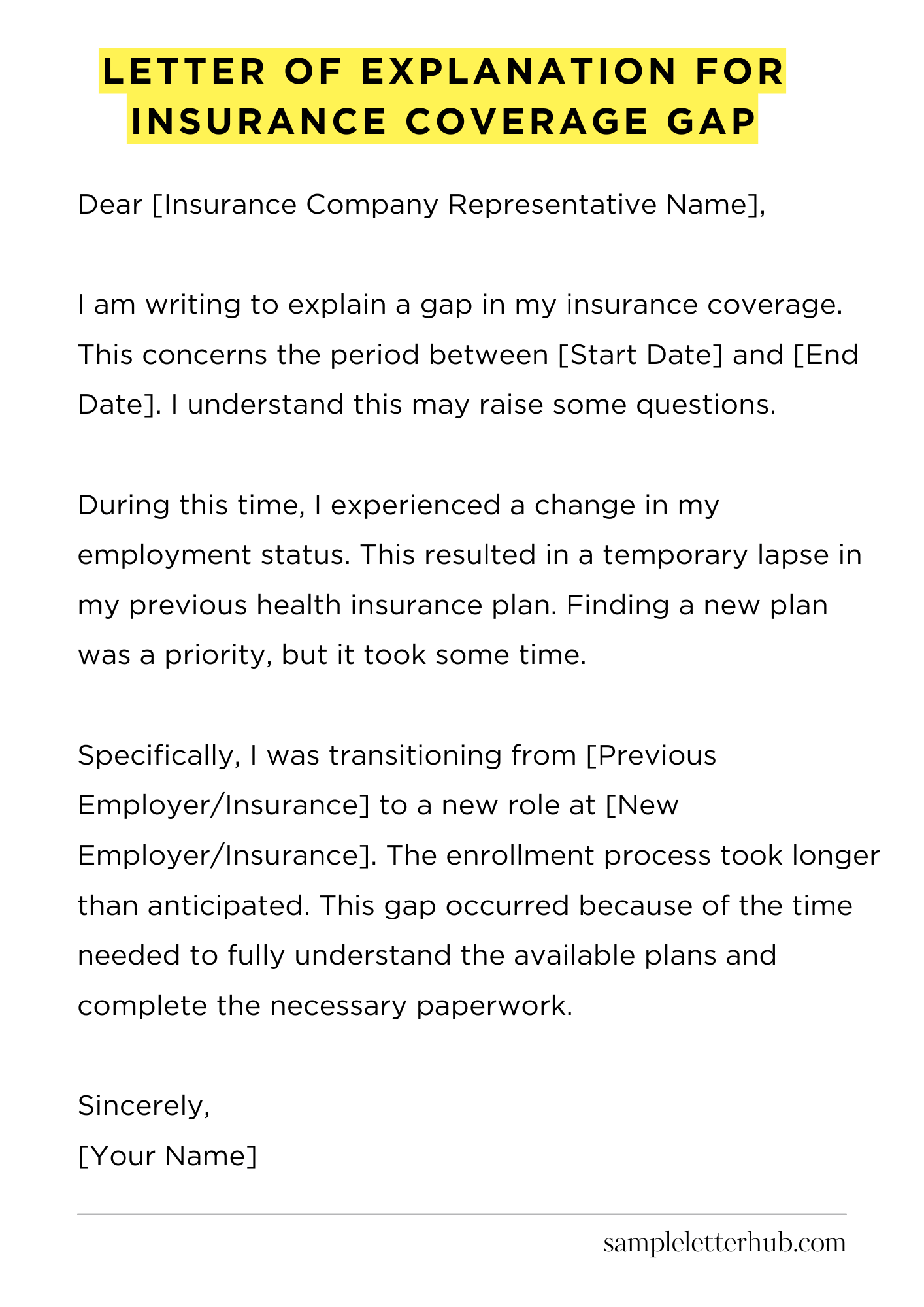
Dear [Insurance Company Representative Name],
I am writing to explain a gap in my insurance coverage. This concerns the period between [Start Date] and [End Date]. I understand this may raise some questions.
During this time, I experienced a change in my employment status. This resulted in a temporary lapse in my previous health insurance plan. Finding a new plan was a priority, but it took some time.
Specifically, I was transitioning from [Previous Employer/Insurance] to a new role at [New Employer/Insurance]. The enrollment process took longer than anticipated. This gap occurred because of the time needed to fully understand the available plans and complete the necessary paperwork. I wanted to choose the best option for my needs.
I am now fully covered under a new insurance plan, which started on [Start Date of New Coverage]. I have attached a copy of my new insurance card for your review. This will help you see I have continuous insurance now.
I apologize for any inconvenience this may cause. I take my health insurance coverage very seriously. I strive to maintain coverage at all times.
Thank you for your understanding. I would be grateful if you could clarify any further details. I am available to discuss this matter further if needed.
Sincerely,
[Your Name]
How to Write Letter of Explanation for Insurance Coverage Gap
1. Comprehending the Quandary: What’s a Coverage Gap?
Insurance coverage gaps represent periods where you are ostensibly without active insurance, despite your best intentions. This might occur due to a myriad of reasons: a policy lapse, a change of employment, or a delay in securing a new plan.
These chasms in coverage can have significant consequences, especially when healthcare costs or unexpected damages arise. Thus, a letter of explanation is often required to clarify the circumstances.
2. Unveiling the Premise: The Purpose of Your Letter
The primary function of this letter is to furnish the insurance provider with a clear and concise rationale for the existence of the coverage gap.
It serves as your official account of the situation, providing crucial context that can impact their assessment of your application or claims. Transparency is paramount, and honesty is the best policy. Ensure it is written clearly so that there is no ambiguity.
3. Drafting the Foundation: Essential Components and Format
The letter should adhere to a formal business letter format. Start with your full name, address, and contact information. Follow this with the date, then the insurance company’s name and address.
The salutation, such as “Dear Claims Adjuster,” should be professional. A subject line indicating the policy number and stating “Letter of Explanation for Coverage Gap” is advantageous. Then the body paragraphs should go.
4. Articulating the Narrative: Detailing the Circumstances
This section is the heart of your letter. Here, you must explain the reason for the gap with comprehensive detail. Specify the exact start and end dates of the period without coverage. Offer a detailed account of events that transpired, and substantiate your account with supporting documentation.
For example, include a termination letter from your previous employer, or a new policy enrollment confirmation. Avoid vagueness; precision is key. Elaborate further on specific reasons, such as job loss, change in residence, or any other pertinent factors.
5. Corroborating Evidence: Assembling Supporting Documentation
Documentation is your ally. Attached copies of all pertinent documents. This might include prior insurance cards, separation notices, policy enrollment forms, or any communications that validate your narrative.
List each document by name in your letter and make sure they are clearly referenced. The more evidence you can offer, the stronger your defense against potential coverage denials.
6. Finalizing the Plea: The Concluding Remarks
In your concluding paragraph, reiterate the reason for the coverage gap and express your commitment to maintaining insurance coverage going forward.
You can reaffirm your adherence to the policies and also appreciate their attention to detail. End with a professional closing, such as “Sincerely,” followed by your full name and signature (if submitting a physical copy). Double check for spelling and grammar.
7. Delivery and Deliberation: Submission and Follow-Up
Decide whether to submit the letter by mail or electronically, depending on the insurance company’s guidelines. Ensure you retain a copy of the letter and all attachments for your records.
Allow sufficient time for the insurer to review your submission. If you have not received a response within a reasonable timeframe, consider following up via phone or email to inquire about the status of your request.
FAQs about Letter of Explanation for Insurance Coverage Gap
What is a Letter of Explanation (LOE) for an insurance coverage gap?
A Letter of Explanation (LOE) for an insurance coverage gap is a written document that you, the applicant, provide to an insurance company. It’s used to explain the reason for any breaks in your insurance coverage history.
These gaps can impact your eligibility for new coverage or the premium rates you’re offered, as insurance companies often view continuous coverage favorably. The LOE gives you the chance to clarify circumstances surrounding the gaps, which might include job changes, financial hardship, or other unforeseen events.
Why do insurance companies require a Letter of Explanation for coverage gaps?
Insurance companies request LOEs to assess risk. A history of continuous insurance coverage often indicates a lower risk of future claims.
Coverage gaps might suggest that the applicant has not prioritized insurance or may have experienced issues leading to the lapse. The LOE allows the insurer to understand the reasons behind these gaps. It provides an opportunity to evaluate the applicant’s circumstances and make an informed decision on their application.
What information should I include in my Letter of Explanation?
Your LOE should be clear, concise, and honest. Start by stating the dates of your coverage gap. Then, provide a detailed explanation of why the gap occurred. Examples include job changes, periods of unemployment, or financial difficulties.
Support your explanation with any available documentation, such as termination letters, proof of unemployment benefits, or medical records. Ensure that all the information aligns with the truth and is easily understandable for an insurance representative.
Will my Letter of Explanation guarantee approval or impact my premium?
The LOE doesn’t guarantee approval for coverage, nor does it automatically determine your premium. However, the details of your letter are an important piece of the insurance application process. Your explanation can influence the insurer’s decision.
A well-written, honest LOE, along with supporting documentation, might sway the insurer to approve coverage despite the gap. If coverage is approved, the specifics of your explanation can impact your premium. Depending on the reason and the details in your LOE, the insurer may or may not adjust your rate.
What happens if I don’t provide a Letter of Explanation when requested?
If you don’t provide a Letter of Explanation when requested, the insurance company may deny your application for coverage. They may view the lack of explanation as a sign of unreliability.
Alternatively, they might approve coverage but at a higher premium rate to reflect the increased risk associated with the coverage gap. It’s always best to provide the LOE promptly to avoid delays and ensure the insurance company has all the information needed to evaluate your application fairly.
Related:
Resignation letter due to rude boss
Resignation letter moving to another state
Resignation letter due to illness of family member
Resignation letter due to study