

Dealing with a car accident, especially one with no witnesses, can be incredibly stressful. An explanation letter for accident with no witnesses becomes crucial in this situation. It serves as your official account of what happened. The letter helps insurers and authorities understand the circumstances of the accident. This can impact the claims process and any legal proceedings.
Writing this letter can feel daunting. That’s why we’re here to help. We’ll provide a variety of explanation letter for accident with no witnesses templates. You can easily adapt these sample accident letters to fit your specific situation. This article makes writing a clear and concise accident explanation letter much easier.
Consider these accident letter examples your starting point. Use our provided explanation letter samples to create a strong narrative. They offer you the structure. Writing about the car accident just got a lot simpler, thanks to these easy-to-use templates.
[Your Name/Company Name (if applicable)]
[Your Address]
[Your Phone Number]
[Your Email Address]
[Date]
[Recipient’s Name/Company Name (if applicable)]
[Recipient’s Address]
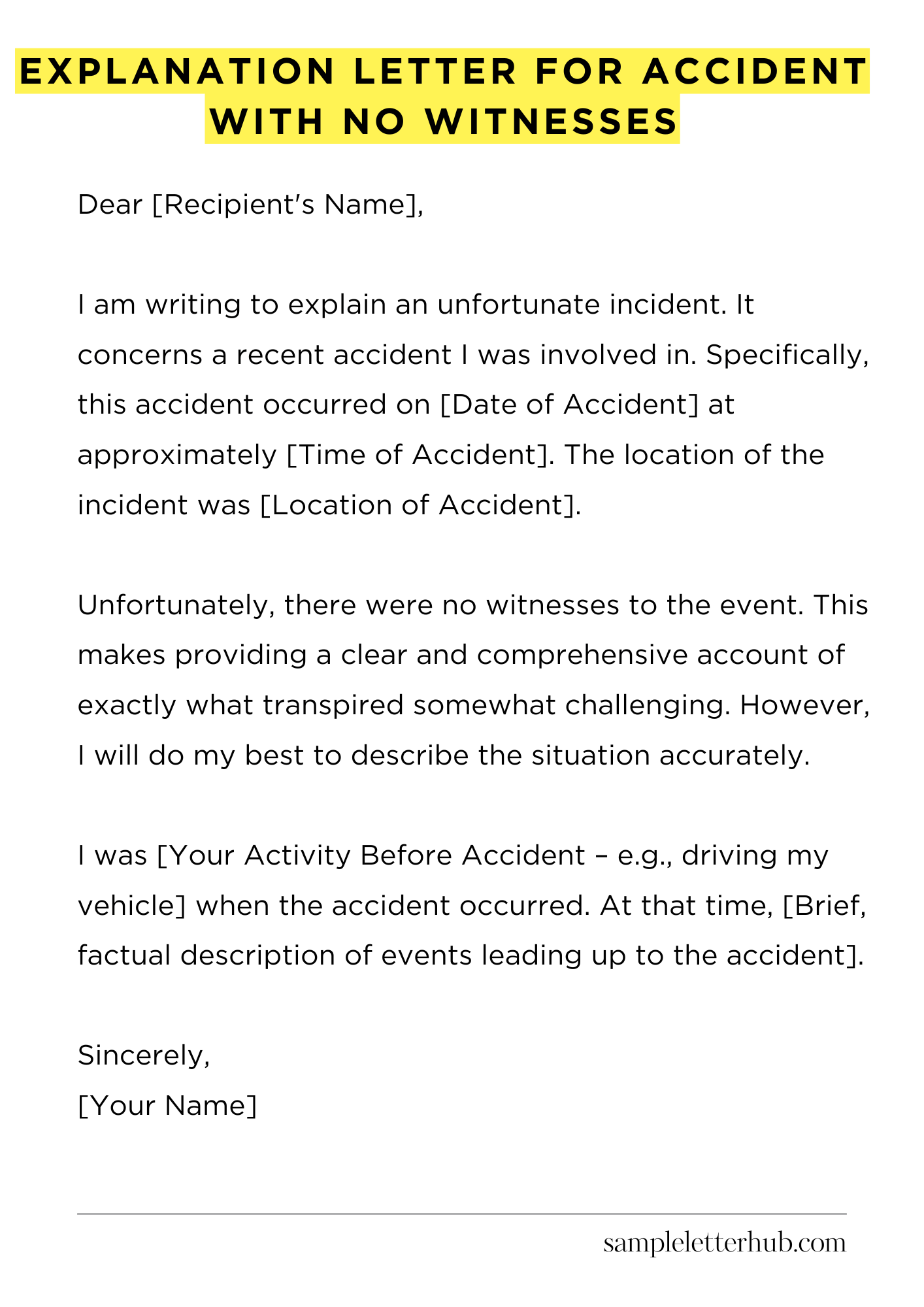
Dear [Recipient’s Name],
I am writing to explain an unfortunate incident. It concerns a recent accident I was involved in. Specifically, this accident occurred on [Date of Accident] at approximately [Time of Accident]. The location of the incident was [Location of Accident].
Unfortunately, there were no witnesses to the event. This makes providing a clear and comprehensive account of exactly what transpired somewhat challenging. However, I will do my best to describe the situation accurately.
I was [Your Activity Before Accident – e.g., driving my vehicle] when the accident occurred. At that time, [Brief, factual description of events leading up to the accident]. Suddenly, [Describe the Accident – what happened]. I immediately [Your actions after the accident – e.g., stopped the vehicle, checked for injuries].
As mentioned, there were no other individuals present who could offer their perspective. Because of this, my account is based solely on my observations and recollections. I can honestly state that [Your Statement – e.g., I was not speeding, I was paying attention to the road].
I understand the complexities associated with an accident that lacks witnesses. I am fully cooperating with the relevant authorities in their investigation. I am prepared to provide any further information or assistance required. Please do not hesitate to contact me if you need anything else.
Sincerely,
[Your Name]
How to Write an Explanation Letter for Accident with No Witnesses
Accidents, unfortunately, happen. And when they do, especially without any eyewitnesses, it can become a complex situation. Crafting a letter that clearly and concisely explains your perspective is crucial.
This guide provides a strategic framework for constructing a compelling narrative, even when the only evidence is your own account.
1. Commence with a Cogent Opening
Your introductory paragraph serves as the epistolary threshold. Begin by formally identifying yourself and the date of the incident. This establishes immediacy. State the purpose of your letter upfront: to elucidate the events leading to the accident. Be direct and avoid unnecessary embellishments. The aim is to immediately establish clarity and context.
2. Detail the Antecedents: The Pre-Collision Narrative
This is where you paint the picture. Before the actual collision, what were the prevailing circumstances? Elaborate on your location, speed, and direction of travel.
Detail any preceding actions, such as signaling intentions or checking blind spots. Provide meticulous descriptions of the environmental conditions, like visibility and weather. This will assist the reader to visualise the sequence of events. The more detail you provide, the better.
3. Recount the Crucible: The Accident Itself
Here, you meticulously describe the collision itself. Start at the precise moment of impact. Narrate the events chronologically, with particular attention to how the vehicles or individuals interacted.
Describe the point of impact and any immediate consequences. Be factual and avoid conjecture. Emphasise what you saw, felt, and heard. The goal is to provide a precise account of the incident’s pivotal moments.
4. Enumerate the Immediate Aftermath
The post-collision phase is equally significant. Describe your actions immediately following the accident. Did you check for injuries? Did you call for help? What did you observe about the other vehicle or individuals involved?
This portion establishes your response and behaviour, which can reflect on your level of responsibility. Provide an accurate picture of the scene after the impact.
5. Substantiate with Corroborating Evidence (If Any Exists)
Even without witnesses, you might have supporting evidence. Include any photographic documentation you have taken. Were there any street signs or environmental features relevant to the incident?
Did you take any recordings? Provide details of any documentation you can provide, as these will corroborate your claims. If there isn’t any corroborating evidence, state that plainly.
6. Articulate Your Perspective of Accountability
This is the moment for transparency. Acknowledge your contribution to the incident. If you believe there was any fault on your part, state it explicitly, but also explain the circumstances that contributed to the event. Demonstrate responsibility without admitting outright blame. This shows that you are being truthful and reasonable.
7. Conclude with a Concluding Statement
In your final paragraph, reiterate the key points of your letter. Thank the recipient for their time and consideration. You can express your willingness to cooperate with any further investigations. Ensure that you have signed and dated the letter. This strengthens its credibility and signifies the end of your communication.
FAQs about Explanation Letter for Accident with No Witnesses
What is an explanation letter for an accident with no witnesses?
An explanation letter for an accident with no witnesses is a written statement detailing the events of a car accident when there were no independent individuals to observe the incident.
This letter aims to provide a clear and comprehensive account of what happened, as perceived by the driver involved, for insurance companies, police, or other relevant parties.
What information should be included in an explanation letter?
A comprehensive explanation letter should include the date, time, and location of the accident. It should provide a detailed description of the events leading up to the crash, the accident itself, and the immediate aftermath.
Include a description of the vehicles involved, any damage sustained, and the driver’s perspective on the cause of the accident. Also, include the contact information of all parties involved.
Why is an explanation letter important in a no-witness accident?
In the absence of witnesses, the explanation letter becomes crucial evidence. It helps insurers and authorities understand the circumstances of the accident, assess liability, and determine the extent of damages. A well-written letter can support your claim and protect your interests, especially when there are disputes about what occurred.
How should I structure the explanation letter?
The letter should follow a logical and chronological order. Begin with an introduction providing basic details. Then, describe the events leading up to the accident, the accident itself, and the aftermath.
Maintain a calm and objective tone, avoiding speculation. Include relevant details like weather conditions, traffic flow, and any road hazards. Conclude with a clear and concise summary.
Can an explanation letter be used against me?
Yes, the information provided in the explanation letter can be used by insurance companies and legal professionals. Therefore, it is essential to be accurate and truthful in your account.
Any inconsistencies or omissions could be used to challenge your version of events. It is recommended to consult with a legal professional before submitting the letter to ensure your rights are protected.
Related:
Resignation letter due to rude boss
Resignation letter moving to another state
Resignation letter due to illness of family member
Resignation letter due to study