

Dealing with health insurance can be confusing. Sometimes, your insurer needs more information before covering medical costs. This is where a “Letter Explaining Medical Tests Required by Insurer” comes in. The letter clarifies why specific medical tests are necessary. Its main purpose is to convince your insurance company to approve your medical claims.
Writing this kind of letter can seem daunting. That is why we are here to help you. We understand your frustration. We will provide you with samples of letters to send to your insurer. These letter samples are easy to use.
We have gathered different letter templates. You can easily adapt them to your situation. This guide simplifies the process. Get ready to write your perfect letter explaining medical tests!
[Your Name/Company Name]
[Your Address]
[Your City, Postal Code]
[Your Email]
[Your Phone Number]
[Date]
[Insurance Company Name]
[Insurance Company Address]
[Insurance Company City, Postal Code]
Subject: Information Regarding Required Medical Tests for Insurance Coverage
Dear [Name of Contact Person or To Whom It May Concern],
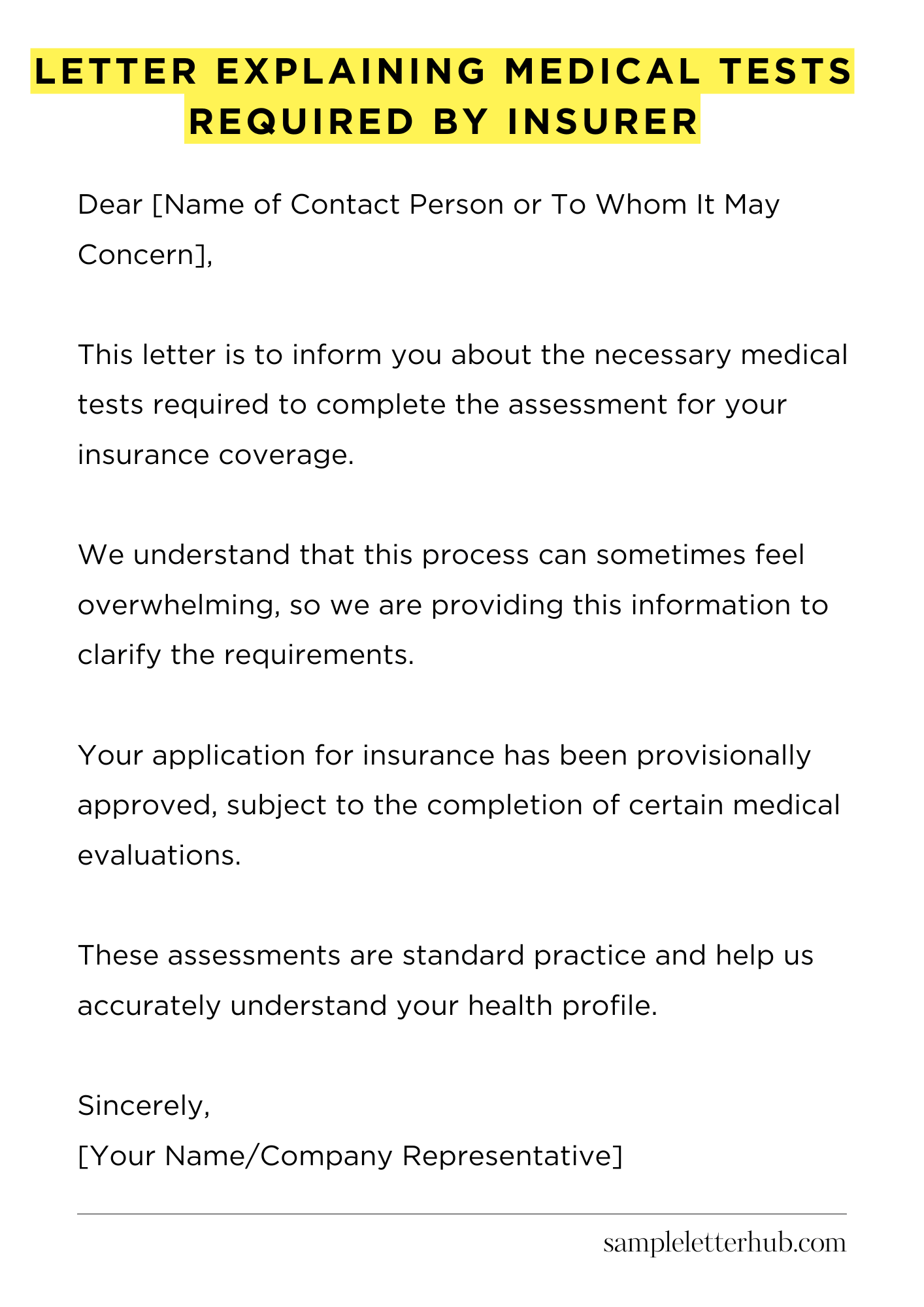
This letter is to inform you about the necessary medical tests required to complete the assessment for your insurance coverage. We understand that this process can sometimes feel overwhelming, so we are providing this information to clarify the requirements. It is important to complete these steps to ensure your application can be processed smoothly and efficiently.
Your application for insurance has been provisionally approved, subject to the completion of certain medical evaluations. These assessments are standard practice and help us accurately understand your health profile. The results assist us in determining the final terms of your insurance policy.
Specifically, we require the following tests:
First, a routine blood test. This will allow us to evaluate several key health indicators. These include your cholesterol levels, blood sugar, and overall organ function. This provides important insights.
Second, a urine analysis. This straightforward test helps identify any potential issues with your kidney function, among other things. It’s a vital part of the overall health picture.
Third, a physical examination with your primary care physician. During this exam, your doctor will assess your general health. They will also address any concerns you may have.
These tests can typically be scheduled with your own doctor. If you don’t have a primary care physician, we can help you find a suitable medical professional in your area. We want to make this process as easy as possible for you.
Please arrange for these tests to be completed within [Number] days of receiving this letter. Once the tests are completed, please ask your physician to forward the results directly to us. Our email address for submission is [Email Address]. Alternatively, you may have your doctor fax the results to [Fax Number].
We appreciate your cooperation in this matter. We are committed to providing you with the best possible service. If you have any questions or require further clarification, please do not hesitate to contact us at [Phone Number]. We are available to help you.
Sincerely,
[Your Name/Company Representative]
How to Write Letter Explaining Medical Tests Required by Insurer
1. Commence with Precise Identification
Your initial foray into drafting this missive demands impeccable clarity. You must unequivocally identify yourself. Include your full legal name, address, date of birth, and policy number.
This information acts as the cornerstone of the entire communication. Accuracy is paramount; a misconstrued detail can precipitate unfortunate delays. It’s the lynchpin that ensures your document reaches the correct recipient and is expeditiously processed.
2. Articulate the Genesis of Correspondence
The introductory paragraph should succinctly state the purpose of your letter. Clearly reference the insurer’s request for medical testing. Reiterate the date of the request, if known, and any specific requirements or instructions provided by the insurer.
This sets the stage and provides immediate context. Consider it your opening gambit; a well-crafted introductory sentence can substantially impact the reader’s perception.
3. Detail the Specified Medical Examinations
This is where you delve into the heart of the matter. Provide a comprehensive and itemized list of all the medical tests the insurer is requesting. Be meticulously specific.
Mention the exact name of each test. If possible, include the medical code (like CPT code) associated with it for further verification. Precision is key. This section should leave no room for ambiguity or equivocation.
4. Elucidate the Rationale for Each Test
This is where you weave a narrative to support your claims. For each test, explain the medical reason it is being performed. State the symptoms, diagnoses, or underlying conditions the test aims to assess.
If the test relates to a pre-existing condition, specifically state this. Provide a rationale for why each test is pertinent and relevant to your claim. A persuasive narrative increases the odds of a positive outcome.
5. Furnish Pertinent Medical Documentation
Bolster your claims by providing corroborating evidence. Enclose copies of all relevant medical records. This includes physicians’ reports, diagnostic results, and any other documentation that substantiates the need for the requested tests.
Ensure all documents are legible. Organize the attached documents logically for easier interpretation. This exhibits diligence and supports your arguments.
6. Indicate the Test Execution Timeline
Informing the insurer about your test schedule is important. If you have already scheduled the tests, clearly state the dates, times, and locations of each examination. If the tests are yet to be scheduled, provide a realistic timeline for when you anticipate them being completed. This offers transparency and helps the insurer anticipate the forthcoming documentation.
7. Conclude with a Call to Action and Signatory
Your concluding paragraph should politely and directly request the insurer’s action. Reiterate your understanding of the situation and the test requirements. Express your willingness to provide any further information that might be needed. Close the letter with a formal closing (e.g., “Sincerely,” or “Respectfully,”).
Sign your name legibly above your typed name. Include contact information: phone number and email address, for expeditious follow-up communication.
FAQs about Letter Explaining Medical Tests Required by Insurer
Why did I receive a letter from my insurer requesting medical tests?
Insurers often require medical tests to assess your health status. This information helps them evaluate the risk associated with your coverage, determine eligibility for specific treatments or procedures, or process claims accurately. The letter you received outlines the specific tests they need and the reason for the request.
What medical tests are typically requested by insurance companies?
The type of tests requested varies based on the insurance plan, the reason for the request, and your medical history. Common examples include blood tests (for cholesterol, glucose, or other markers), imaging scans (X-rays, MRIs, CT scans), urine analysis, and other diagnostic procedures. The letter will detail the specific tests needed.
What should I do after receiving the letter requesting medical tests?
Carefully review the letter to understand which tests are required, the deadlines for completing them, and the instructions for scheduling them. Contact your primary care physician or the designated testing facility to schedule the tests promptly.
Follow the letter’s instructions regarding any necessary pre-test preparations, such as fasting. Keep copies of all communication and test results.
What happens if I don’t complete the requested medical tests?
Failure to complete the requested tests can have several consequences. Your insurance claim for specific procedures may be denied, your existing coverage could be delayed, or your premiums may increase. In some cases, your policy could be affected, so it’s essential to comply with the insurer’s requirements.
Who pays for the medical tests requested by the insurer?
The financial responsibility for the medical tests depends on your insurance plan’s coverage. Your plan’s benefits may cover the tests, and you might be responsible for a co-pay, deductible, or coinsurance. Contact your insurance provider to understand your financial responsibilities related to the tests. The letter may provide information on billing and coverage.
Related:
Resignation letter due to rude boss
Resignation letter moving to another state
Resignation letter due to illness of family member
Resignation letter due to study
Resignation letter due to long commute