

Ever heard of a “Health Insurance Explanation Letter for Medical History”? It’s a crucial document. It helps you share your medical history with your health insurance provider. The purpose? To ensure accurate coverage and avoid claim denials. This letter ensures your health insurance company understands your past medical conditions.
Need help writing one? Look no further! We’re diving into the world of Health Insurance Explanation Letters for Medical History. We’re providing several sample letters and templates. These examples will act as your guide. Creating this important document just got easier.
Our article is your resource. We’ve got you covered. Use these sample letters to craft your own. Tailor them to your specific needs. Get ready to understand your health insurance better. Get ready to get help with the medical history explanation letter.
[Your Name/Insurance Company Letterhead]
[Your Address]
[Your Phone Number]
[Your Email Address]
[Date]
[Recipient Name]
[Recipient Address]
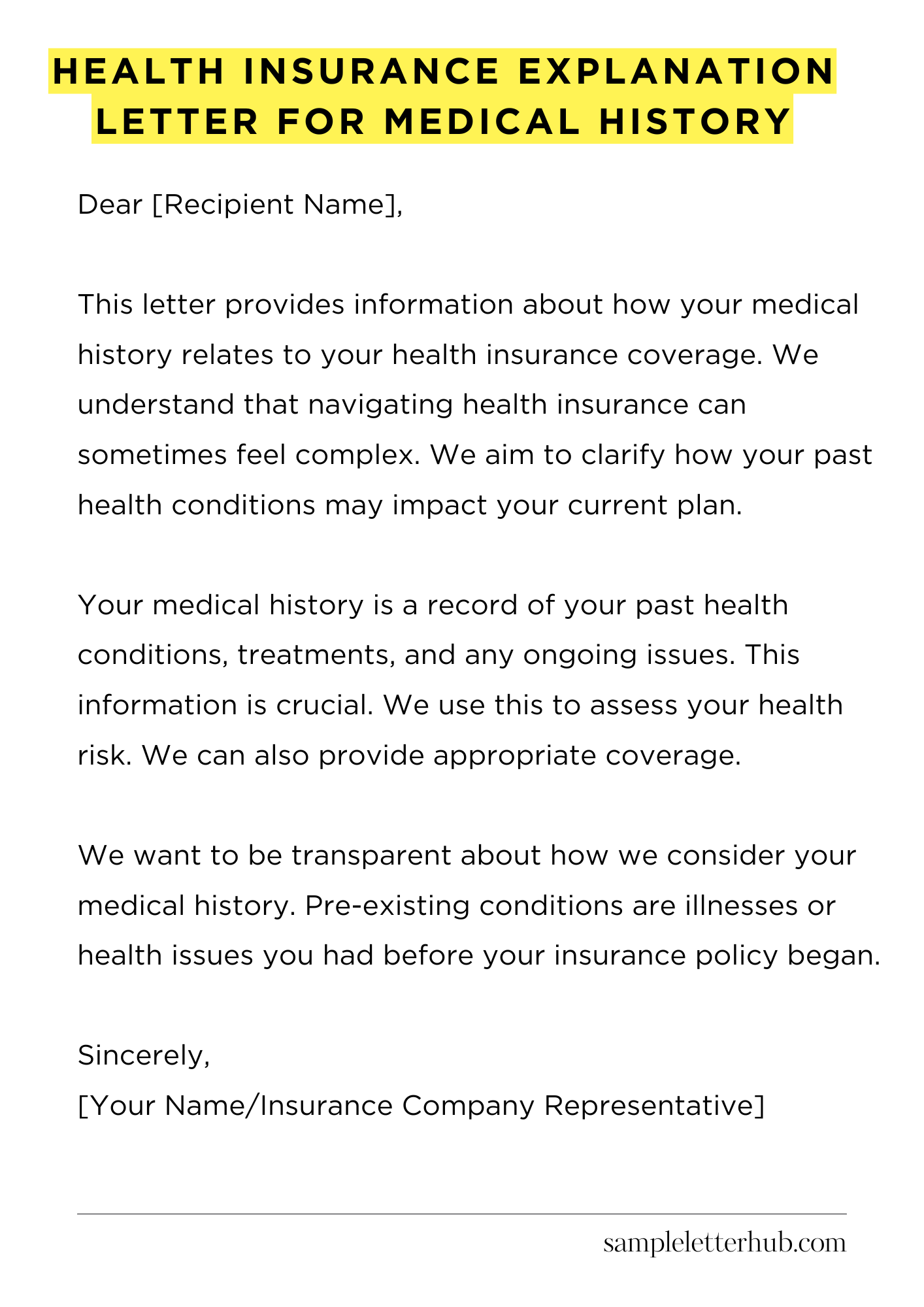
Dear [Recipient Name],
This letter provides information about how your medical history relates to your health insurance coverage. We understand that navigating health insurance can sometimes feel complex. We aim to clarify how your past health conditions may impact your current plan.
Your medical history is a record of your past health conditions, treatments, and any ongoing issues. This information is crucial. We use this to assess your health risk. We can also provide appropriate coverage.
We want to be transparent about how we consider your medical history. Pre-existing conditions are illnesses or health issues you had before your insurance policy began. These conditions might affect your premiums or coverage options. We assess each case individually.
We carefully review your medical records when you apply for coverage. This review helps us understand your overall health. We consider the type, severity, and treatment of your conditions. This helps us ensure you have access to the care you need.
Depending on your plan, there may be waiting periods for certain conditions. Some plans might have exclusions for pre-existing conditions. These exclusions are usually temporary. We aim to provide clear explanations of all terms.
Please review your policy documents. They have detailed information. They explain your specific coverage and any limitations. You can find these documents online or in the materials we sent you. They include important details.
If you have any questions or concerns about your coverage, please do not hesitate to contact us. We are here to help you. We can explain your policy in more detail. Our customer service team is available. They can be reached at the phone number listed above. We strive to provide you with the best service possible.
Sincerely,
[Your Name/Insurance Company Representative]
How to Write Health Insurance Explanation Letter for Medical History
Navigating the labyrinthine world of health insurance can often feel like deciphering an ancient scroll. When you need to explain your medical history to an insurance provider, clarity and precision are paramount.
You must render a comprehensive and cogent letter. Your goal is to provide a straightforward explanation. Here is a guide to help you create a compelling and informative health insurance explanation letter.
1. Precursory Data Acquisition: Gathering Your Arsenal
Before you even put pen to paper (or fingers to keyboard), assemble your vital documents. This preliminary stage is crucial. You’ll need records of all past treatments. Also, collect all diagnoses and medications.
Gather documentation of hospitalizations. Ensure you include the dates, locations, and names of your medical practitioners. Obtain any relevant test results, such as lab reports or imaging scans. The more comprehensive your assemblage, the more persuasive your narrative will be. This will strengthen your case.
2. Formatting: The Architectural Blueprint
Structure your letter with scrupulous attention to detail. Use a formal business letter format. Include your full name, address, and contact information at the top left. Then, on the top right, add the date.
Next, provide the insurance company’s name and address. Begin with a clear and concise salutation, such as “To Whom It May Concern.” A professional presentation is an initial indicator of credibility. Your words will carry more weight when presented with this format.
3. The Opening Salvo: Establishing the Premise
The first paragraph is your opportunity to capture your audience. State the purpose of your letter succinctly. Clearly indicate you are providing your medical history for insurance purposes.
Briefly mention the specific policy or claim the letter pertains to. Maintain a professional and respectful tone. This sets the tone for the entire communication. This is a very important part.
4. Illuminating the Narrative: Detailing Your History
This is the heart of your letter. This is the place for the comprehensive medical history. Systematically outline your medical history. Start with the earliest relevant conditions or incidents.
Provide the dates, diagnoses, treatments, and outcomes for each. Use clear, easily understood language, avoiding overly technical jargon unless absolutely necessary. Be meticulous in your explanations.
Maintain chronological order. If you have had any surgeries or invasive procedures, provide details. This stage allows you to convey your message in detail.
5. The Concluding Summation: Reiteration and Call to Action
In the final paragraph, reiterate the purpose of your letter. Briefly summarize your key points. Express your willingness to provide further information if needed. Include your contact details again for easy reference.
Thank the recipient for their time and consideration. You must create an appropriate closing. For example, “Sincerely” or “Respectfully.” This reinforces your professionalism and positive attitude.
6. The Art of Attestation: Supporting Documentation
Always attach copies of your supporting documents to your letter. Do not send originals. These attachments include medical records, test results, and any other relevant documentation. In your letter, mention the number of attachments included.
This will ensure that all essential information is included in the review. This indicates that all essential data is provided.
7. The Pre-Flight Check: Proofreading and Polishing
Before dispatch, meticulously proofread your letter. Check for grammatical errors, spelling mistakes, and inconsistencies. Ensure your information is accurate and easy to understand.
Have someone else read your letter for an unbiased perspective. A fresh pair of eyes can often catch errors that you might miss. An immaculate letter is an assurance of a compelling communication.
FAQs about Health Insurance Explanation Letter for Medical History
What is a Health Insurance Explanation Letter for Medical History?
A Health Insurance Explanation Letter for Medical History, often referred to as an “Explanation of Benefits” (EOB) or a similar document, is a written statement provided by your health insurance company after you receive medical services.
It details the services you received, the charges billed by the healthcare provider, how much the insurance company paid, and any remaining amount you are responsible for, such as deductibles, copayments, or coinsurance. The ‘medical history’ component refers to the record of healthcare services and related information.
What Information is Typically Included in a Health Insurance Explanation Letter?
An explanation letter typically includes: the date of service, the type of service (e.g., doctor visit, lab test, surgery), the healthcare provider’s name and address, the total charges for the service, the amount the insurance company paid, any discounts applied, the amount you are responsible.
Why Do I Need a Health Insurance Explanation Letter?
You need a health insurance explanation letter for several reasons. Primarily, it allows you to verify that the insurance company processed the claim correctly. It enables you to cross-reference the charges with the services you received.
It helps you track your healthcare spending and understand how your deductible and out-of-pocket maximums are being met. It also provides a record for tax purposes or if you need to dispute a bill.
How Do I Obtain a Health Insurance Explanation Letter?
You typically receive an explanation letter from your health insurance company either by mail, electronically via email, or through an online portal on the insurance company’s website.
You can often access older EOBs through the member portal of your insurance provider. You can also contact your insurance provider directly by phone to request copies of previous explanation letters.
What Should I Do if I Disagree with Information on My Explanation Letter?
If you disagree with the information on your explanation letter, such as the charges, services listed, or the amount you owe, you should contact your health insurance company immediately.
Gather any supporting documentation you have, such as the bill from your healthcare provider or a record of your medical services. You will likely need to file an appeal with your insurance provider, following their specific appeal process. They will review the claim and provide a final decision.
Related:
Resignation letter due to rude boss
Resignation letter moving to another state
Resignation letter due to illness of family member
Resignation letter due to study