

Navigating healthcare and insurance can be tricky. A “Letter of Explanation for Pre-Existing Medical Condition” is often required. It clarifies your medical history to insurance companies or lenders. The goal is to provide details about a pre-existing condition. This helps them understand your situation.
Need help crafting your letter? This article is your guide. We will provide Letter of Explanation samples. We also have Letter of Explanation templates. You can use them for various situations. Write your pre-existing condition letter with ease.
We understand the challenges. Writing can be stressful. Our letter examples simplify the process. Access Letter of explanation examples that fit your needs. Get ready to write your pre-existing condition letter with confidence.
[Your Name]
[Your Address]
[Your Phone Number]
[Your Email Address]
[Date]
[Insurance Company Name]
[Insurance Company Address]
Dear [Insurance Company Name] or To Whom It May Concern,
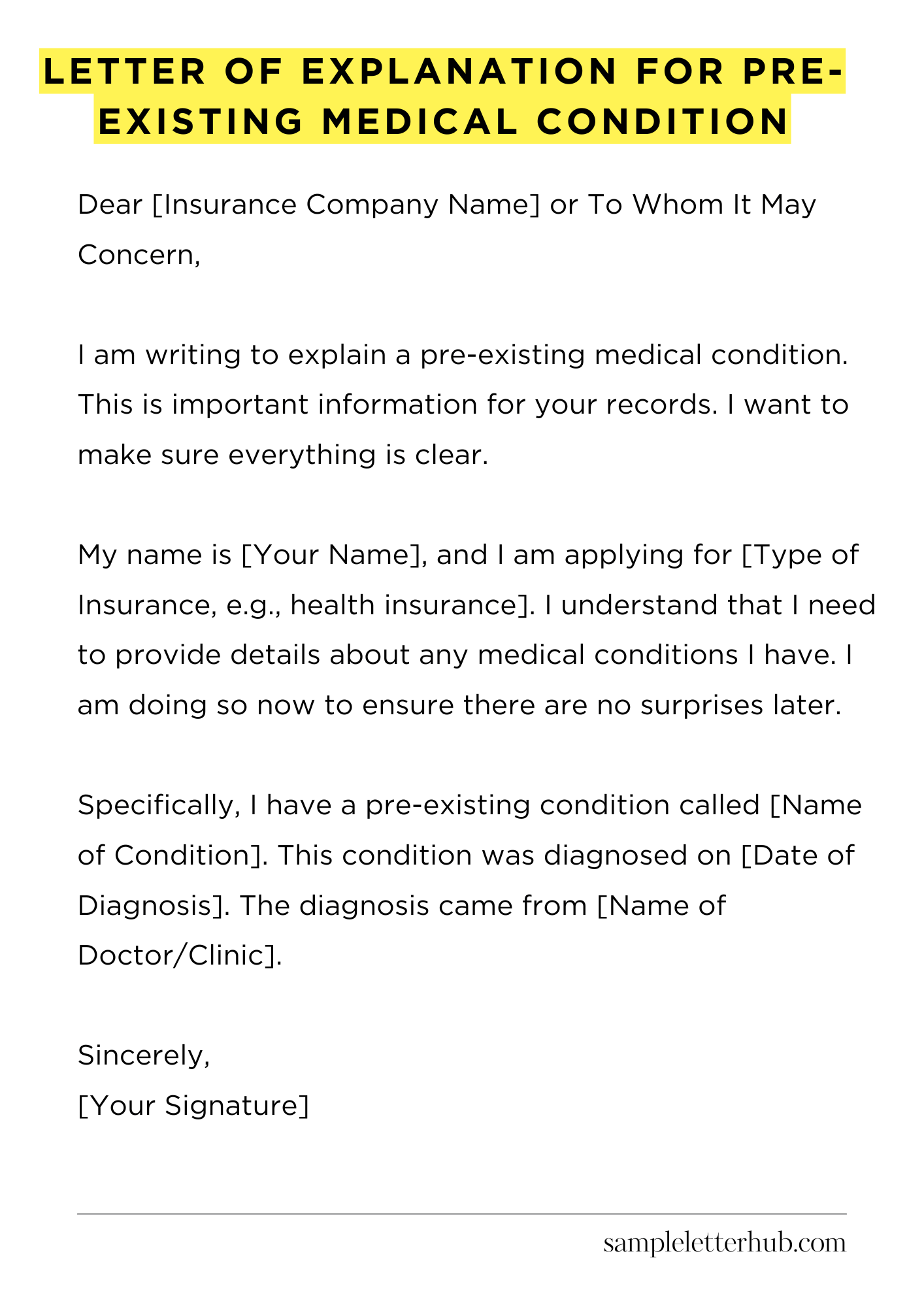
I am writing to explain a pre-existing medical condition. This is important information for your records. I want to make sure everything is clear.
My name is [Your Name], and I am applying for [Type of Insurance, e.g., health insurance]. I understand that I need to provide details about any medical conditions I have. I am doing so now to ensure there are no surprises later.
Specifically, I have a pre-existing condition called [Name of Condition]. This condition was diagnosed on [Date of Diagnosis]. The diagnosis came from [Name of Doctor/Clinic].
I began experiencing symptoms such as [List a few key symptoms]. After some tests, my doctor identified the problem. Currently, I manage the condition through [Treatment, e.g., medication, physical therapy, lifestyle changes]. The treatment plan has been very helpful.
I have been receiving ongoing care for this condition, and I am under the supervision of [Doctor’s Name]. I attend regular check-ups to monitor my health. My doctor believes I am currently in a stable state. It’s important to note that my condition is managed effectively.
I have attached copies of my medical records for your review. These records include the diagnosis, treatment plan, and recent progress. Please let me know if you need any additional information. I am happy to provide it.
Thank you for your time and consideration. I appreciate you taking the time to read this letter.
Sincerely,
[Your Signature]
How to Write Letter of Explanation for Pre-Existing Medical Condition
Navigating the terrain of pre-existing medical conditions can sometimes feel like traversing a labyrinth. Insurance companies, for example, often scrutinize applications with particular attention to pre-existing ailments.
Consequently, a well-crafted Letter of Explanation (LOE) becomes your strategic asset, your verbal semaphore in the intricate dance of documentation. This guide furnishes you with the necessary tools to compose a potent LOE, one that persuasively communicates your circumstances.
1. Commence with a Candid Confluence of Facts
The genesis of a compelling LOE lies in its unvarnished honesty. Begin by unequivocally stating the pre-existing condition in question. This is not the time for obfuscation; be perspicuous and explicit.
Specify the precise medical diagnosis. Include the date of initial diagnosis or the earliest manifestation of symptoms. Provide concise medical history, including any treatments undertaken and their corresponding dates. Remember, candor is the bedrock of credibility.
2. Explicate the Etiology of the Ailment
Delve deeper into the origin of the condition. Explain, in layperson’s terms, what caused it. Did it stem from a congenital anomaly? Was it the byproduct of environmental factors? Was it a consequence of lifestyle choices?
While you are not expected to proffer medical jargon, a basic understanding of your medical narrative is essential. Furthermore, if you are aware of triggers, be sure to mention them.
3. Substantiate with Corroborating Evidence
An LOE is more than just a recitation of facts. It is a persuasive argument, and like all arguments, it requires substantiation. Enclose copies of pertinent medical records. Include doctor’s notes, test results, and any relevant correspondence.
If applicable, provide details of any medications you are taking or have taken in the past. Remember, the more comprehensive your supporting documentation, the stronger your case becomes.
4. Articulate the Mitigation of Symptoms
A crucial segment of your LOE involves demonstrating your commitment to managing the condition. Detail the measures you have taken to mitigate symptoms and prevent complications.
This might encompass lifestyle modifications, such as dietary adjustments or regular exercise. It could also include adherence to prescribed medication regimens. This section underscores your proactive role in maintaining your health and wellness.
5. Highlight the Prognosis and Future Expectations
Provide a clear vision of the future. Briefly touch on the prognosis of the condition. Will it require ongoing treatment? Are there potential long-term complications? How might this affect your ability to work?
Your narrative should be a testament to your personal resilience and positive outlook. If you are optimistic about your prospects, your letter’s impact on readers will be increased.
6. Showcase Your Intent and Goals
Articulate your purpose. Why are you writing this letter? What do you hope to achieve? Be explicit about your request or the information you are providing. For example, if you are applying for insurance, state your desire to secure coverage.
If you are appealing a denial of benefits, emphasize your need for financial assistance. Always maintain a tone of professionalism, with a strong voice.
7. Finalize with a Professional Persona
Conclude your LOE with a dignified flourish. Reiterate your appreciation for the reader’s consideration. Include your full name, contact information, and the date. Ensure that your letter is meticulously proofread for any errors in grammar or punctuation.
A polished presentation reflects well on your credibility and increases the chances of a favorable outcome. This letter is your opportunity to represent yourself: do so effectively.
FAQs about Letter of Explanation for Pre-Existing Medical Condition
What is a Letter of Explanation for a Pre-Existing Medical Condition?
A Letter of Explanation (LOE) for a pre-existing medical condition is a document, typically required by lenders (mortgage, auto loans, etc.) or insurance providers, that details a borrower’s or applicant’s medical history and provides context regarding any pre-existing health conditions.
What Information Should Be Included in a Letter of Explanation?
A comprehensive LOE should include: a clear description of the pre-existing medical condition; the date of diagnosis; details of treatment and medication, including dosages and frequency; the current status of the condition (stable, improving, or worsening); frequency of doctor visits.
Who Typically Needs to Provide a Letter of Explanation?
Applicants for mortgages, auto loans, life insurance, or disability insurance are frequently required to provide an LOE, especially if they have a history of significant medical conditions.
Additionally, individuals applying for certain government benefits or programs might need to submit an LOE to support their application. The specific requirements depend on the lender or insurer’s policies and the nature of the condition.
How Do I Obtain a Letter of Explanation from My Doctor?
To obtain a Letter of Explanation from a physician, first, contact your doctor’s office and request a letter. Provide the specific information requested by the lender or insurer.
It’s helpful to provide them with a template or list of requirements. Allow sufficient time for your doctor to prepare the letter, as it requires gathering information from medical records and formulating an informed opinion. Ensure the letter is on official letterhead, signed by the doctor, and includes their professional credentials.
What Happens if My Letter of Explanation is Insufficient?
If the lender or insurer deems the LOE insufficient, they may request further clarification or additional information. This could include asking for a more detailed medical history, requiring additional examinations, or seeking a second opinion from another medical professional.
In some cases, an insufficient LOE could lead to the denial of the loan or insurance application or the imposition of higher interest rates or premiums. Always address any concerns or requests for more information promptly and thoroughly.
Related:
Resignation letter due to rude boss
Resignation letter moving to another state
Resignation letter due to illness of family member
Resignation letter due to study