

Sometimes your insurance documents might be incomplete. You might need to explain missing information to your insurance provider. A letter explaining missing information does just that. Its purpose is to clarify the gaps. This helps your insurance company process your claim correctly.
We know writing can be tough. That is why we’re here to help. We’ll share letter templates and samples! These examples are for a Letter Explaining Missing Information on Insurance Documents. Consider it your writing shortcut.
Need to write a missing information letter? No problem. Use our sample letters as a starting point. Tailor them to fit your specific situation. This article makes explaining missing details in your insurance documents simple. Get ready to write with ease!
[Your Name/Company Name]
[Your Address]
[Your Phone Number]
[Your Email Address]
[Date]
[Recipient Name/Insurance Company Name]
[Recipient Address]
Subject: Clarification Regarding Missing Information on Insurance Documents
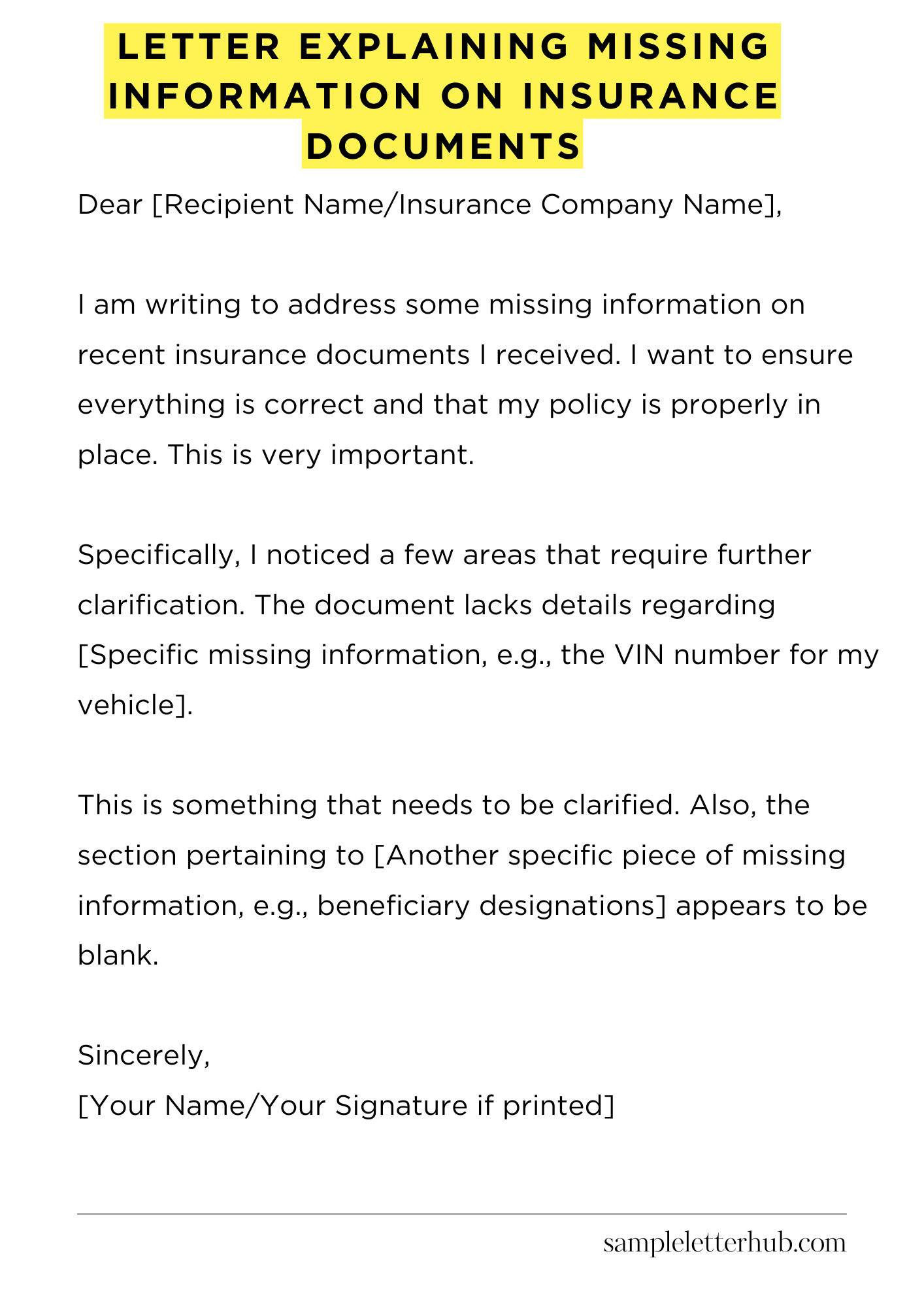
Dear [Recipient Name/Insurance Company Name],
I am writing to address some missing information on recent insurance documents I received. I want to ensure everything is correct and that my policy is properly in place. This is very important.
Specifically, I noticed a few areas that require further clarification. The document lacks details regarding [Specific missing information, e.g., the VIN number for my vehicle].
This is something that needs to be clarified. Also, the section pertaining to [Another specific piece of missing information, e.g., beneficiary designations] appears to be blank.
Furthermore, there is an absence of [Yet another piece of missing information, e.g., confirmation of the agreed-upon coverage amount] in the policy summary. I would appreciate it if these omissions could be rectified. I trust this matter can be resolved efficiently.
To assist in the correction of these discrepancies, I have attached [mention what you’re attaching, e.g., a copy of my vehicle registration] to this letter. The attachment may provide the necessary information. Please let me know if you require any further documentation from my end.
Could you please send me an updated version of the insurance documents as soon as possible? I would also appreciate confirmation that the missing information has been correctly incorporated. Prompt attention to this matter would be greatly appreciated.
Thank you for your time and assistance in resolving this. I look forward to hearing from you soon.
Sincerely,
[Your Name/Your Signature if printed]
How to Write Letter Explaining Missing Information on Insurance Documents
Insurance documents, a veritable labyrinth of legalese, can often lead to confusion. You might find yourself staring at a form, realizing crucial information is absent. Fear not! This guide will provide you with the necessary tools to pen a cogent and persuasive letter explaining any missing data on your insurance documentation. Let’s get started.
1. Commence with the Salutation: The Art of Opening
The commencement of your letter is paramount. Address the recipient formally. Instead of a bland “To Whom It May Concern,” consider specifics. Knowing the claims adjuster or the relevant department allows for a more personalized approach.
Begin with a formal salutation like “Dear Mr./Ms. [Last Name]” or “Dear Claims Department.” This establishes an initial level of respect and professionalism. A well-crafted opening sets the tone for the entire correspondence. This ensures a more positive reception.
2. The Subject Line: Precision is Key
A concise and unambiguous subject line is your secret weapon. This crucial element alerts the recipient to the letter’s purpose instantly. Instead of a vague phrase like “Concerning Insurance,” utilize something more specific, such as “Missing Information on Policy Number [Policy Number]”.
This immediately conveys the core issue, enabling efficient processing. Think of it as the headline that grabs their attention.
3. Clearly Articulate the Deficiency: The Missing Pieces
In this section, you need to clearly and concisely identify the missing information. Be explicit. If a policy number is absent, explicitly state the missing number.
Did you fail to fill in your date of birth or social security number? Clearly highlight the information gaps. Include the relevant section of the form where the omission occurred. Be precise; precision is your ally here. Avoid ambiguity, as this can lead to further delays and confusion.
4. Providing the Requested Information: Filling the Void
This is where you fill in the blanks. Present the missing information with absolute accuracy. Double-check everything, including dates, names, and any other pertinent details.
Type the information if possible; if you must handwrite, ensure your penmanship is impeccable. Consider attaching copies of supporting documents, like your driver’s license or birth certificate, for verification. Always provide a comprehensive and accurate account of the information that was not originally present.
5. Explaining the Omission: Why the Silence?
Briefly and reasonably explain why the information was originally missing. If the error was yours, own it. “I inadvertently omitted…” is a straightforward approach. If the form was confusing, simply state that.
You may have experienced a temporary lapse of memory, so do not over-exaggerate the facts. A simple, honest explanation is usually sufficient. Remember to remain polite. No need to point any fingers. Being honest and direct can smooth the process significantly.
6. The Call to Action: Guiding the Response
This is where you explicitly state what you want the recipient to do. Do you need them to update your records? Are you waiting for confirmation? End your letter with a clear call to action.
For example, “Please update my records with the information provided” or “I would appreciate confirmation of the update within 10 business days.” This provides clarity and directs the recipient’s response, expediting the process. This helps to eliminate any misinterpretations or confusion.
7. Concluding with Professionalism: Sealing the Deal
End your letter with a professional closing. Use “Sincerely,” or “Respectfully,” followed by your full name and signature. If you are sending the letter electronically, you may include your typed name.
Include your contact information—phone number and email address—for easy communication. Proofread the entire letter meticulously before sending. A well-written, error-free letter reflects your attention to detail and increases the likelihood of a positive outcome. Make sure you retain a copy for your records.
FAQs about Letter Explaining Missing Information on Insurance Documents
What information typically needs to be included in a letter explaining missing information on insurance documents?
A comprehensive letter explaining missing information on insurance documents should include: the policyholder’s full name, policy number, the specific document or information that is missing, a clear explanation of why the information is missing (e.g., it was forgotten, unavailable at the time, or a system error).
What are the potential consequences of not providing the missing information or an explanatory letter?
Failing to provide missing information or an explanatory letter can lead to a variety of negative consequences. These can include delays in processing claims, denial of claims, suspension of coverage, or even cancellation of the insurance policy. Furthermore, it could result in difficulty securing insurance in the future or a higher premium due to perceived risk.
How should I format a letter explaining missing information on insurance documents?
The letter should be formatted professionally. Use a formal tone and clear, concise language. Begin with a proper salutation (e.g., “Dear [Insurance Company Name]”), followed by a brief introduction stating the purpose of the letter.
The body of the letter should provide the missing information or explain its absence. Include the policyholder’s full name, policy number, and date. Close with a courteous closing (e.g., “Sincerely”) and the policyholder’s signature (if applicable, also the printed name and contact information).
What if I don’t know why information is missing on my insurance document?
If you are unsure why information is missing, it’s important to investigate the situation immediately. Contact the insurance company’s customer service or the insurance agent who handles your policy.
They can likely explain the issue. When writing the letter, you can state that the information is missing and you are currently working with the insurance company to resolve the issue, providing their contact information, if applicable. Be sure to document all communications with the insurance company, including dates, times, and names of representatives.
Is it necessary to send the explanatory letter via certified mail or another traceable method?
While not always mandatory, sending the explanatory letter via certified mail or a traceable method is a good practice. This provides proof that the letter was sent and received by the insurance company.
This can be beneficial in case of any disputes regarding claims or coverage later on. It is especially advisable if the missing information is critical or if the absence of the information might affect the policyholder’s coverage.
Related:
Resignation letter due to rude boss
Resignation letter moving to another state
Resignation letter due to illness of family member
Resignation letter due to study