

Ever received a letter about an insurance record discrepancy? It happens. An Explanation Letter for Discrepancy in Insurance Records is your response. Its purpose? To clarify any errors or inconsistencies in your insurance files. It helps set the record straight. It ensures accurate information. This is critical for claims and coverage.
Need to draft your own Explanation Letter for Discrepancy in Insurance Records? We’ve got you covered. We’ll provide helpful templates, examples, and samples. These resources will guide you. They make letter writing easy. They simplify the process.
Our goal is to assist you. Writing an insurance explanation letter shouldn’t be stressful. We’ve compiled useful formats. Use these sample letters to craft your perfect explanation. Handle insurance record discrepancies with confidence.
[Your Name/Company Name]
[Your Address]
[Your Phone Number]
[Your Email Address]
[Date]
[Insurance Company Name]
[Insurance Company Address]
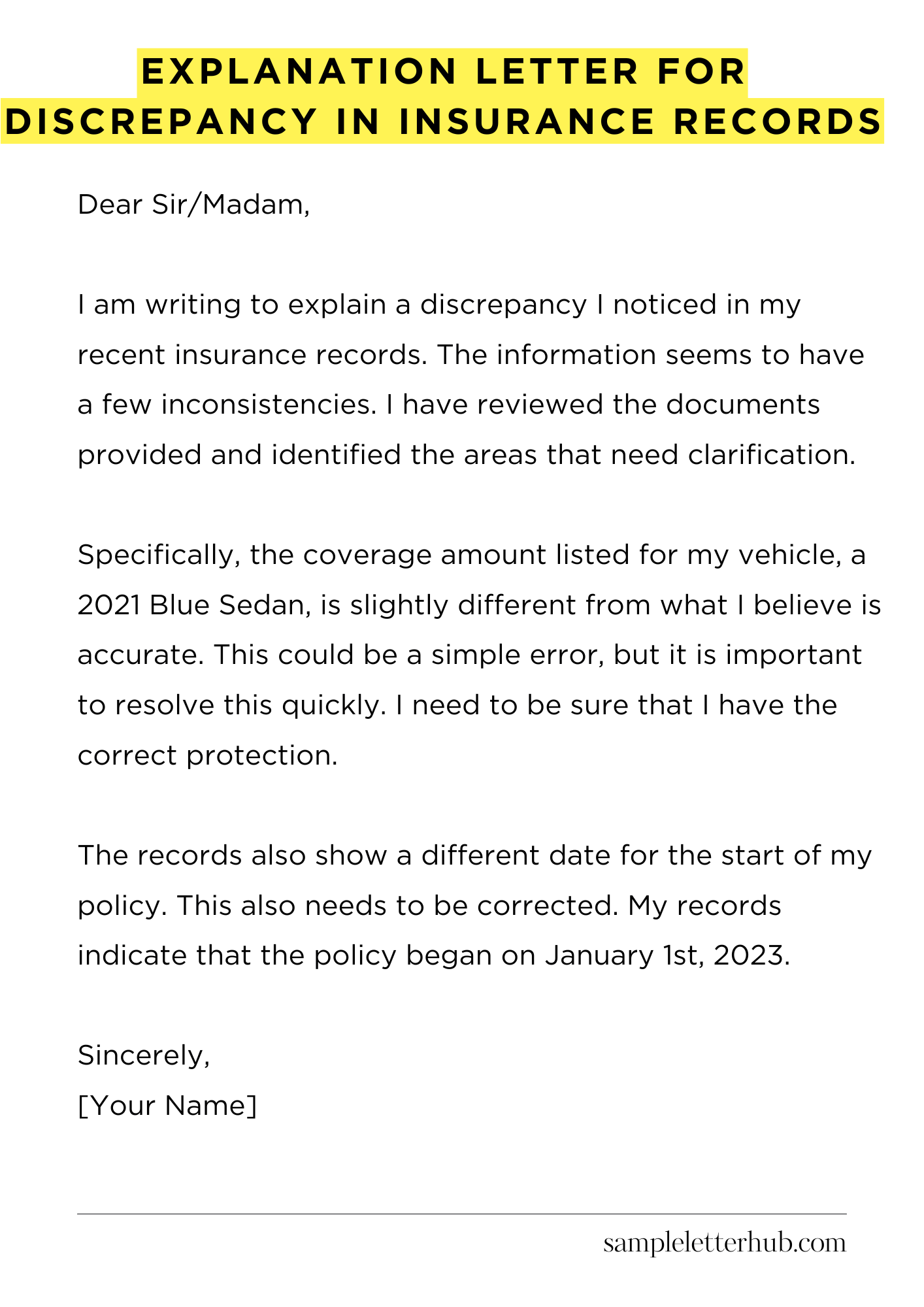
Dear Sir/Madam,
I am writing to explain a discrepancy I noticed in my recent insurance records. The information seems to have a few inconsistencies. I have reviewed the documents provided and identified the areas that need clarification.
Specifically, the coverage amount listed for my vehicle, a 2021 Blue Sedan, is slightly different from what I believe is accurate. This could be a simple error, but it is important to resolve this quickly. I need to be sure that I have the correct protection.
The records also show a different date for the start of my policy. This also needs to be corrected. My records indicate that the policy began on January 1st, 2023, rather than the date listed in your documents. These dates are quite important.
I have attached copies of my original policy documents for your review. Please find them included with this letter. These documents should help clarify the details.
I would appreciate it if you could investigate these discrepancies and update my records accordingly. The corrections are necessary to avoid any issues in the future. I am keen to have everything sorted correctly.
Please let me know if you require any further information from my side. I look forward to your prompt response and the correction of these details. Thank you for your time and attention to this matter.
Sincerely,
[Your Name]
How to Write Explanation Letter for Discrepancy in Insurance Records
Encountering a discrepancy in your insurance records can be a frustrating experience. It’s often difficult to unravel what precisely caused the issue.
However, by crafting a clear and concise explanation letter, you can initiate the resolution process efficiently. Here’s a comprehensive guide to help you compose a compelling letter that addresses the discrepancy and secures a favorable outcome.
1. Commence with a Formal Salutation and Identification
Begin your letter with a formal salutation, such as “Dear [Insurance Company Name] Claims Department.” Subsequently, immediately identify yourself and provide crucial information.
Specify your full name, policy number, and any other relevant identification details. This initial section establishes your identity and provides the foundational context for the rest of the letter. Be precise and avoid any ambiguity from the outset; provide the policy holder name along with your relation to them, if any.
2. Explicitly State the Discrepancy
The crux of your letter lies in the clear delineation of the issue. Articulate the precise discrepancy you are addressing. Is it a misquoted premium? An incorrect record of a claim payment?
A misunderstanding of coverage? Be meticulous and provide specific details. Mention the date, document number, or any other identifying information relevant to the discrepancy.
Consider including supporting documentation, such as copies of receipts or previous statements, to substantiate your assertions. This will give your claim credence and make its rectification easier.
3. Furnish a Detailed Explanation
Once you’ve identified the discrepancy, provide a thorough and logically presented explanation of what you believe happened. This is where you explain your perspective on the matter.
Be honest and factual; avoid hyperbole or exaggerated language. If the discrepancy arises from a misunderstanding, clearly clarify your position. If there’s an error in your information, confess without obfuscation.
Present the facts in a chronological order to enhance clarity. When describing events, avoid jargon that the reader may not be familiar with.
4. Enumerate Supporting Documentation
In this section, explicitly list all the supporting documents you are enclosing with your letter. This is very important. This ensures that the insurance company can easily locate and review the evidence you are providing.
Mention the type of document (e.g., “copy of bank statement,” “original receipt,” “medical record”) and the date of each document. For instance, you could write: “Enclosed are the following documents: a copy of my bank statement dated October 26, 2024, a receipt from ABC Pharmacy dated November 10, 2024, and a medical report from Dr. Smith dated December 5, 2024.”
5. Stipulate the Desired Resolution
Clearly state what you want the insurance company to do to resolve the discrepancy. Do you seek a correction of the records? Do you require a refund? Is the aim to have a claim processed?
Be explicit in your request and mention the specific actions required. For example, you might write: “I request that you revise my policy records to reflect the accurate premium payment of $ [amount] as indicated in the enclosed bank statement.”
6. Offer Contact Information and a Proactive Closure
Provide your contact information – including your phone number, email address, and mailing address. This enables the insurance company to easily reach you for any clarifications or follow-up.
End the letter with a polite but firm closing. Thank the recipient for their time and attention to the matter. Include a concise statement indicating your anticipation of a prompt resolution. For example: “Thank you for your prompt attention to this matter. I look forward to receiving confirmation of the resolved discrepancy and corrected records within 30 business days.”
7. Proofread and Deliver Methodically
Before sending your letter, meticulously proofread it for any grammatical errors or typos. Double-check all dates, names, and numbers. Ensure that your supporting documentation is clear and legible.
Send the letter via certified mail with a return receipt requested. This provides proof that the insurance company received your letter. Keep a copy of the letter and all supporting documents for your records.
This methodical approach will not only enhance the credibility of your appeal but also facilitate easy referencing during follow-up correspondence.
FAQs about Explanation Letter for Discrepancy in Insurance Records
What is an Explanation Letter for Discrepancy in Insurance Records?
An Explanation Letter for Discrepancy in Insurance Records is a formal document written to address inaccuracies, inconsistencies, or errors found within an individual’s or organization’s insurance records.
It provides a clear and concise explanation for the discrepancy, along with any supporting documentation needed to rectify the issue and ensure the records are accurate.
What Information Should Be Included in an Explanation Letter?
A well-written explanation letter should include the following key elements: your full name and contact information, the insurance policy details (policy number, insurance company name), a clear description of the discrepancy, the date the discrepancy was discovered, a detailed explanation of the reason for the discrepancy.
Who Typically Needs to Write an Explanation Letter?
Individuals, policyholders, or their representatives (such as attorneys or brokers) are usually the ones who write these letters. These letters can be needed when an error is found.
This could be regarding policy information, billing statements, claims history, or any other aspect of the insurance record that requires clarification or correction.
What Supporting Documents Are Commonly Included with an Explanation Letter?
Supporting documents are crucial to strengthen the explanation and provide evidence to back up the claim. Common supporting documents can include the original policy documents, receipts for payments made, medical bills, correspondence related to the policy, prior claim forms.
How Should an Explanation Letter Be Submitted?
The method of submission can vary depending on the insurance company. It’s best to check with the insurer for their preferred method, which may include mail, email, or an online portal.
It is generally recommended to keep a copy of the letter and any supporting documentation for your records. Consider sending the letter via certified mail with a return receipt requested to confirm delivery and establish a paper trail, especially if the matter is complex or significant.
Related:
Resignation letter due to rude boss
Resignation letter moving to another state
Resignation letter due to illness of family member
Resignation letter due to study