


Ever received a confusing insurance bill? Or perhaps your claim was denied? An insurance claim explanation letter (also called an insurance appeal letter) clarifies the details. It’s a formal document. Its purpose is to explain a claim or challenge a decision. It helps you understand what happened. It helps you advocate for yourself.
We understand navigating insurance can be tricky. That’s why we’re here to help you. We have crafted helpful insurance claim explanation letter templates. These include samples and examples. They are easy to adapt. You can use them to write any kind of claim letter. You can write them to contest denials. These will save you time and stress.
This article gives you the tools you need. We’ll offer sample letters. We will cover various insurance scenarios. We have all types of insurance letter examples. This includes examples for health insurance, car insurance, and more. We made this article with insurance claim success in mind. It’s time to simplify your insurance claim explanation letter writing!
[Your Name/Company Name]
[Your Address]
[Your City, Postal Code]
[Your Email]
[Your Phone Number]
[Date]
[Insurance Company Name]
[Insurance Company Address]
[Insurance Company City, Postal Code]
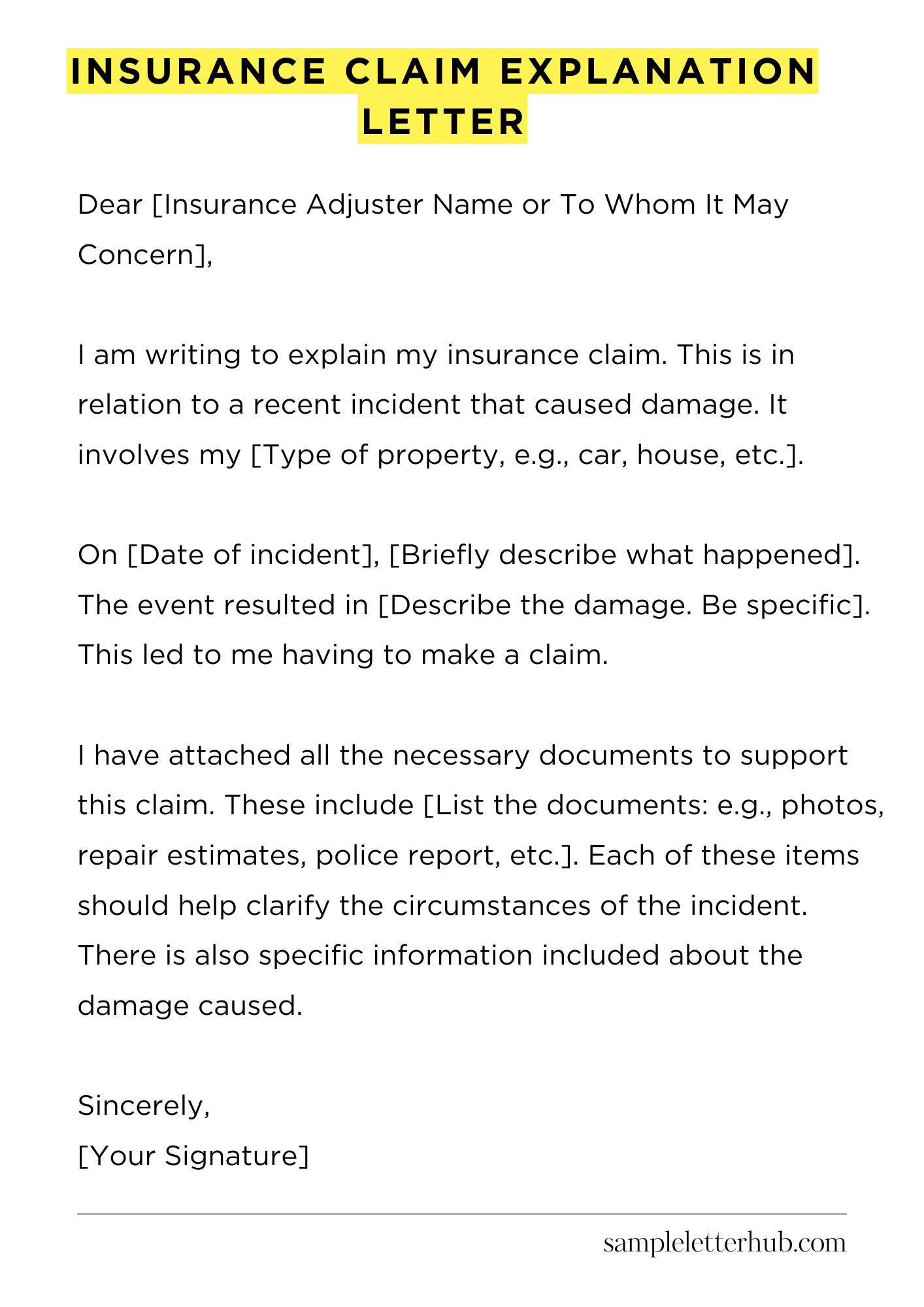
Dear [Insurance Adjuster Name or To Whom It May Concern],
I am writing to explain my insurance claim. This is in relation to a recent incident that caused damage. It involves my [Type of property, e.g., car, house, etc.].
On [Date of incident], [Briefly describe what happened]. The event resulted in [Describe the damage. Be specific]. This led to me having to make a claim.
I have attached all the necessary documents to support this claim. These include [List the documents: e.g., photos, repair estimates, police report, etc.]. Each of these items should help clarify the circumstances of the incident. There is also specific information included about the damage caused.
I have carefully reviewed the policy documents. I believe this damage is covered under my insurance policy, number [Policy number]. I understand the importance of making sure everything is clear.
I would appreciate it if you could process my claim as quickly as possible. I would be very grateful to hear back from you soon. Kindly let me know if you require any further information.
Thank you for your time and consideration.
Sincerely,
[Your Signature]
How to Write Insurance Claim Explanation Letter
Navigating the labyrinthine world of insurance claims can feel daunting, but crafting a well-structured explanation letter is crucial. It clarifies your predicament and strengthens your prospects of a successful claim.
With the right approach, you can communicate your case with clarity and precision. Here’s how to pen an effective insurance claim explanation letter.
1. Commence with a Cogent Introduction
Your opening gambit sets the tone. Start with your full name, address, policy number, and the date. Following this, clearly state the purpose of your letter: to explain the circumstances surrounding your claim.
Briefly summarize the event that precipitated the claim. This immediate clarification will inform the recipient of your intention. Succinctness is key; avoid unnecessary preamble.
2. Detail the Precipitating Circumstances
This is where you flesh out the narrative. Articulate the events leading up to the incident that triggered your claim. Provide a comprehensive, chronological account of what transpired.
Be factual and avoid emotive language. Include specific details like the date, time, and location of the event. Authenticity is pivotal; ensure that you accurately depict the occurrences. Support your account with any available documentation, such as police reports or witness statements.
3. Articulate the Damages Incurred
Clearly delineate the extent of the damage or loss. Be as specific as possible. List all items damaged or lost, along with their estimated values. If applicable, specify the nature of any injuries sustained.
Supplement your descriptions with photographic evidence or other supporting materials to substantiate your claims. Be methodical and leave no room for ambiguity. This section should leave the reader convinced of the extent of your losses.
4. Enumerate Supporting Documentation
This section is of great importance. This is where you itemize all the documentation you are including with your letter. Provide a brief description of each document. Think invoices, repair estimates, medical records, or any other paperwork that bolsters your claim. Mention the number of pages for each document to assist in their tracking.
This ensures the insurer is aware of all the data you are providing. Organize them in a coherent order to facilitate the evaluation process.
5. Declare Your Claim and Desired Outcome
Explicitly state what you are claiming. Specify the amount you are seeking to recover. If applicable, state the specific benefits you are requesting under your policy. Be direct and unambiguous in your requests.
Clearly articulate your desired outcome, whether it be reimbursement for damages, payment for medical expenses, or other benefits. This declaration leaves no doubt about your objectives.
6. Compose a Courteous Conclusion
Conclude your letter with a polite and professional closing. Thank the insurer for their time and consideration. Reiterate your contact information, including your phone number and email address, for any required follow-ups.
Express your willingness to provide any additional information they may need. End the letter with a professional closing, such as “Sincerely” or “Respectfully.” This gesture leaves a positive impression.
7. Polishing and Dispatch
Before submitting your letter, proofread it scrupulously. Check for grammatical errors, spelling mistakes, and factual inaccuracies. Ensure that your letter is clear, concise, and well-organized.
Make a copy of the letter and all attached documents for your records. Send the letter via certified mail with return receipt requested. This ensures that you have proof of delivery and acknowledgment, a valuable safeguard should any disputes arise in the future. Now you’re all set!
FAQs about Insurance Claim Explanation Letter
What is an Insurance Claim Explanation Letter, and why is it important?
An Insurance Claim Explanation Letter, often referred to as an EOB (Explanation of Benefits), is a document sent by your insurance company after a medical service, treatment, or product has been provided. It details the services received, the billed charges, the amount the insurance company paid.
What information is typically included in an Insurance Claim Explanation Letter?
A typical Insurance Claim Explanation Letter will include various pieces of information. This includes the patient’s and provider’s details, the date of service, a description of the medical service or item, the billed amount by the provider, the allowed amount (the amount the insurance company deems reasonable), the amount the insurance company paid.
How do I read and understand my Insurance Claim Explanation Letter?
Reading an Insurance Claim Explanation Letter involves understanding several key components. Start by verifying the patient and provider information. Next, review the “billed amount” – this is what the provider initially charged.
Then, look at the “allowed amount,” which is often lower and represents the amount the insurance company agrees to pay. The “amount paid” is what the insurance company covered, and the “patient responsibility” section details what you owe.
Carefully check each line to ensure the services listed match what you received. Familiarize yourself with common insurance terms like “deductible,” “co-pay,” and “coinsurance” to understand your financial obligations.
What should I do if I find an error in my Insurance Claim Explanation Letter?
If you find an error in your Insurance Claim Explanation Letter, such as incorrect information, services you didn’t receive, or discrepancies in the billed amount, it’s crucial to take action. First, gather all relevant documents, including your medical bills and any records of services. Then, contact your insurance company and the healthcare provider.
Provide them with specific details about the errors and any supporting documentation. Keep a record of all communication. The insurance company will then investigate the claim and make necessary corrections. This process may involve submitting a formal appeal if the initial resolution is unsatisfactory.
How long should I keep my Insurance Claim Explanation Letters?
It’s generally recommended to keep your Insurance Claim Explanation Letters for at least three years, and often longer. This is because there is a typical three-year window in which insurance claims can be re-examined.
Keeping these documents allows you to easily reference the details of services, payments, and any potential issues or errors. They can be particularly useful if you need to contest a bill, file an appeal, or gather information for tax purposes (e.g., for medical expense deductions).
Related:
Resignation letter due to rude boss
Resignation letter moving to another state
Resignation letter due to illness of family member
Resignation letter due to study