

A “Letter of Explanation to Insurance Company” is a document you write. It tells your insurance company about something that happened. The letter helps them understand the situation. Its main purpose is to provide context.
We understand writing these letters can be tricky. That’s why we’re sharing some handy tools. We’ve got letter of explanation templates, examples, and samples. This makes writing your own letter to insurance super simple. We’ve got you covered.
Our goal is to make your life easier. These examples help with various insurance claims. You’ll find it easier to communicate with your insurance provider. Ready to get started? Let’s dive in!
[Your Name]
[Your Address]
[Your Phone Number]
[Your Email Address]
[Date]
[Insurance Company Name]
[Insurance Company Address]
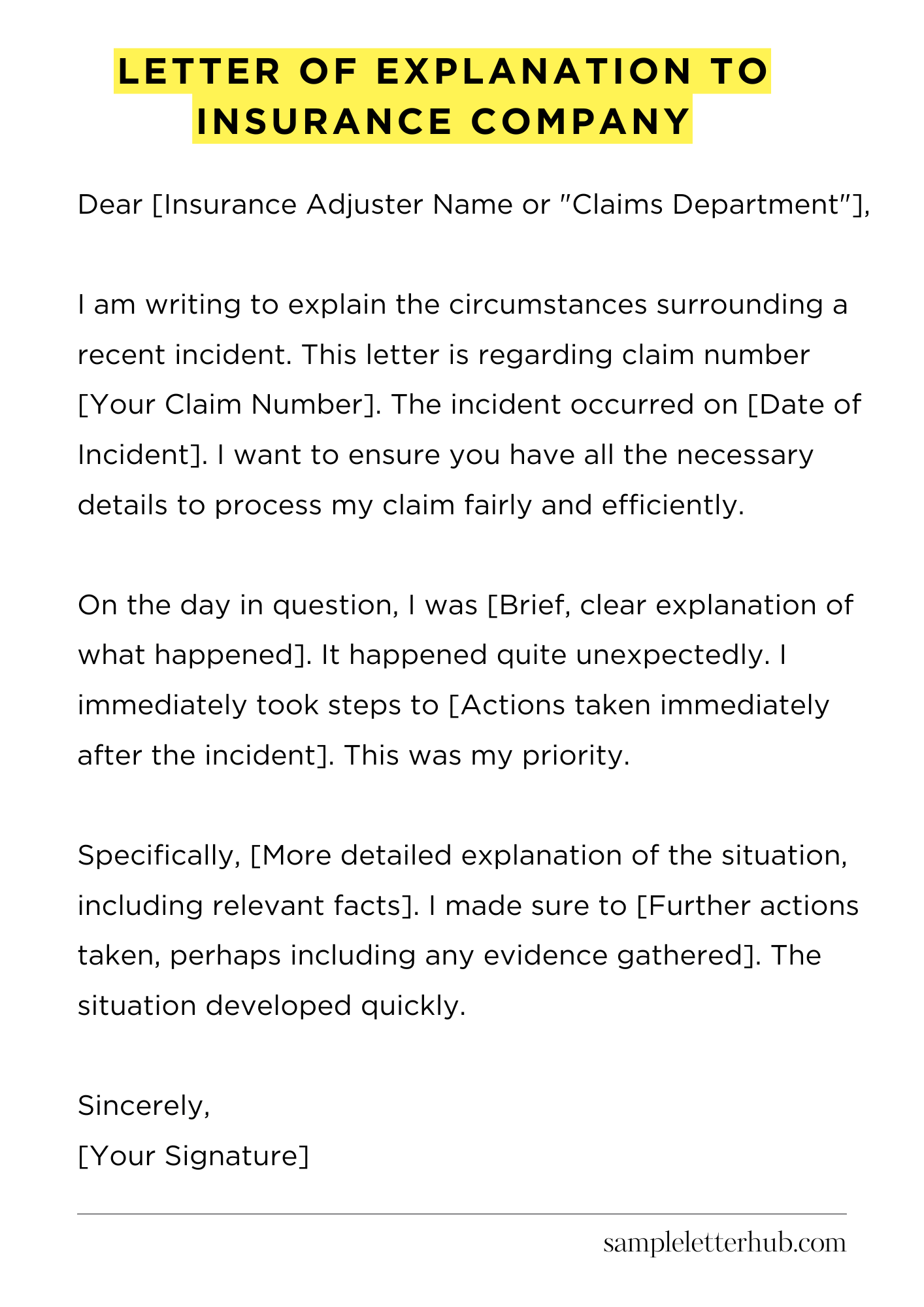
Dear [Insurance Adjuster Name or “Claims Department”],
I am writing to explain the circumstances surrounding a recent incident. This letter is regarding claim number [Your Claim Number]. The incident occurred on [Date of Incident]. I want to ensure you have all the necessary details to process my claim fairly and efficiently.
On the day in question, I was [Brief, clear explanation of what happened]. It happened quite unexpectedly. I immediately took steps to [Actions taken immediately after the incident]. This was my priority.
Specifically, [More detailed explanation of the situation, including relevant facts]. I made sure to [Further actions taken, perhaps including any evidence gathered]. The situation developed quickly.
As a result of this incident, [Explain the damage or loss]. This has caused some inconvenience. I have already [Actions taken regarding the damage/loss, e.g., “taken photographs of the damage” or “reported the incident to the police”]. I believe this information is very important.
I have attached [List any supporting documents you are including, e.g., “photographs,” “police report,” “repair estimates”]. I hope these provide sufficient evidence. I believe all the information is complete.
Please let me know if you require any further information or clarification. I am readily available to assist in any way possible. I can be reached by phone or email. Thank you for your time and attention to this matter.
Sincerely,
[Your Signature]
How to Write Letter of Explanation to Insurance Company
Navigating the labyrinthine complexities of insurance can often feel like traversing an uncharted territory. It is common that you will need to prepare a Letter of Explanation (LOE).
This crucial document serves as your articulate voice when contesting a denial, clarifying ambiguity, or providing supplementary data. Understanding how to construct an effective LOE is thus paramount. Let’s explore the essential steps.
1. Commence with an Impeccable Salutation
Your missive’s commencement sets the tone. Use a formal, professional salutation. Address the letter to the appropriate claims adjuster or department. This establishes respect.
Begin with “Dear [Claims Adjuster Name],” or, if unknown, “Dear Claims Department.” This seemingly minor detail fosters a sense of courteous discourse.
2. Subject Line: The Quintessence of Clarity
The subject line is not an afterthought, it is a crucial component. Condense the core of your communication into a concise, easily identifiable phrase.
For instance, “Re: Claim Denial – Policy Number [Your Policy Number]” or “Clarification Regarding Treatment – Claim Number [Your Claim Number].” A clear subject line ensures swift processing.
3. Articulate the Issue with Precision
The body of your letter is where you unravel your narrative. Start by plainly stating the issue. Be factual and avoid emotive language. Specify the date of the event, the claim number, and any relevant policy details. This provides the context for your explanation. Stick to the salient points; superfluous details can obfuscate your intent.
4. Providing Thorough Explanation
Provide a meticulous clarification of the circumstances. Be exhaustive. Offer a narrative that is both cogent and comprehensible. Back up your assertions with documented evidence.
Include copies of pertinent documents such as medical records, bills, photos, or witness statements. This substantiates your claims. Leave no room for ambiguity.
5. Deciphering the Underlying Reasoning
Clearly state the reason behind your communication. Are you appealing a denial? Providing additional details? Correcting an error? Explicitly state what you are seeking from the insurance company. This clarity eliminates the possibility of misinterpretation. Your desired outcome should be clearly stated.
6. The Art of Closure: Summarizing and Seeking Action
Conclude your letter by summarizing the critical points. Reiterate what you are requesting from the insurance company. End with a polite, yet firm, closing.
“Thank you for your time and consideration” is an acceptable option. Include your contact information (phone number, email address) and your signature. This creates a lasting impression of professionalism.
7. Polishing your Letter with Meticulous Proofreading
Prior to dispatching your letter, subject it to the crucible of thorough proofreading. Scrutinize it for grammatical errors, spelling mistakes, and stylistic inconsistencies.
A polished document reflects professionalism. Errors can undermine your credibility. It is recommended to have another person review the letter for a fresh perspective. Finally, retain a copy for your records.
FAQs about Letter of Explanation to Insurance Company
What is a Letter of Explanation, and why is it needed for my insurance claim?
A Letter of Explanation (LOE) is a written document you provide to your insurance company. It clarifies specific details surrounding an insurance claim.
This letter helps the insurer understand the context, reason, and circumstances behind the event that led to the claim. Insurance companies often request an LOE when the claim requires additional information or clarification beyond the initial claim form or supporting documentation.
This can be for various reasons, such as missing information, inconsistencies in the submitted data, or the need to fully grasp the event’s specifics to determine coverage and liability.
What kind of information should I include in my Letter of Explanation?
The information to include in your LOE varies based on the claim type, but generally, it should contain a clear and concise account of what happened. Key elements include the date and time of the incident, a description of the event, the location, and who was involved.
Also, detail the specific damages or losses. Explain why the event occurred, if applicable, and provide any relevant supporting information, such as witness statements, police reports, or medical records.
Ensure the information provided is accurate, truthful, and consistent with other documentation you’ve submitted. Always refer to your insurance policy and the specific requirements communicated to you by your insurer.
How do I write a Letter of Explanation that is effective and helps my claim?
To write an effective LOE, start by being direct and concise. State your policy number and the claim number clearly. In the first paragraph, briefly explain the reason for the letter.
Then, in the following paragraphs, provide a detailed account of the event, following the chronology as it occurred. Use factual language and avoid speculation or emotional statements.
Include all requested information and ensure that all details are consistent with the original claim. Proofread the letter carefully for grammar and spelling errors. If applicable, attach copies of any supporting documents that will strengthen your explanation. Finally, sign and date the letter, and keep a copy for your records.
Can I use a template or sample letter when writing my Letter of Explanation?
Yes, you can use a template or sample letter as a guide when writing your LOE, but it’s essential to customize it to your specific situation. Many sample letters are available online.
Tailor the template to the specifics of your claim. Remove any sections that do not apply and add all the necessary details pertinent to your individual claim. Your LOE should be a unique document that reflects your particular situation and accurately describes the events that led to your claim. Ensure that all the information included is correct and relevant to your claim.
What should I do if my insurance company denies my claim after submitting a Letter of Explanation?
If your insurance company denies your claim after you’ve submitted an LOE, the first step is to carefully review the denial letter to understand the reasons for the denial.
Contact your insurance agent or the claims adjuster to seek clarification and further information. You may have the right to appeal the decision. If so, thoroughly review your policy and gather any additional supporting documentation.
You can write a formal appeal letter, reiterating the details of your claim, addressing the insurer’s concerns and presenting additional evidence to support your position. If you still have trouble, consider seeking advice from a legal professional or a consumer advocate who specializes in insurance claims.
Related:
Resignation letter due to rude boss
Resignation letter moving to another state
Resignation letter due to illness of family member
Resignation letter due to study