

Ever lost a receipt? It happens! A “Letter for Submitting Missing Receipts for Insurance Claim” is your key. It helps you get reimbursed by your insurance company. This letter explains why you can’t provide the original receipts. It details the lost items.
Don’t worry if writing seems hard. We’ve got you covered. We’ll share letter for submitting missing receipts for insurance claim templates. They are ready-to-use samples. Need a receipt letter example? We offer it! This article provides insurance claim letter samples to guide you.
Our easy-to-use missing receipt letter samples streamline the process. You can easily adapt these templates. Get your claim processed smoothly. Get back what you deserve. No more stress!
[Your Name]
[Your Address]
[Your Phone Number]
[Your Email Address]
[Date]
[Insurance Company Name]
[Insurance Company Address]
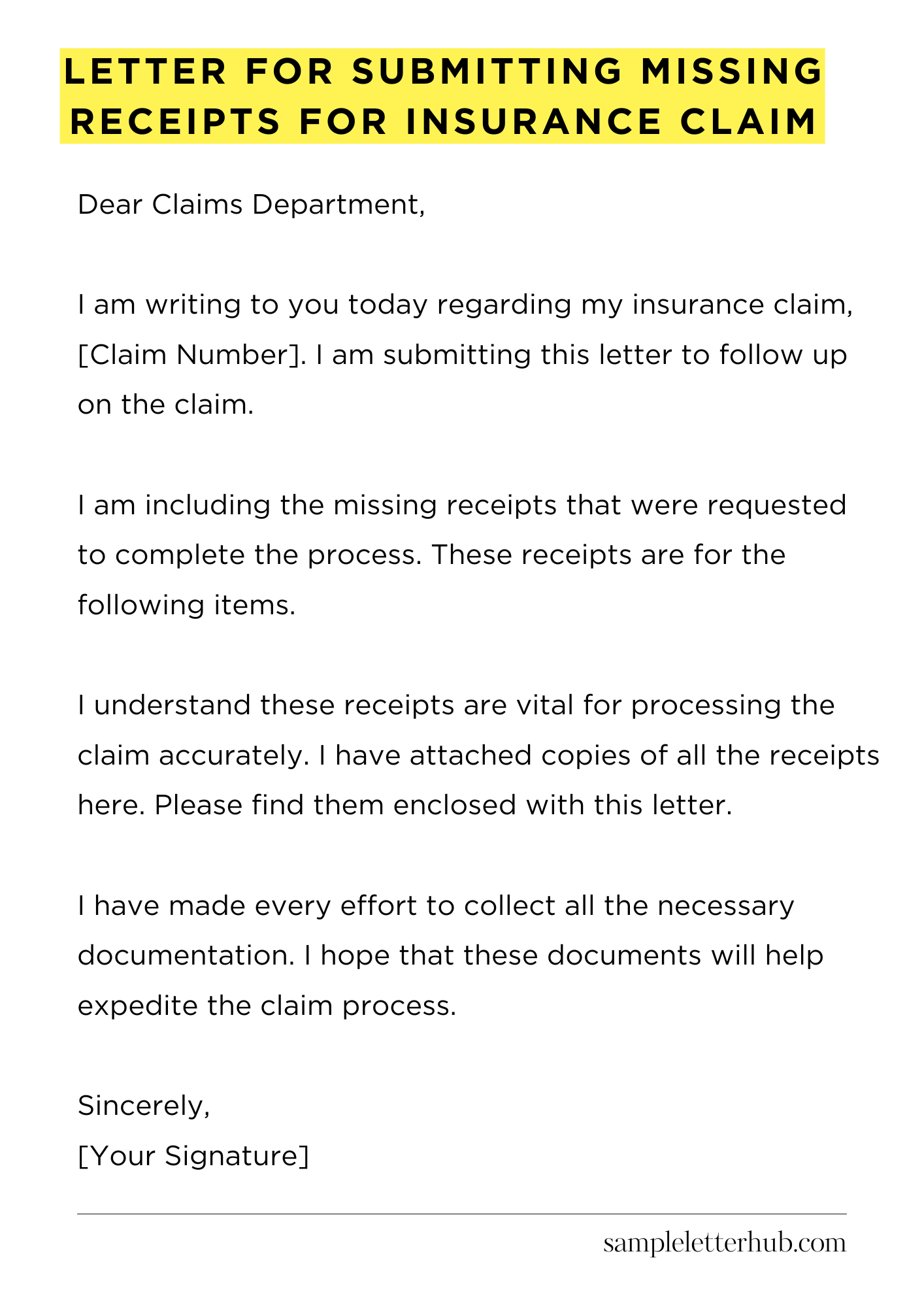
Dear Claims Department,
I am writing to you today regarding my insurance claim, [Claim Number]. I am submitting this letter to follow up on the claim.
I am including the missing receipts that were requested to complete the process. These receipts are for the following items: [List each item and its corresponding receipt]. This includes receipts for the [Type of item] and [Another type of item].
I understand these receipts are vital for processing the claim accurately. I have attached copies of all the receipts here. Please find them enclosed with this letter.
I have made every effort to collect all the necessary documentation. I hope that these documents will help expedite the claim process. I have taken great care in gathering all the important documents.
Could you please confirm the receipt of these documents? Also, I would like to know if anything else is needed from my end. Please let me know if you require any further information.
Thank you very much for your time and attention to this matter. I appreciate your assistance in resolving this claim. I look forward to hearing from you soon regarding the status of my claim.
Sincerely,
[Your Signature]
How to Write Letter for Submitting Missing Receipts for Insurance Claim
Navigating the aftermath of an unexpected event that necessitates an insurance claim can be a taxing experience. Often, a crucial component of this process involves providing evidence, particularly in the form of receipts.
However, life’s exigencies don’t always align perfectly, and sometimes, receipts vanish into the ether. Fear not, though, as a well-crafted letter can often bridge this gap, ensuring your claim is processed expeditiously.
1. Commence with Precise Identification
Your letter’s inauguration should be marked by pinpoint accuracy. Begin by clearly stating your full name, address, and contact details. This establishes your identity and provides the insurer with immediate access to your contact information.
It streamlines the administrative process and prevents any potential delays in processing your claim. Concurrently, include your policy number and the claim number if you have it. This will make it easier for the insurance company to track your correspondence within their system.
2. Subject Matter: A Succinct Declaration
The subject line is your letter’s siren call. It should be a concise summary of your communication. Something like “Submission of Missing Receipts – Claim Number [Insert Claim Number]” is ideal. This immediately alerts the recipient to the letter’s purpose, enabling efficient prioritization.
3. Articulate the Circumstances with Clarity
Now, to the crux of the matter: detail the situation necessitating the submission of missing receipts. Explain why these receipts are unavailable. Be candid and forthright.
Were they lost, misplaced, or damaged in the incident? Perhaps the vendor is no longer in operation. Provide a brief, but comprehensive explanation, maintaining a tone of professional decorum.
4. Offer Substitutive Proof When Possible
Even if the original receipts are irretrievable, you might still possess alternative forms of documentation. This is where your resourcefulness is tested.
Could you provide bank statements showing the transactions? Perhaps credit card summaries? Invoices from the vendor? Any corroborating evidence will bolster your case. Include copies of these documents with your letter, ensuring that each item is clearly labeled and referenced. Highlighting the key details can be helpful, too.
5. The Affidavit’s Affirmation: A Declaration of Truth
Consider including a formal affidavit, especially if you have no substitute proof. An affidavit is a sworn statement, before a notary public, verifying the accuracy of the information provided. While not always mandatory, an affidavit lends weight and credibility to your claims. This demonstrates your commitment to transparency.
6. Express a Plea for Assistance
Politeness and a courteous tone can go a long way. After providing all the necessary information, request the insurance adjuster to consider your claim. Emphasize your understanding of the process and your willingness to cooperate fully.
Kindly inquire about any further documentation or information needed to process your claim promptly. This demonstrates your commitment to a smooth and efficient resolution.
7. Conclude with a Signature and a Call to Action
End your letter formally with your signature above your printed name. Provide your contact information, just in case any further questions arise. If you possess an email address, include it.
Finally, state what you hope the recipient will do with the information. For example: “I trust this information is sufficient to process my claim. Please contact me if you require any additional information.” This proactive conclusion leaves no doubt about your desired outcome: the swift adjudication of your insurance claim.
FAQs about Letter for Submitting Missing Receipts for Insurance Claim
What is the primary purpose of a letter submitting missing receipts for an insurance claim?
The main purpose is to formally notify the insurance provider that you are unable to provide original receipts for certain expenses related to your claim. It serves as an official communication, explaining the reasons for the missing documentation and providing any alternative evidence, like bank statements or credit card transactions, to support your claim.
What key information should be included in this letter?
The letter should clearly state your policy number, the claim number, and the date the claim was filed. You must also describe the expenses for which receipts are missing, including the dates, amounts, and the nature of the expense.
Importantly, provide a detailed explanation of why the receipts are missing (e.g., lost, damaged, etc.) and any alternative documentation you are providing as supporting evidence.
Are there specific formats or templates I should follow for writing this letter?
While there isn’t a universally mandated format, it’s beneficial to adopt a professional business letter format. Include your contact information, the insurance company’s address, and a clear subject line indicating the purpose of the letter (e.g., “Submission of Missing Receipts – Policy # XXXXX”).
Templates can be found online, but tailor the content to accurately reflect your situation. Check your policy documents for specific requirements.
What types of alternative documentation are typically accepted when original receipts are missing?
Acceptable alternative documentation often includes copies of credit card or bank statements showing the transactions, invoices, bills, or any other proof of payment.
For medical expenses, it can involve appointment schedules or statements from the healthcare provider. The acceptability of alternative documentation can depend on the insurance company’s policy and the specific type of claim. It is crucial to provide whatever you can, even if it is not the original receipt.
How can I increase the chances of my insurance claim being approved when I submit missing receipts?
You can improve your chances by being as thorough and honest as possible in your letter. Explain the reasons for the missing receipts clearly and provide as much supporting documentation as you can.
Consider contacting your insurance company beforehand to inquire about their specific policies on missing receipts and what alternative documents they typically accept. Also, make sure all supporting documentation is legible and clearly references the expenses you’re claiming.
Related:
Resignation letter due to rude boss
Resignation letter moving to another state
Resignation letter due to illness of family member
Resignation letter due to study