

A “Letter to Submit Warranty Claim Documents” is a formal letter. It’s used to request a product repair or replacement. You send this letter to the company. Its purpose is to officially initiate a warranty claim. This helps you get your faulty item fixed.
We understand writing these letters can be tricky. Don’t worry, we’ve got you covered. This article offers helpful Letter to Submit Warranty Claim Documents samples. You will find different Warranty Claim Letter examples here. Use our warranty claim letter template samples.
Our goal is simple. We aim to simplify your warranty claim process. We are sharing ready-to-use letter samples. They’re easily customizable. Pick one and tailor it to your needs. Make your warranty claim experience hassle-free.
[Your Name/Company Name]
[Your Address]
[Your Phone Number]
[Your Email Address]
[Date]
[Recipient Name/Company Name]
[Recipient Address]
Subject: Warranty Claim Submission for [Product Name] – [Serial Number, if applicable]
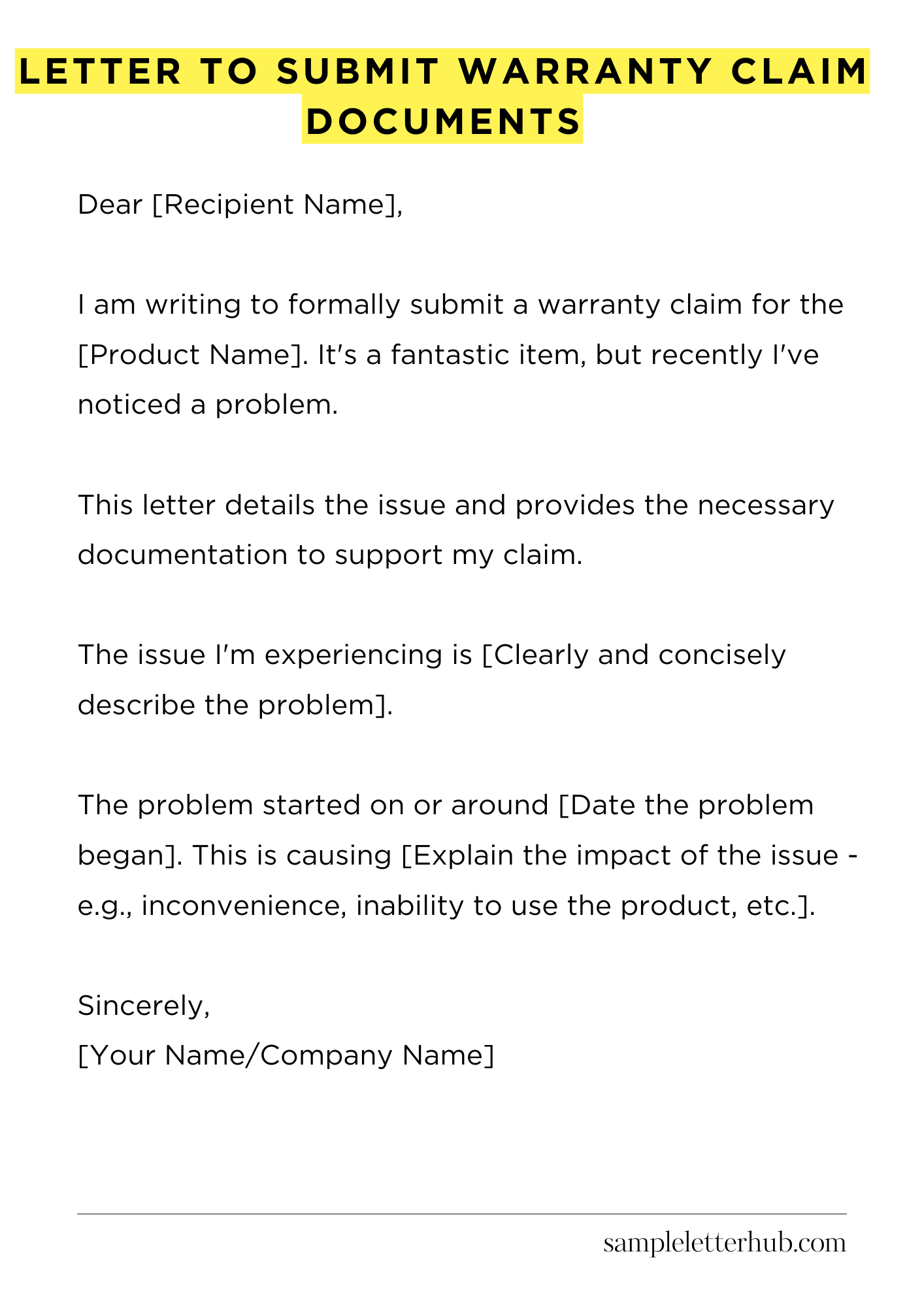
Dear [Recipient Name],
I am writing to formally submit a warranty claim for the [Product Name]. It’s a fantastic item, but recently I’ve noticed a problem. This letter details the issue and provides the necessary documentation to support my claim.
The issue I’m experiencing is [Clearly and concisely describe the problem]. The problem started on or around [Date the problem began]. This is causing [Explain the impact of the issue – e.g., inconvenience, inability to use the product, etc.].
To support my claim, I’ve enclosed the following documents:
* [List of documents – e.g., Original purchase receipt, Proof of ownership, Photographs of the damage, etc.] These are crucial for the claim’s verification.
* I have also included [mention additional documents if applicable].
I have owned this product since [Date of purchase] and it is still covered by the warranty. This warranty period is [State the length of the warranty]. I believe this falls well within the warranty terms.
I would appreciate it if you could review my claim and process it as quickly as possible. Please let me know if you require any additional information from my side. I look forward to your prompt response and a resolution to this problem.
Thank you for your time and attention to this matter.
Sincerely,
[Your Name/Company Name]
How to Write a Letter to Submit Warranty Claim Documents
1. Initiate Your Correspondence with a Precise Salutation
Begin your missive by addressing the recipient appropriately. This is your initial foray into conveying professionalism. Use a formal salutation, such as “Dear [Warranty Provider Name] Customer Service,” or if you have a specific contact, “Dear Mr./Ms. [Last Name].” This preempts any misinterpretations or confusion. Make sure to spell the recipient’s name correctly.
2. The Elaboration of Your Query: Stating the Purpose
Immediately state the purpose of your letter in the first paragraph. Be upfront. Clearly indicate that you are submitting a warranty claim. Succinctly mention the product in question and your customer/account number. Don’t beat around the bush; clarity is king. This sets the stage for a smooth processing of your claim.
3. Detailing the Defective Artifact: Substantiating Your Claim
This is where you elucidate the precise nature of the defect. Provide a detailed account of the issue, including when the problem began, the frequency of occurrence, and how it impacts the product’s function.
Incorporate relevant dates, such as the purchase date and the date the issue first manifested. Utilize precise language and avoid vague descriptions. Use terms like “malfunction,” “degradation,” or “non-operability” to enhance the gravity of your description.
4. Assembling the Evidentiary Ensemble: Enclosures and Attachments
Indicate what documentation you are enclosing to support your warranty claim. This may include a copy of your purchase receipt, the warranty document itself, photographs or videos of the defect, and any other relevant evidence.
In the body of the letter, briefly list each attachment. For instance, “Enclosed are copies of the following documents: 1) Purchase Receipt, 2) Warranty Agreement.” Make sure all attachments are of good quality.
5. Demanding Redress: Defining Your Expected Outcomes
Explicitly state what you seek as a resolution to the problem. Do you want a repair, a replacement, or a refund? Clearly articulate your desired outcome.
This ensures the warranty provider understands your expectations and can take appropriate action. Be assertive, but remain polite and professional.
6. The Concluding Adieu: Formalities of Closure
End your letter with a formal closing, such as “Sincerely,” “Respectfully,” or “Yours faithfully,” followed by your full name. Type your name, then print the letter and sign above it to make the document formal.
Include your contact information below your signature, including your phone number and email address, and mailing address. Ensure that the address is up-to-date.
7. The Preemptive Vetting Process: Review and Refinement
Before sending your letter, proofread it meticulously. Check for any grammatical errors, typos, or inconsistencies. Verify that all information is accurate and that your attachments are correctly referenced.
Make sure the writing is concise and easy to understand. Consider asking a trusted friend or colleague to review your letter for a second opinion. This last step ensures a polished and professional submission.
FAQs about Letter to Submit Warranty Claim Documents
What information should I include in the letter to submit warranty claim documents?
The letter should include your contact information (name, address, phone number, email), the product’s details (model number, serial number, purchase date, proof of purchase), a clear description of the issue you are experiencing, the desired resolution (repair, replacement, refund), and any relevant supporting documents you are including.
Always reference the warranty terms and conditions. The more specific and detailed you are, the better.
What supporting documents are typically required with a warranty claim letter?
Commonly required documents include a copy of the original purchase receipt or proof of purchase, the warranty card or documentation, any relevant photos or videos that illustrate the problem, and any previous communication related to the issue. Always review the warranty terms for specific requirements.
How do I address and send the letter to submit warranty claim documents?
Address the letter to the warranty provider or the designated department mentioned in the warranty documentation. Send the letter via a method that provides proof of delivery, such as certified mail with return receipt requested or registered mail, or, if available, submit online or via email with read receipts. Always retain a copy of the letter and all supporting documents for your records.
What should I do if the warranty provider denies my claim?
Carefully review the reason for the denial provided by the warranty provider. If you believe the denial is incorrect, you can appeal the decision.
Gather additional supporting evidence, such as independent expert opinions or further documentation that supports your claim. Follow the appeal process outlined in the warranty terms, and consider seeking legal advice if the matter is substantial.
How long does it typically take to receive a response to a warranty claim letter?
The response time can vary depending on the warranty provider and the complexity of the claim. Generally, you should expect a response within a few weeks, but it could take longer.
The warranty terms and conditions may specify a timeframe for a response. If you have not received a response within the stated timeframe, follow up with the warranty provider.
Related:
Resignation letter due to rude boss
Resignation letter moving to another state
Resignation letter due to illness of family member
Resignation letter due to study